
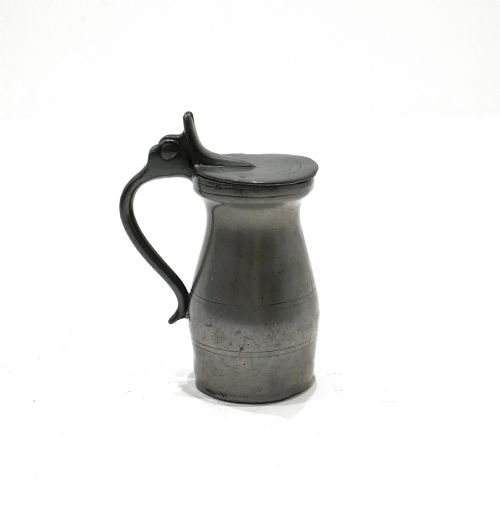

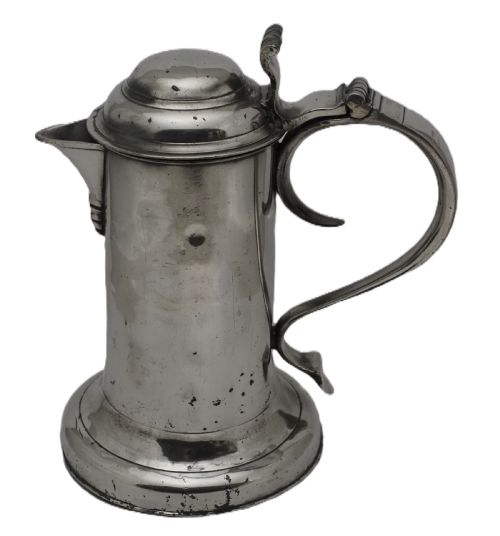


Grey Pewter Flagon
A grey pewter flagon brings tactile, utilitarian history to a room, offering robust metalwork shaped for secular service and ecclesiastical use.
Grey Pewter Flagon
A grey pewter flagon is a historic vessel designed to hold and pour liquids, appearing here in forms ranging from tall church flagons to heavy measures and lidded tankards. These items emerge from periods spanning the eighteenth, nineteenth, and early twentieth centuries, reflecting diverse regional output from England, Ireland, Scotland, Jersey, Guernsey, and Germany. The selection leans heavily toward eighteenth-century English and Irish church flagons alongside continental German beer vessels and Channel Islands measures.
Buyers encountering this phrase will find a mix of specialised capacities, such as the Scottish tappit hen, spire flagons with distinctive lids, and flat-lidded ale jugs. Styles cross from Georgian and Queen Anne austerity through Victorian mass production into decorative Art Nouveau motifs with hops decoration. Each piece serves as a physical record of past hospitality, institutional ceremony, and domestic beverage consumption.
Materials and construction
Every piece listed relies entirely on pewter, an alloy traditionally composed of tin combined with lead, copper, or antimony to achieve stability and weight. Smiths formed these vessels through casting and hammering, joining sections with solder to create rigid structures capable of holding liquids. Over centuries, the metal develops a dull grey surface patina.
Makers shaped spouts, applied lids with thumbpieces, and engraved crests or inscriptions directly onto the metal body. German examples incorporate cast decorative reliefs like hops or masonic symbols, while British and Channel Islands pieces rely on clean, functional lines stamped with capacity marks.
The listings show pewter flagons and measures produced across England, Ireland, Scotland, the Channel Islands, and Germany.
Distinctions in quality
Quality rests upon the crispness of the original cast form and the survival of makers' marks or touchmarks stamped into the pewter. Vessels that retain their original lids, thumbpieces, and structural integrity without heavy replacement parts stand at the upper end of the range. Finer examples display balanced proportions, clear regional capacity stamps, and minimal distortion to the soft metal.
The sophistication of the engraving and the clarity of regional types, such as a well-defined spire lid or a correctly proportioned Scottish pint capacity, elevate specific items. Pieces bearing identified touchmarks from established makers command greater attention than unmarked domestic ware.
John Heaney of Dublin·Robert Iles of London·John de St Croix
The Grey Pewter Flagon Glossary
- Flagon
- A large vessel with a handle and spout or lid used for holding liquids, particularly ale or wine. Church flagons were often produced in larger capacities for ecclesiastical services.
- Tappit hen
- A traditional Scottish type of pewter drinking vessel featuring a lid and a distinct knob on top. These hold specific historic capacity measurements like the Scots pint.
- Spire flagon
- A tall drinking or sacramental vessel characterised by a sharply tapered lid resembling a spire. These typically date from the eighteenth century.
- Spirit measure
- A standardised metal container used for gauging and serving specific volumes of alcohol. Examples include half gill and imperial half pint sizes.
- Touchmark
- An official stamp or signature impressed into pewter by the maker or guild to guarantee standard composition and origin. Finding a clear touchmark helps identify the workshop.
Grey Pewter Flagon: Frequently Asked Questions
What were pewter flagons used for?
These vessels primarily served to hold, measure, and pour liquids such as ale, wine, and beer for daily consumption or communal gatherings. Many larger examples functioned specifically as church flagons for sacramental wine during services.
Over time, standardised measures also played a role in taverns and households for dispensing exact quantities of spirits and other drinks.
How do I identify eighteenth-century pieces?
Eighteenth-century items often feature flat lids, thumbpieces, and heavy-walled bodies cast in specific regional styles like those from London or Dublin. They frequently display touchmarks struck directly onto the metal by individual pewterers.
Shape and capacity indicators, such as spire lids or early half gill measures, help separate these older forms from later nineteenth-century manufacturing.
How should I display a pewter flagon?
Pewter suits plain wooden shelves, sideboards, or dedicated display cabinets where the dark grey metallic surface contrasts against neutral backgrounds. Keeping them away from direct moisture helps preserve the historic finish.
Grouping different forms, such as pairing a tankard with a tall flagon, highlights the varied silhouettes found across different regions.
What is a Channel Islands measure?
Channel Islands measures are specific regional vessels originating from islands like Jersey and Guernsey, made to local volume standards such as one quart or one pot. They exhibit distinct local casting characteristics that separate them from mainland British wares.
These pieces often carry local makers' names and offer a glimpse into specific insular metalworking traditions.