



Georgian Pewter Pitcher
A georgian pewter pitcher is a historic vessel of solid alloy, sought after for its honest utilitarian form and deep historic character.
Georgian Pewter Pitcher
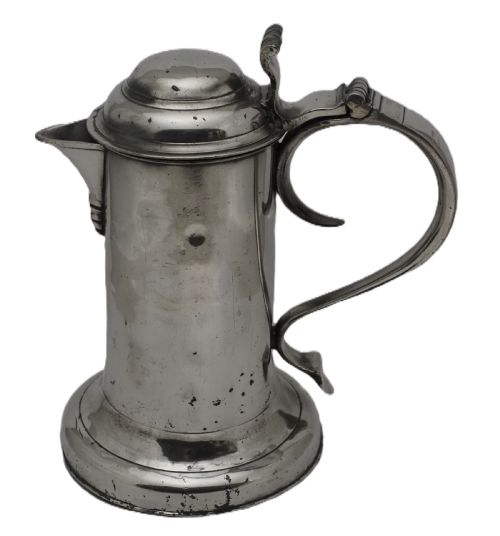
The objects take distinct shapes depending on their regional origin and intended function, from the tall spire flagon to the stout tappit hen. English examples often present clean spouted or gallon profiles, while Irish and Channel Islands pieces show characteristic local forms such as the Jersey measure. Buyers find both domestic ale vessels and ecclesiastical flagons represented within these periods.
How they were made
These items are constructed from pewter, a traditional metal alloy composed principally of tin combined with lead, copper, or antimony to provide rigidity. Makers shaped the metal by casting components in moulds and subsequently hammering or turning them on a lathe to achieve the desired wall thickness and surface smoothness. Soldered joints connect bodies, handles, and spouts, while touchmarks and capacity stamps are struck directly into the soft metal.
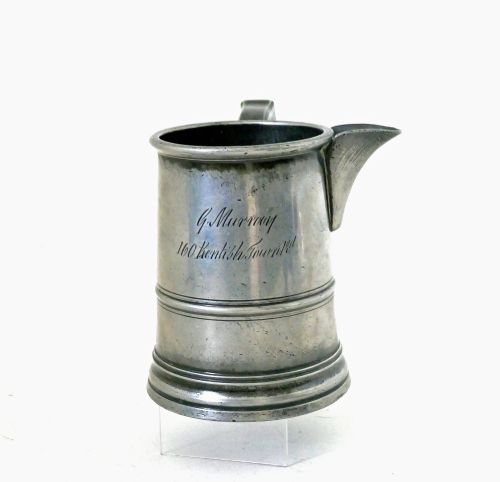
Engraving appears on selected pieces, showing initials or names such as tavern owners alongside location details like Kentish Town Road. Surviving surfaces retain the dull grey patina characteristic of aged tin alloys, sometimes enhanced by touchmarks identifying the maker or capacity standard.
Geographic origins represented include England, Ireland, Scotland, Jersey, and Guernsey, illustrating diverse regional metalworking traditions.
What varies in quality
Quality in these vessels rests upon the crispness of the original casting and the survival of distinct maker marks or touchmarks. Well-preserved capacity stamps and legible ownership inscriptions add significant interest for collectors seeking documented provenance. The integrity of soldered seams and the retention of original lids, thumbpieces, and hinges dictate the overall preservation state.
Proportion and regional distinctiveness also separate standard utilitarian items from exceptional workshop examples. Pieces retaining their original touchmarks from known makers command greater attention than unmarked domestic wares of the same period.
JOHN HEANEY·ROBERT ILES·JOHN DE ST CROIX
The Georgian Pewter Pitcher Glossary
- Flagon
- A large vessel with a handle and lid, frequently used in churches or taverns for holding liquids. These pieces often feature spouts or thumbpieces.
- Measure
- A standardised vessel designed to contain precise fluid quantities such as a quart, noggin, or pot. They serve commercial or domestic measurement functions.
- Touchmark
- An identifying stamp struck by a pewterer into the metal to denote the maker or workshop. These marks assist in dating and attributing individual pieces.
- Tappit Hen
- A traditional Scottish form of pewter drinking vessel featuring a distinctive lid and body shape. The name relates to the Scots pint capacity standard.
- Spire Flagon
- A tall vessel characterised by a tapered lid resembling a spire. This specific profile appears frequently in eighteenth-century English church silver and pewter.
Georgian Pewter Pitcher: Frequently Asked Questions
What is a tappit hen?
A tappit hen is a traditional Scottish pewter vessel type designed for holding specific drink volumes such as the Scots pint. These pieces feature characteristic lidded forms associated with northern taverns and households.
Collectors prize them for their distinct regional silhouette and robust seventeenth- and eighteenth-century construction.
How do I identify church flagons?
Church flagons are larger metal vessels often marked by tall spire lids or capacious bodies intended for ecclesiastical communion wine. They frequently originate from eighteenth-century English and Irish workshops.
Their substantial weight and formal spouted or lidded profiles separate them from domestic ale jugs.
What do capacity marks mean?
Capacity marks indicate the official volume standard the vessel was certified to hold, such as a gallon, quart, or noggin. These stamps were applied to ensure fair trade in taverns and markets.
Finding clear capacity stamps helps determine the original commercial or domestic function of the piece.
Where were Channel Islands measures made?
Channel Islands measures were produced by local pewterers working in islands such as Jersey and Guernsey. These items follow distinct insular design traditions separate from mainland English styles.
Their unique capacity designations and touchmarks make them readily identifiable to specialists.