

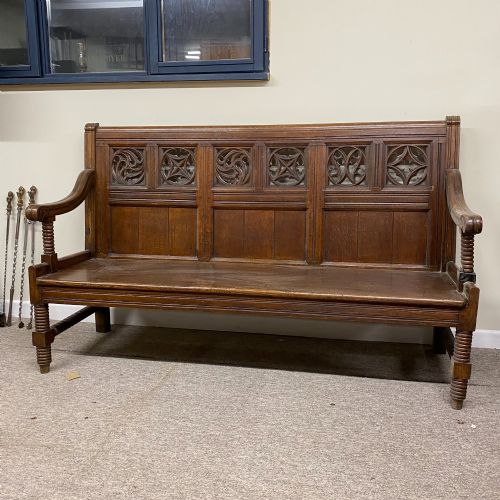

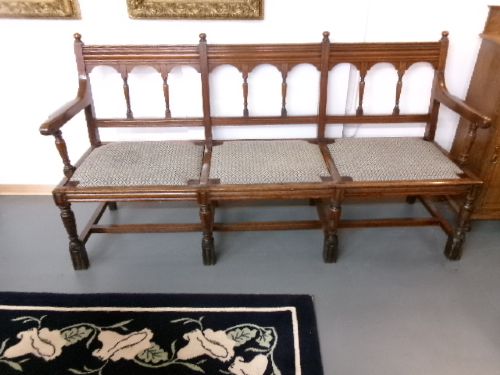
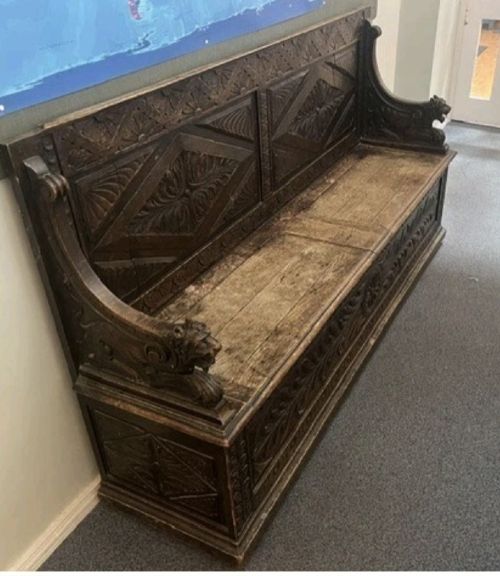
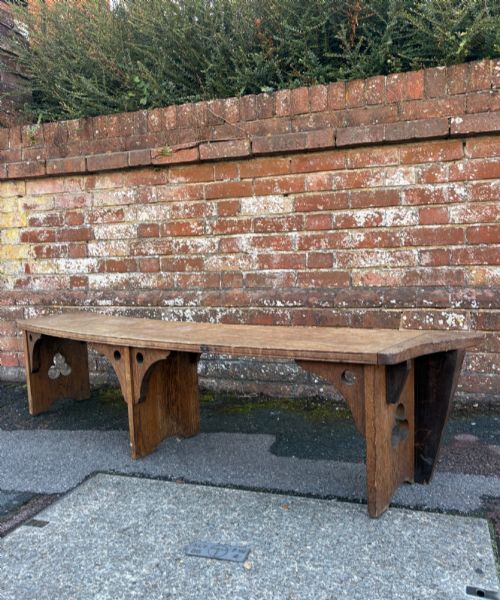
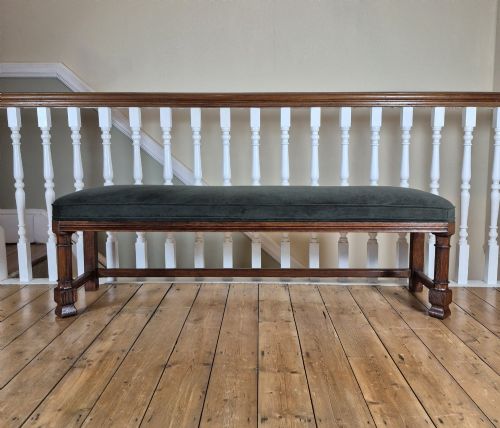
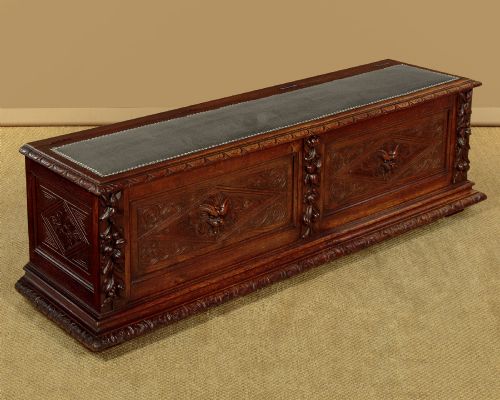
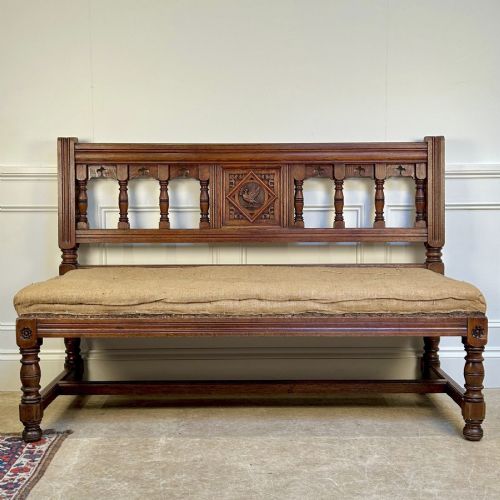
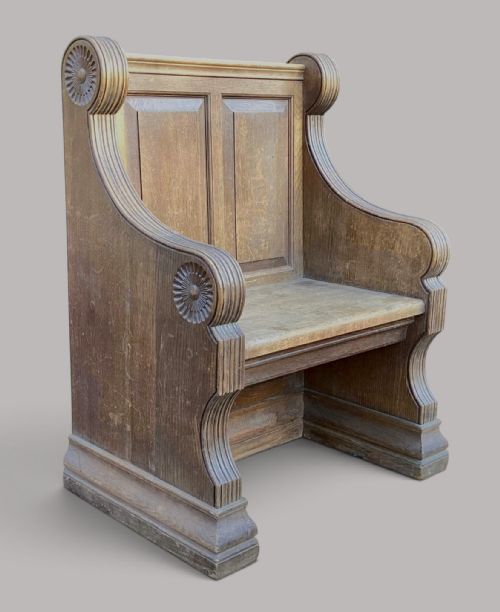
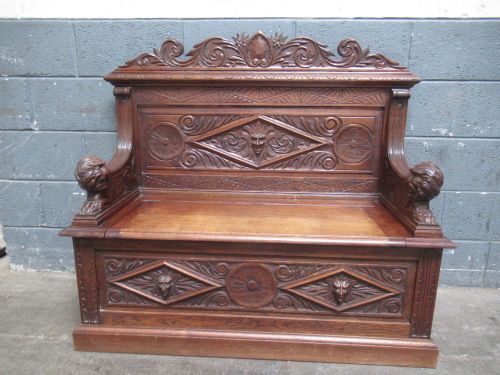
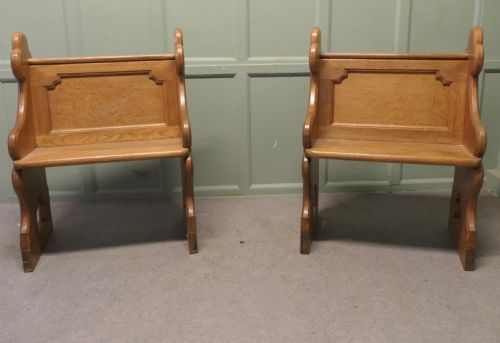
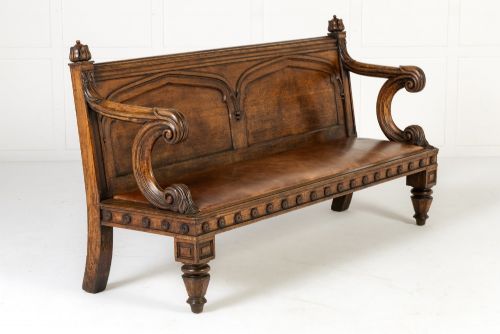


Gothic Revival Hall Bench
These gothic revival hall bench examples combine architectural presence with practical entrance seating, offering a solid period statement for any hallway.
Gothic Revival Hall Bench
A gothic revival hall bench serves as a substantial piece of entrance furniture designed to anchor a hallway with architectural authority.
Buyers encounter solid oak and elm forms most frequently, spanning the nineteenth century, Victorian era, and early twentieth century.
The objects take various seating formats, including settles, monks benches, window seats, and lift-up storage boxes.
Materials and Construction
Cabinet makers built these benches primarily in English oak, frequently pairing the hardwood with secondary timbers like elm and walnut.
Decoration relied on deep hand carving, producing trefoil supports, panelled backs, and architectural motifs executed in the manner of Pugin.
Hardware elements in brass and iron appear alongside upholstered sections in leather, velvet, fabric, and hessian.
Gothic Revival Hall Bench Retail Price Guide 2026
Typical asking prices for gothic revival hall bench among the pieces listed under this phrase on Sellingantiques today, from the lower quarter to the upper quarter. They describe what is for sale here now, not the wider market.
The listings span the nineteenth century through to the nineteen-twenties, utilising oak, elm, walnut, and iron.
Judging Quality
Quality rests on the crispness and depth of the architectural carving, separating standard production from exceptional cabinet work.
Proportion and structural integrity define the better examples, particularly where hinged lift-up seats or complex frames meet.
The presence of secondary timbers like burr elm or distinct stylistic attribution elevates the standing of a piece.
GIllows
The Gothic Revival Hall Bench Glossary
- Settle
- A wooden wooden bench with a high panelled back and arms, often incorporating a box seat beneath. This form protects occupants from draughts in entrance halls.
- Monks bench
- A convertible piece of furniture that functions as a table when the back folds down and a bench when upright. It remains a staple of Victorian entrance halls.
- Trefoil
- A three-lobed decorative ornament derived from Gothic architecture. Carvers frequently applied this shape to wooden supports and panel corners.
- Reformed Gothic
- A nineteenth-century design movement that emphasised structural honesty and simplified medieval forms. Pieces in this manner shunned excessive ornamentation.
Gothic Revival Hall Bench: Frequently Asked Questions
Where should I place a gothic revival hall bench?
These benches suit entrance halls, boot rooms, and wide corridors where their architectural presence can be appreciated. Their solid construction handles everyday use in high-traffic transition spaces.
Position them against load-bearing walls that complement their heavy oak frames and high panelled backs.
How do I care for the oak and upholstery?
Feed the timber periodically with traditional beeswax to maintain the rich patina of the nineteenth-century surface. Avoid placing the wood near direct heat sources that might cause splitting.
Vacuum fabric, leather, or velvet sections gently to remove dust without damaging period textiles.
How do I identify a Pugin-style piece?
Pugin-style pieces display rigorous adherence to medieval architectural principles, featuring pointed arches, trefoil cutouts, and chamfered structural members. The ornament arises directly from the construction rather than sitting as superficial veneer.
Look for austere geometry combined with precise, unfussy carving executed in solid oak.