



Gothic Brass Candle Stands
Gothic brass candle stands bring heavy ecclesiastical character and structured architectural metalwork into domestic spaces.
Gothic Brass Candle Stands
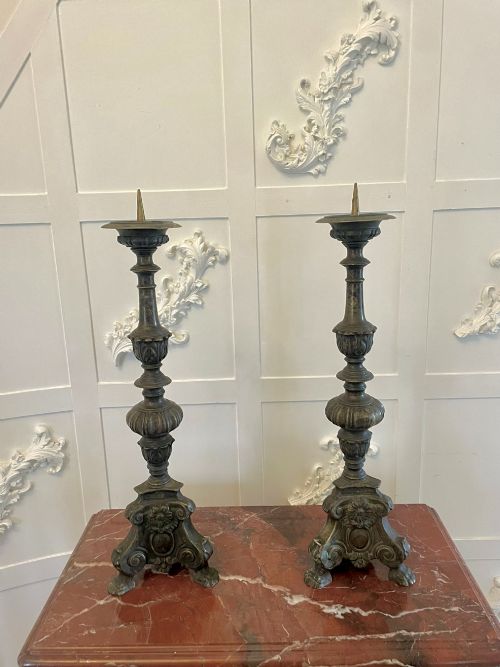
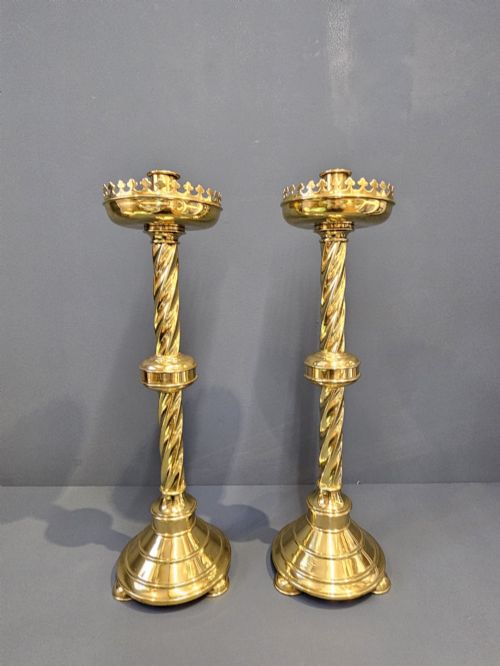
When you search for gothic brass candle stands, you encounter heavy altarware, church lighting, and domestic pieces produced across the nineteenth and early twentieth centuries. These objects combine utilitarian candle holders with pointed arch motifs, cusped tracery, and pricket spikes designed to secure large wax candles.
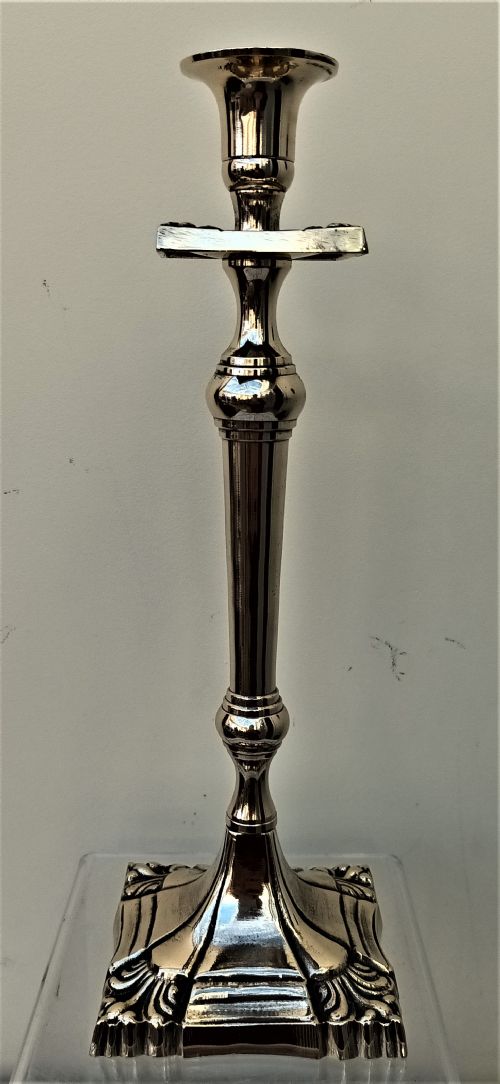
The versions you meet most frequently on this page date from the Victorian period through to nineteen thirty, spanning ecclesiastical revivals, Arts and Crafts workshops, and Dutch decorative arts. Forms range from tall floor-standing holders and multi-branched candelabras down to pairs of table candlesticks and specialised candle screens.
Makers drew heavily upon medieval church architecture, translating stone window tracery, flying buttresses, and trefoil patterns into cast and wrought metal. This architectural lineage gives the pieces their distinctive verticality and rigorous geometric symmetry.
Assessing quality and execution
Superior examples distinguish themselves through crispness of cast detail, where intricate foliate patterns, tracery, and moulding profiles remain sharp and deeply undercut rather than softened or blurred. Weight distribution also matters; fine pieces use heavy-gauge metal and wide bases that prevent tipping, particularly on tall church pieces and multi-light candelabras.
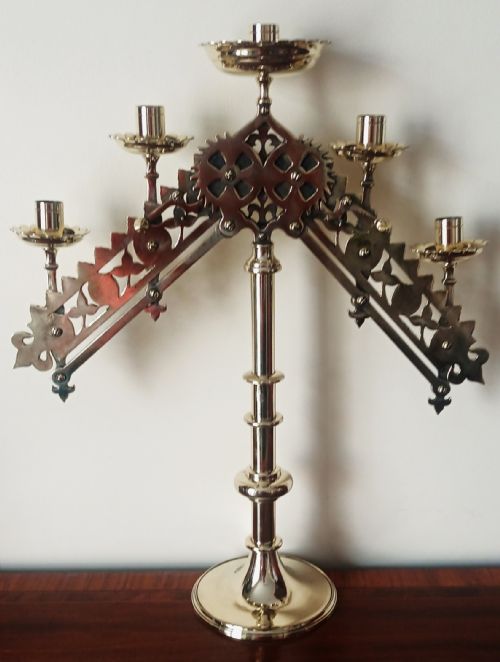
Integration of secondary materials and mechanical components separates standard production from exceptional design. Articulated joints operate smoothly without slack, and mixed-metal accents of copper or iron are fitted with precision rather than simply applied as surface decoration.
Listings feature works spanning the nineteenth and twentieth centuries, encompassing Victorian Gothic Revival, Arts and Crafts, and Amsterdam School movements.
Wm. Tonks & Sons·Dr Christopher Dresser·T Thomason & Co
The Gothic Brass Candle Stands Glossary
- Pricket
- A sharp metal spike set in the centre of a drip pan to support a candle without a socket. This form is common on ecclesiastical and gothic revival lighting.
- Candelabra
- A branched lighting fixture holding multiple candles on separate arms. These pieces often feature central shafts decorated with architectural mouldings.
- Arts and Crafts
- A design movement prioritising visible hand-working, honest materials, and simple construction over machine-made ornamentation. Pieces from this tradition often feature hammered copper and brass surfaces.
- Ecclesiastical
- Design inspired by Christian church architecture and furnishings. Objects in this style utilise medieval motifs such as trefoils, cusps, and pointed arches.
- Amsterdam School
- An expressionist architectural and design style characterised by rounded brickwork, fantastic forms, and rich surface ornamentation. Metalwork from this movement often combines brass and iron in sculptural pairings.
Gothic Brass Candle Stands: Frequently Asked Questions
What is a pricket candlestick?
A pricket candlestick uses a sharp metal spike instead of a hollow socket to hold the candle in place. The base of the candle is pressed directly onto this spike.
This form derives directly from medieval church altars where large, heavy wax tapers required stable mounting on spikes rather than standard cups.
How do I date gothic brass candle stands?
Dating relies on examining casting techniques, styles, and maker marks. Nineteenth-century examples often display heavy Victorian Gothic Revival ornamentation and sand-cast surfaces.
Later pieces from the early twentieth century lean towards Arts and Crafts simplicity or Amsterdam School geometric forms, reflecting changing design priorities.
Were these made for churches?
Many large examples originated in churches, chapels, and cathedrals as altar lighting or processional fixtures. They were built sturdily to support thick wax candles through long services.
Smaller domestic variants adapted these ecclesiastical motifs for Victorian and Edwardian drawing rooms and libraries.
How do I clean antique brass?
Antique brass is best maintained with a soft dry cloth to remove dust without disturbing the aged patina. Aggressive metal polishes strip away historical surfaces and reduce the visual depth of the cast details.
Leaving the metal unpolished allows the natural oxidation accumulated over a century to remain visible.