


Large Brass Pricket Holders
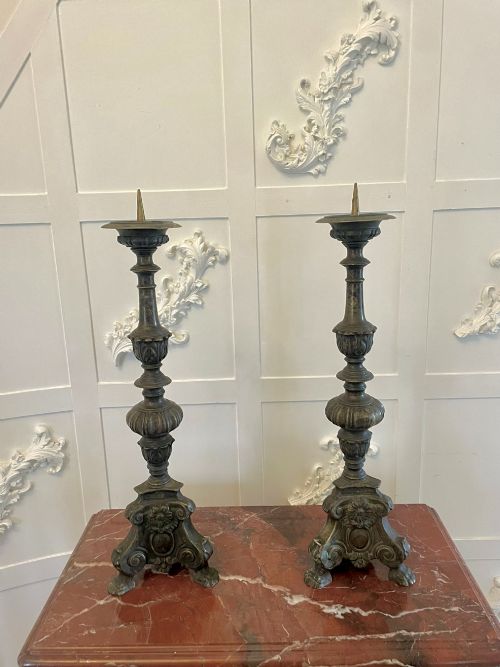
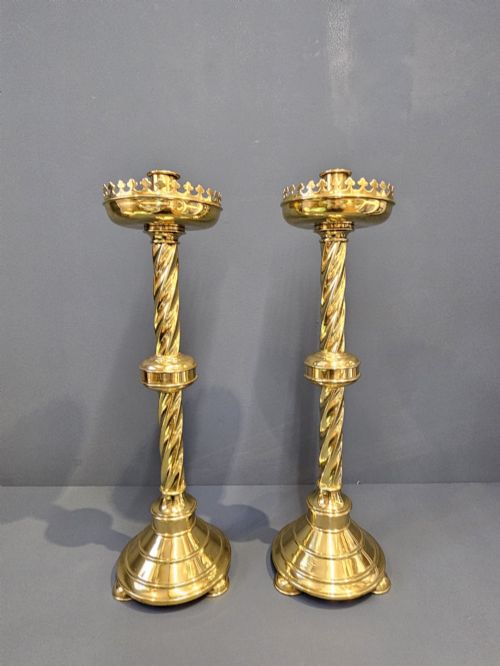
Large brass pricket holders are substantial altar lights that anchor a room with their height and metalwork.
Large Brass Pricket Holders
Large brass pricket holders appear mainly as pairs of church candlesticks and floor standing candle holders from the nineteenth and early twentieth centuries. These pieces span periods such as the Victorian era, Edwardian period, and the nineteen-twenties, alongside specific design movements like Gothic Revival and Amsterdam School.
Most examples take the form of tall candlesticks designed to support candles on a central spike rather than inside a socket. The inventory includes sets of four and floor standing versions alongside standard pairs.
Origin points range from Dutch schools to French workshops, utilising the substantial presence typical of ecclesiastical furnishings.
Materials and construction
The construction relies heavily on cast and wrought brass, often paired with iron, copper, gilt brass, bronze, and occasional hardwood elements. Metals are shaped into heavy shafts and wide drip pans designed to catch wax during long services.
Makers combine materials such as brass and iron within Amsterdam School designs, or merge copper and brass in Dutch school pieces to create contrast along the pillar and base.
Some tall floor candlesticks stand ready to hold a candle higher than a dining chair.
Evaluating the standard
Quality rests in the weight of the metal casting and the complexity of the ornate detailing across the base and shaft. Pieces that display confident execution in styles like Gothic Revival or Art Nouveau hold greater distinction.
Completeness of sets, such as matching pairs or sets of four, elevates the standing of these altar lights compared to single examples.
The Large Brass Pricket Holders Glossary
- Pricket
- A sharp metal spike on top of a candlestick designed to impale the base of a candle. This method predates the common use of candle sockets.
- Ecclesiastical
- Relating to the Christian Church or its clergy. These items originate from places of worship and chapels.
- Amsterdam School
- An architectural and design style of the early twentieth century known for expressive forms and brick or metal craftsmanship. Pieces from this movement feature robust combined metals.
- Gothic Revival
- An architectural and decorative style drawing inspiration from medieval forms. Ornate tracery and heavy vertical lines define this aesthetic.
Large Brass Pricket Holders: Frequently Asked Questions
What is a pricket holder used for?
These holders support large candles on a metal spike during religious services or ceremonial gatherings. Their height ensures steady illumination across wide spaces.
Today they function as prominent decorative objects in domestic interiors, often placed on large tables or directly on the floor.
How do I date a brass candlestick?
Dating relies on stylistic markers such as Victorian Gothic Revival details or later Amsterdam School and Art Deco geometries. Materials like cast brass, iron, and gilt surfaces also point to specific periods.
Construction methods and weight help distinguish nineteenth-century examples from twentieth-century pieces.
Are these items from churches?
Many of these pieces originate directly from church altars and ecclesiastical settings. Their substantial scale was built for large religious interiors.
Over time, many have transitioned into secular collections while retaining their liturgical character.
How do I clean antique brass?
Maintenance usually involves removing dust with a soft cloth while preserving the aged surface finish. Harsh polishes can strip the historic character built over decades.
Consulting a specialist helps maintain the original patina on bronze, copper, and gilt-brass surfaces.