


Glazed Corner Display Case
A glazed corner display case turns awkward room angles into useful display space while keeping precious porcelain and glass safe behind glass doors.

Glazed Corner Display Case
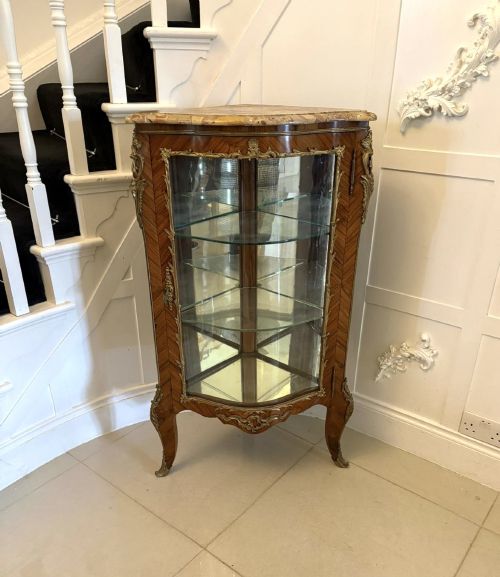
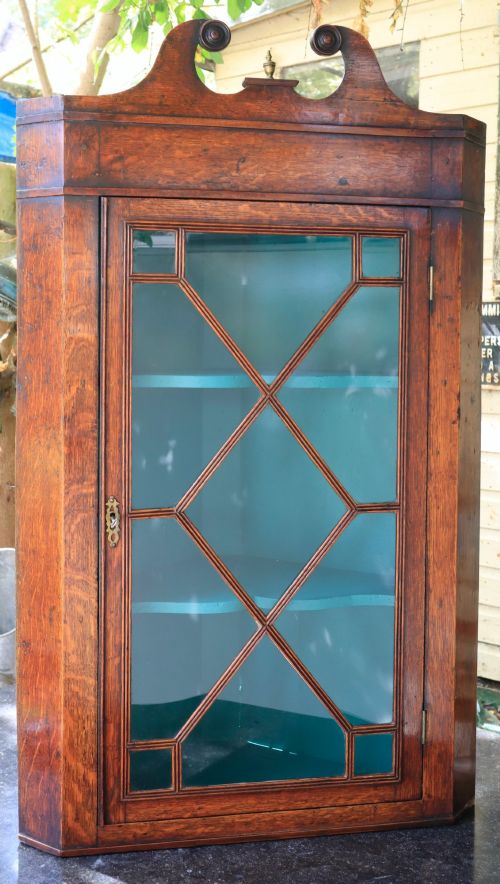
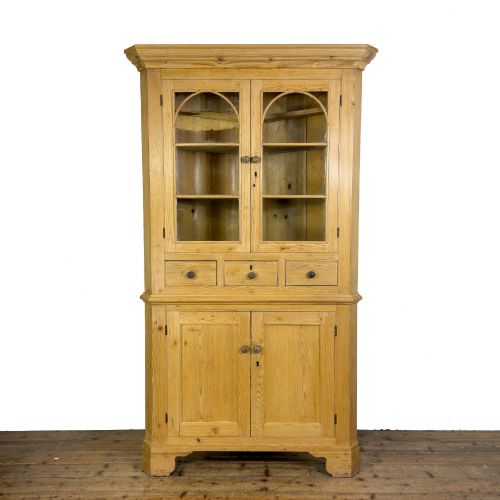
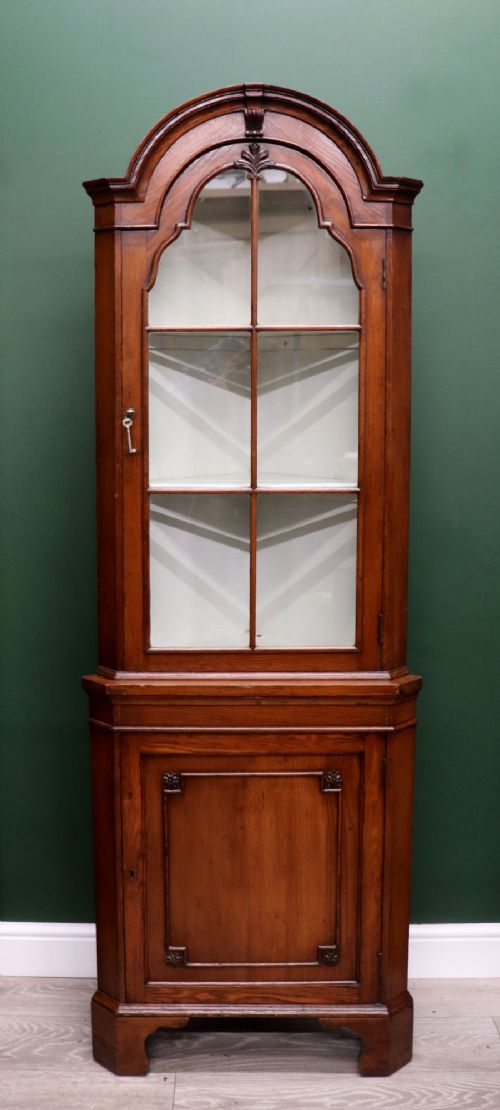
A glazed corner display case makes use of unused angles in a room, taking the form of wall-hanging cupboards or standing two-part cabinets. You will frequently find Edwardian mahogany examples and Georgian mahogany or oak pieces on this page.
These items serve to showcase prized objects while protecting them from dust. The design adapts to domestic interiors from the eighteenth century through to the early twentieth century, including Art Deco and Arts and Crafts interpretations.
Makers constructed these pieces to fit neatly into ninety-degree junctions. They range from small hanging wall units to substantial standing double-height furniture with bow fronts or serpentine shapes.
How they were made
Cabinetmakers relied heavily on mahogany, oak, and walnut, often applying satinwood inlay, brass mounts, or kingwood veneers to enhance the appearance. Timber selection dictated the structural integrity of the angled carcass and the alignment of the glazed doors.
Glass production evolved to allow large curved panes, visible in the bowed doors of Edwardian and Victorian specimens. Joinery techniques ensured that the heavy weight of glass and stored items remained securely supported against the wall or floor.
Several pieces include working original keys, proving that eighteenth-century owners worried about secret biscuit stashes just as much as we do.
What varies in quality
The refinement of the timber grain and the crispness of the marquetry inlay set superior examples apart from standard utility items. Cabinetmakers who invested time in matched veneers and delicate stringing produced pieces of lasting distinction.
Proportion and glazing bar arrangement dictate visual success. Slender, well-balanced astragals and high-grade glass panels indicate a workshop of superior standing compared to heavier, plain frameworks.
Edwards And Roberts
The Glazed Corner Display Case Glossary
- Astragal
- The wooden or brass bar that holds individual panes of glass within a sash frame. These mouldings define the period style of the glazing.
- Marquetry
- Decorative veneer work created by fitting together small pieces of different coloured wood to form complex patterns. It appears frequently on Edwardian pieces.
- Serpentine
- A gently undulating curved shape with a convex centre flanked by concave curves. This contour adds movement to cabinet fronts.
- Bow front
- A convex curved front that projects outward from the corners. It became popular during the Georgian and Edwardian eras.
- Double height
- A standing cabinet built in two distinct stacked sections, usually comprising a glazed upper display area above a cupboard base.
Glazed Corner Display Case: Frequently Asked Questions
How do I hang a wall corner cabinet?
Hanging a wall corner cabinet requires locating sturdy wall studs or using heavy-duty fixings suited to the weight of the timber and glass. Because these units pull forward from the corner, secure anchoring at multiple points is essential.
Professional installation ensures the heavy glazed door swings true without straining the hinges or the wall fixings.
Are these cabinets suitable for small rooms?
These cabinets suit compact spaces because they occupy neglected room angles rather than floor area along a flat wall. The glass doors also reflect light and keep small rooms feeling open.
Wall-hanging versions free up the floor entirely, making them practical for tight hallways or alcoves.
How do I tell Georgian from Edwardian pieces?
Georgian pieces generally display simpler timber grains, hand-cut dovetails, and heavier architectural mouldings. Edwardian iterations often feature machine-cut precision, lighter satinwood inlay, and sometimes bowed glass doors.
Examining the internal construction and secondary woods helps confirm the period of manufacture.
What is the difference between a hanging and standing case?
Hanging cases mount directly to the wall at eye level and often feature a single glazed door. Standing cases rest on the floor, sometimes as a single tall unit or in two stacked sections.
Standing versions provide significantly more storage capacity and frequently include lower wooden cupboards beneath the display area.