
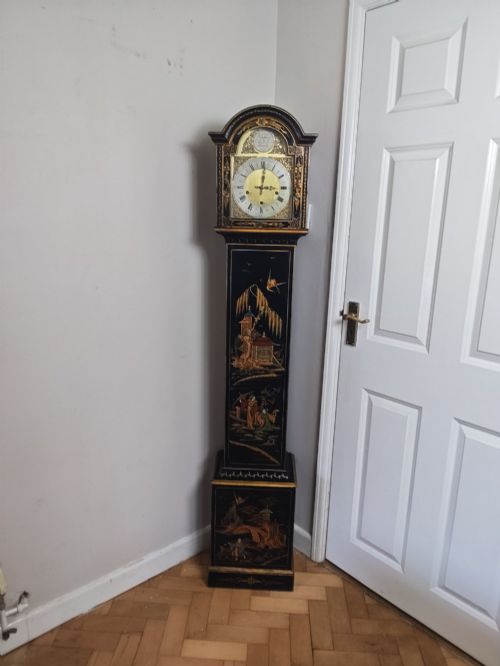
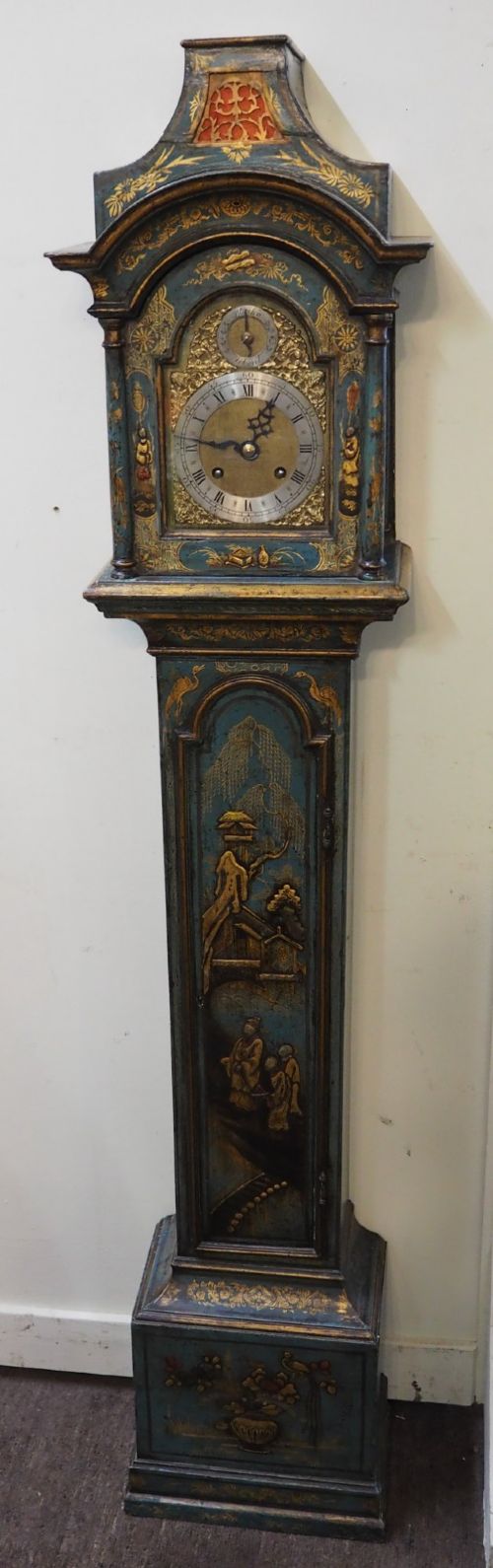


Gilt Chinoiserie Floor Clock
A gilt chinoiserie floor clock brings extraordinary painted lacquer and gilded detail to a tall case timepiece.
Gilt Chinoiserie Floor Clock
A gilt chinoiserie floor clock takes the traditional longcase format and covers it in elaborate japanned wood, lacquer, and gold leaf decoration. These tall timepieces appear in forms ranging from full-sized longcase clocks to smaller grandmother clocks.
The pieces listed here span the Georgian period, the eighteenth century, and later revivals from the early twentieth century. Most examples show the deep influence of Georgian chinoiserie and George I or George III design traditions.
Makers from London, Reading, Edinburgh, and beyond contributed to this tradition, producing longcase clocks and automaton clocks housed in decorated wooden cases.
Materials and construction
The structural carcass of a gilt chinoiserie floor clock utilises wood finished with lacquer, japanned wood, and applied gold leaf. Brass movements and glass dial covers complete the physical assembly of these tall timepieces.
Surface decoration relies on specialised lacquering techniques to build up depth before applying gilt details and figurative scenes. This laborious finish defines the visual character of the woodwork across eighteenth-century and revival pieces.
Some tall clocks feature hidden automata that animate pastoral scenes across the dial whenever the hour strikes.
Distinctions in quality
Quality in a gilt chinoiserie floor clock rests upon the crispness of the lacquer work and the intricacy of the gilded decoration. Finer examples display well-preserved pictorial scenes and careful proportion in the wooden case.
The sophistication of the internal movement also dictates standing within the range, separating standard timekeepers from examples featuring musical mechanisms or automata.
William Kipling London·Wise of Reading·Gardner of London·Robert Berry
The Gilt Chinoiserie Floor Clock Glossary
- Chinoiserie
- European decorative style reflecting Chinese artistic influences, featuring painted landscapes, figures, and pavilions. This aesthetic defines the painted surfaces of these tall cases.
- Japanned wood
- European imitation of East Asian lacquerwork, created using layers of varnish and resin. It provides the dark, glossy background typical of these clock cases.
- Longcase clock
- Tall pendulum clock enclosed in a wooden case, commonly known as a grandfather clock. These standing timepieces house the weights, pendulum, and dial.
- Grandmother clock
- Smaller, more compact version of the traditional longcase clock. These reduced-scale timepieces retain the same stylistic decoration.
- Automaton
- Mechanical device featuring moving figures or scenes integrated into the clock face. These elements animate the dial during the chime.
Gilt Chinoiserie Floor Clock: Frequently Asked Questions
How do I care for a lacquer clock?
Keep the clock away from direct sunlight and dramatic temperature shifts to protect the delicate lacquer and gilt surface. Regular dusting with a soft, dry cloth preserves the finish without damaging the decorations.
Ensure the floor is stable and level to keep the tall wooden case upright and the internal pendulum swinging truly. Professional servicing of the brass movement every few years maintains proper mechanical function.
What is a grandmother clock?
A grandmother clock is a scaled-down version of the traditional longcase floor clock, built with a shorter and narrower wooden body. These smaller timepieces were produced across various periods, including twentieth-century revivals.
Despite the reduced dimensions, they house functional clockwork and feature the same elaborate lacquered decoration found on larger examples.
How are eighteenth-century clocks dated?
Dating relies on stylistic markers within the case design, the construction methods of the wooden body, and signature details on the brass dial. Maker signatures inscribed on the face often provide a direct link to active working years.
Later revival pieces from the twentieth century can mimic earlier Georgian aesthetics, requiring careful inspection of the materials and internal mechanics to confirm the era of production.
Where were these clocks made?
Many examples originated in workshops across England, with prominent clockmakers working in London, Reading, and Edinburgh. Regional cabinetmakers and horologists collaborated to build the decorated cases and precision movements.
Urban centres produced sophisticated musical and automaton variations, while standard timepieces emerged from workshops throughout the British Isles during the Georgian era and later revival periods.