


Black Lacquer Longcase Clock
A black lacquer longcase clock brings extraordinary Chinoiserie decoration and height to a room, offering both reliable timekeeping and striking visual presence.
Black Lacquer Longcase Clock
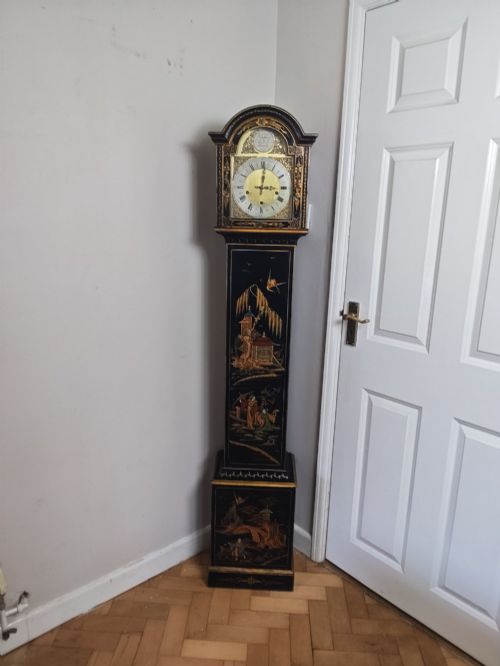
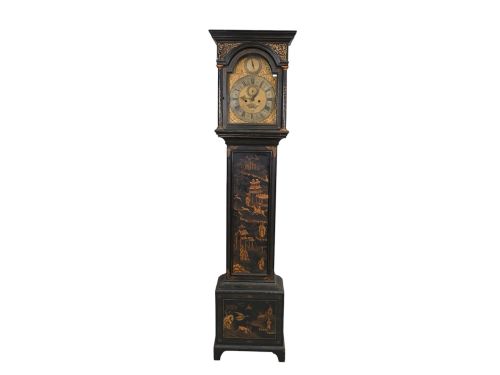
A black lacquer longcase clock is a tall floor-standing timepiece housed in a case finished with oriental-inspired decoration. These pieces serve as both functional horology and substantial items of furniture.
Most examples encountered here originate from the eighteenth century, spanning the Georgian and George III periods, alongside occasional twentieth-century grandmother clocks.
The primary forms include grandfathers and smaller grandmother clocks, featuring decorated wooden cases that enclose the pendulum and weight-driven movements.
How they were made
The construction relies on wooden cases finished with layers of lacquer, often referred to as japanned wood, providing a dark and glossy surface for applied decoration.
Makers embellished these surfaces with gilt details, creating the characteristic raised pictorial motifs associated with Chinoiserie styles.
Dials incorporate materials such as brass and silvered brass, housing mechanical movements designed to keep time over eight-day or musical cycles.
Black Lacquer Longcase Clock Retail Price Guide 2026
Typical asking prices for black lacquer longcase clock among the pieces listed under this phrase on Sellingantiques today, from the lower quarter to the upper quarter. They describe what is for sale here now, not the wider market.
Listings feature eighteenth-century Georgian pieces alongside twentieth-century examples, constructed from lacquered wood with brass and silvered brass dials.
What varies in quality
Quality rests significantly on the depth and execution of the Chinoiserie decoration upon the lacquered wood, distinguishing finely detailed pictorial scenes from simpler surface treatments.
The proportion and architectural integrity of the wooden case determine the overall presence of the clock, alongside the craftsmanship visible in the brass dial and movement.
Wise of Reading·Thomas Utting of Yarmouth·Gardner of London·Robert Berry
The Black Lacquer Longcase Clock Glossary
- Japanned wood
- European wood finished with varnishes and lacquers in imitation of Asian lacquerwork. This technique creates the hard, glossy black surface found on these cases.
- Chinoiserie
- European artistic style reflecting Chinese and East Asian motifs. It appears on these clocks as gilt figures, landscapes, and architectural details.
- Longcase clock
- A tall pendulum clock enclosed in a wooden case standing directly on the floor. These are commonly known as grandfather clocks.
- Grandmother clock
- A scaled-down version of the traditional longcase clock, typically produced in later periods such as the twentieth century.
- Silvered brass
- Brass treated with a chemical compound to produce a silvery white finish. This material is frequently used for the chapter rings on the dial.
Black Lacquer Longcase Clock: Frequently Asked Questions
How do I wind an 18th-century longcase clock?
Winding involves using a key to pull up the weights inside the trunk. Care must be taken not to overwind the movement.
Most eight-day movements require weekly winding to maintain accurate timekeeping.
Where should I place a longcase clock?
Position the clock against an interior wall away from direct sunlight and heat sources. Stable temperatures help preserve the lacquer finish.
Ensure the floor is level so the pendulum swings evenly and the movement keeps correct time.
What is the difference between grandfather and grandmother clocks?
Grandfather clocks are full-height floor-standing timepieces dating primarily from the eighteenth century. They feature large movements and tall wooden cases.
Grandmother clocks are shorter, slender variations often produced in the twentieth century to fit smaller domestic spaces.
How do I identify a George III lacquer clock?
Look for characteristic architectural case proportions typical of the late eighteenth century alongside gilt Chinoiserie decoration on black lacquer.
Maker signatures on the brass dial can often confirm the period of manufacture.