



Georgian Japanned Floor Clock
These georgian japanned floor clock examples bring layered lacquered surfaces and brass movements into an interior.
Georgian Japanned Floor Clock
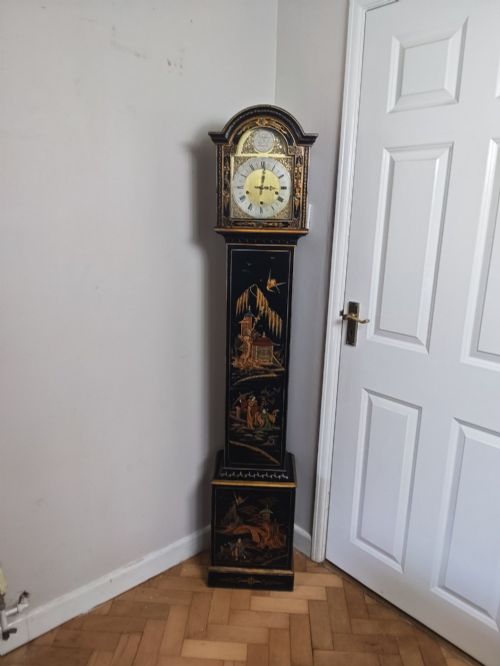
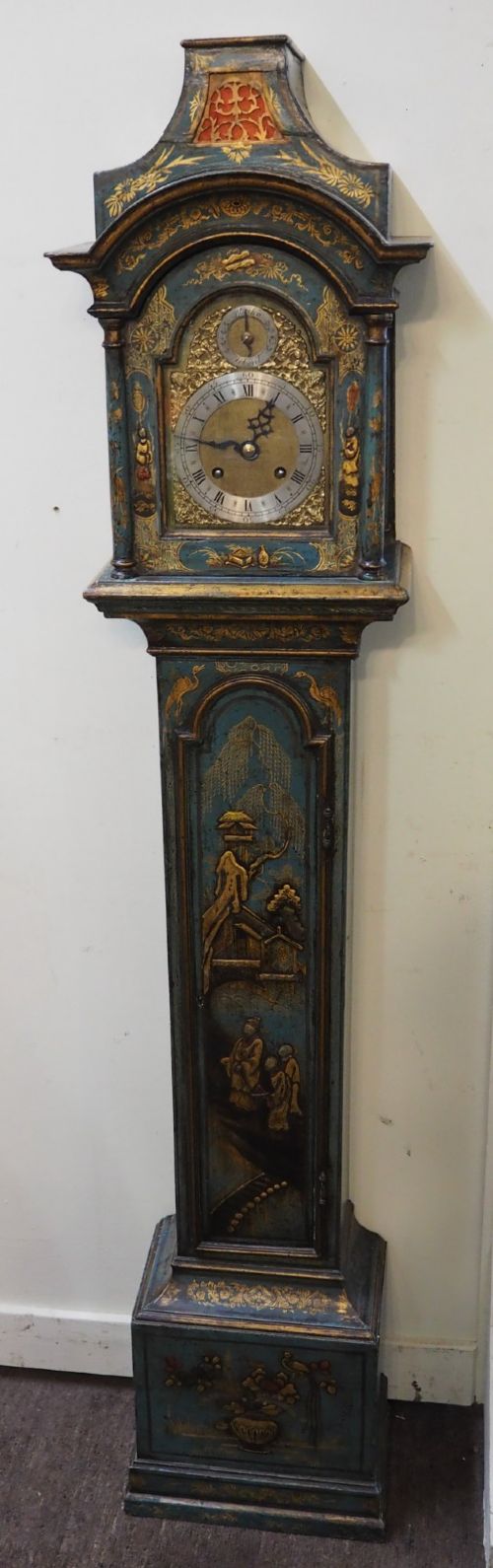
A georgian japanned floor clock is a tall vertical timekeeper featuring decorated lacquerwork, commonly known as a longcase or grandfather clock. The examples present on this page originate primarily from the eighteenth century, spanning periods such as Early Georgian and the reigns of George I and George III, alongside occasional twentieth-century interpretations.
Makers recorded on these pieces include regional and metropolitan horologists such as John Fielder of Alton, William Kipling London, Wise of Reading, Thomas Utting of Yarmouth, Gardner of London, and Robert Berry. Dial movements range from standard brass configurations to musical and automaton variants featuring rocking figures.
The visual vocabulary relies heavily on Chinoiserie motifs applied to tall wooden cases. Ground colours vary from dark green to blue, finished with gilt details and gold leaf.
How they were made
Construction relies on timber cases prepared to receive layers of lacquer and japanning. Artisans applied successive coats of varnish and pigment, often embellishing the surface with raised motifs and gold leaf detailing.
Georgian Japanned Floor Clock Retail Price Guide 2026
Typical asking prices for georgian japanned floor clock among the pieces listed under this phrase on Sellingantiques today, from the lower quarter to the upper quarter. They describe what is for sale here now, not the wider market.
What varies in quality
The distinction between tiers rests upon the depth and intricacy of the japanned decoration across the longcase body. Finer examples display carefully modelled Chinoiserie scenes with crisp gold leaf application, whereas simpler items present more subdued or plain lacquered wooden surfaces.
John Fielder of Alton·William Kipling London·Wise of Reading·Thomas Utting of Yarmouth·Gardner of London·Robert Berry
The Georgian Japanned Floor Clock Glossary
- Japanned Wood
- Wood treated with European resin-based imitation oriental lacquer finishes. This technique produced glossy dark surfaces decorated with raised gilt motifs.
- Chinoiserie
- European artistic interpretation of Chinese and East Asian decorative styles. It appears on these clocks through painted landscapes, figures, and architectural motifs.
- Longcase Clock
- A tall pendulum clock enclosed in a wooden case consisting of a hood, trunk, and base. These pieces are frequently referred to as grandfather clocks.
- Automaton
- Moving mechanical figures integrated into the clock face or dial. Examples include rocking figures such as Father Time.
- Brass Movement
- The internal mechanical brass works driving the clock hands and strike train. Eighteenth-century versions were constructed by specialist horologists.
Georgian Japanned Floor Clock: Frequently Asked Questions
How do I date a japanned clock?
Dating relies on stylistic markers within the Chinoiserie decoration, the proportions of the wooden longcase, and the signature of the maker inscribed on the brass dial. Eighteenth-century examples often exhibit specific regional construction traits alongside period-typical brass movements.
Changes in dial design and case architecture across the reigns of George I and George III provide further chronological reference points for these tall timekeepers.
Where should I place a longcase clock?
These tall floor clocks require a stable, plumb wall surface with adequate vertical clearance to accommodate the case height. Placement away from direct heat sources protects the lacquered wood and sensitive internal brass mechanics.
An entrance hall or principal room offers sufficient space for the pendulum to swing freely and allows the musical or standard chimes to be heard clearly.
What is the difference between grandfather and grandmother clocks?
Grandfather clocks are full-sized eighteenth-century floor clocks designed with tall wooden longcases. Grandmother clocks are smaller scaled versions, often produced in later periods such as the twentieth century.
Both types utilise brass movements and lacquered finishes, but the overall height and internal proportions differ significantly between the two forms.
How do I care for a lacquered surface?
Maintenance of the japanned finish involves dusting gently with a soft, dry cloth to prevent accumulation. Avoid chemical polishes, moisture, and direct sunlight, which can degrade the delicate gold leaf and varnish.
Stable ambient room humidity preserves the underlying timber case and prevents the lacquer from checking or lifting over time.