

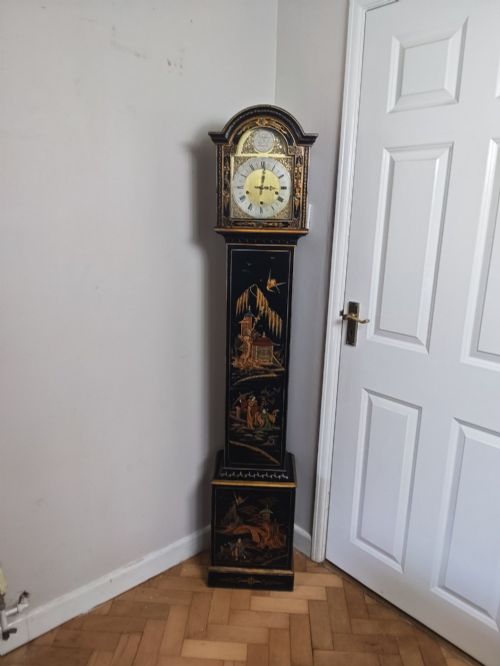
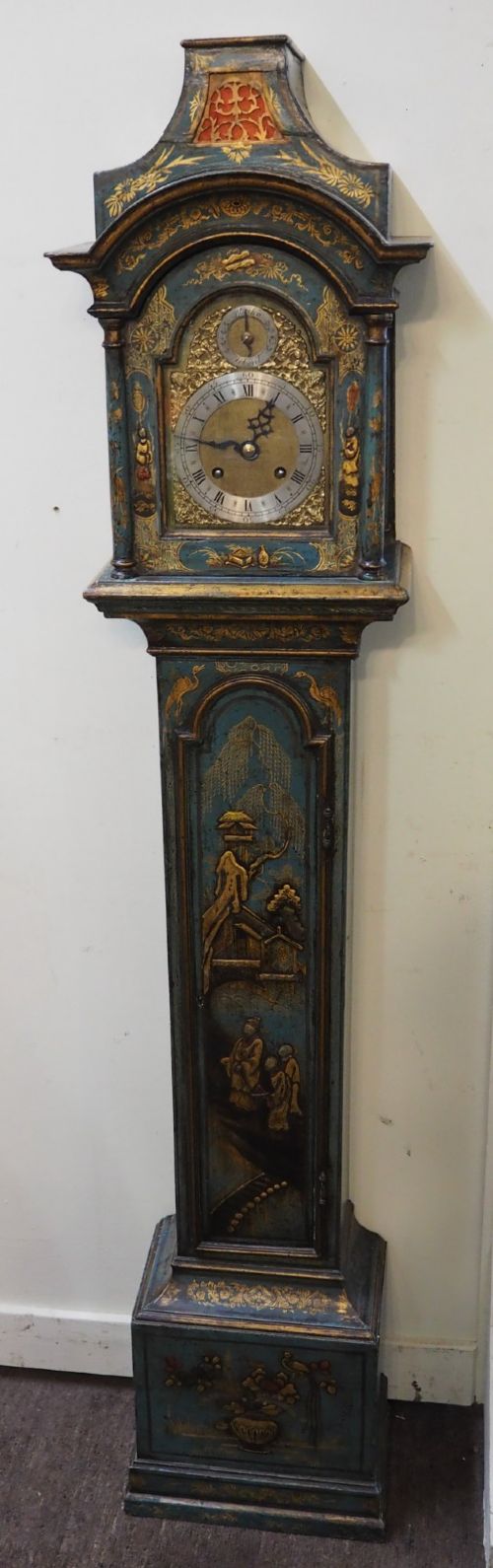


Japanned Longcase Clock
A japanned longcase clock brings striking Chinoiserie decoration and a tall wooden case into a room.
Japanned Longcase Clock
A japanned longcase clock stands tall on the floor, housing a brass movement inside a decorated wooden case. These pieces display elaborate Chinoiserie scenes across the exterior surface, showing figures, landscapes and pavilions.
The selections here span from the early Georgian period through the eighteenth century, with occasional later examples from nineteen thirty. Buyers frequently encounter green or blue lacquer surfaces alongside traditional dark finishes.
Makers such as William Kipling London, John fielder of Alton, and Wise of Reading produced these pieces during the Georgian era. The tall case format includes both full-sized grandfather clocks and smaller grandmother clock variations.
Materials and construction methods
Wood serves as the primary foundation for the tall case, prepared with layers of lacquer to build a smooth base for decoration. Artisans applied gold leaf and gilt details to highlight the raised Chinoiserie motifs across the surface.
Brass movements power the timekeeping mechanism within the hood, visible behind glass panels. The exterior decoration relies on traditional japanning techniques to mimic oriental lacquer work using paint and varnish layers.
Japanned Longcase Clock Retail Price Guide 2026
Typical asking prices for japanned longcase clock among the pieces listed under this phrase on Sellingantiques today, from the lower quarter to the upper quarter. They describe what is for sale here now, not the wider market.
Listings feature periods from early Georgian and eighteen hundred through to nineteen thirty, alongside materials including brass, glass, gold leaf, and lacquered wood.
Distinguishing quality across examples
The refinement of the painted Chinoiserie figures and the depth of the lacquer layers dictate the visual impact of the case. Finer examples display crisp gilt work and detailed scenes that remain distinct against the background colour.
The integration between the maker's brass movement and the decorated wooden case influences the integrity of the piece. Well-preserved surfaces retain their original colour depth, whether green, blue, cream, or dark lacquer.
John fielder of Alton·William Kipling London·Wise of Reading·Thomas Utting of Yarmouth·Gardner of London·Robert Berry·Richard Bullock Ellesmere
The Japanned Longcase Clock Glossary
- Japanning
- European imitation of East Asian lacquerwork, created using layers of varnish and paint decorated with raised motifs. This technique defines the decorative finish found on the exterior of the clock case.
- Chinoiserie
- European interpretation of Chinese and East Asian artistic styles, featuring landscapes, figures and pavilions. This style appears extensively across the painted surfaces of the case.
- Longcase clock
- A tall, floor-standing clock enclosed in a wooden case with a weighted movement, commonly known as a grandfather clock. Shorter variations are referred to as grandmother clocks.
- Brass movement
- The mechanical gear system constructed from brass that drives the timekeeping and striking functions. These mechanisms were often signed by the maker on the dial plate.
- Automaton clock
- A mechanical clock featuring moving figures or elements that animate in time with the mechanism, such as a rocking Father Time. These add a dynamic theatrical feature to the dial face.
Japanned Longcase Clock: Frequently Asked Questions
Where should I place a japanned longcase clock?
Position the piece on a stable, level floor away from direct sunlight and sudden temperature changes to protect the wood and lacquer finish.
Ensure there is sufficient ceiling height for the tall case before final placement in a hallway or principal room.
How do I wind an 18th-century longcase clock?
Use the winding key to raise the weights gently up the interior trunk until they reach the top of their drop. Take care not to over-wind the movement to maintain the internal components.
Consult the specific mechanical requirements of the brass movement to ensure proper tension is applied during winding.
What is the difference between a grandfather and a grandmother clock?
Grandfather clocks are full-sized floor-standing longcase timepieces built during the eighteenth century and later periods. Grandmother clocks are scaled-down versions produced in the twentieth century, such as those from nineteen thirty.
Both types utilise similar brass movements and lacquered wooden cases while differing significantly in height.
How do I identify a George I longcase clock?
Examine the architectural proportions of the wooden case and the stylistic details of the brass dial face. Early Georgian examples often feature rich green or dark lacquer finishes with intricate Chinoiserie decoration.
Look for signatures from makers active during the early decades of the eighteenth century on the dial.