


Black Lacquered Longcase Clock
A black lacquered longcase clock brings architectural presence and intricate Chinoiserie decoration into a room, offering both traditional timekeeping and striking visual depth.
Black Lacquered Longcase Clock
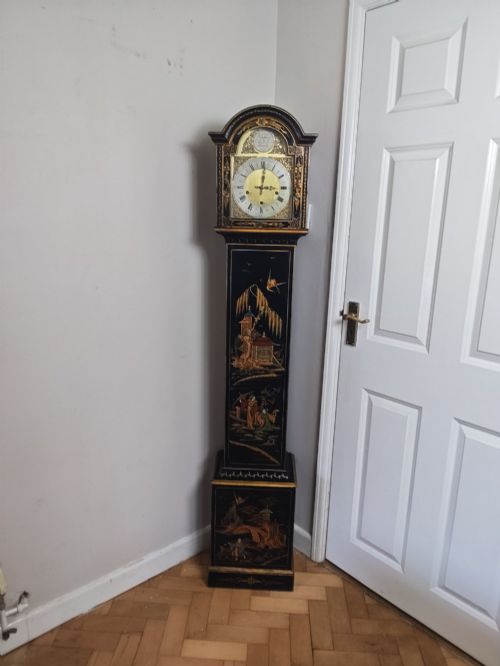
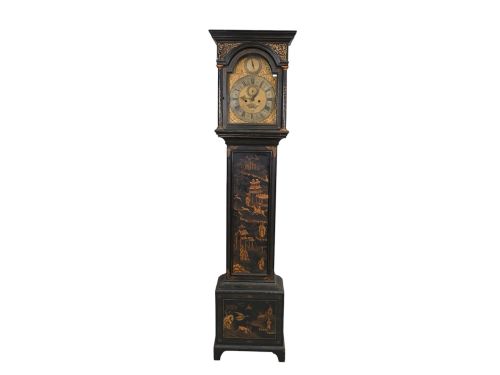
A black lacquered longcase clock combines tall wooden cabinetry with contrasting Orientalist decoration, originating primarily in the eighteenth century and finding revived interest in the twentieth century. These vertical timepieces serve as prominent furniture elements, standing upright with enclosed brass movements and pendulum systems.
The most frequent examples encountered on this page date from the eighteenth century, including the Georgian and George III periods, alongside smaller twentieth-century grandmother clock variants. These pieces showcase various regional British makers and decorative schemes defined by lacquering and Japanning techniques.
Materials and construction methods
The construction relies upon wooden carcases finished with specialised lacquer and Japanning techniques to create dark, polished surfaces that accept gilt and painted detailing. Artisans applied successive layers to achieve deep lustres before embellishing the panels with raised motifs and figures.
Internal mechanics depend on brass for gear trains, plates, and dials, frequently paired with silvered brass chapter rings for legibility. Glass panels protect the dial face within the hood, allowing clear observation of the time while shielding the delicate motion inside.
Current listings demonstrate an aesthetic range spanning eighteenth-century Georgian origins to twentieth-century revivals, utilising brass, glass, and lacquered wood.
Distinctions in craftsmanship and finish
Quality reveals itself in the depth and preservation of the Chinoiserie decoration, where finer examples display intricate, well-defined gilt figures and landscape details across the dark lacquered ground. The complexity of the movement, ranging from standard time-only configurations to musical chimes, also separates standard production from superior work.
The proportions of the wooden case and the crispness of the dial engraving contribute significantly to the overall merit of the piece. Makers who signed their dials generally maintained higher standards of mechanical reliability and cabinetry execution.
Wise of Reading·Thomas Utting of Yarmouth·Gardner of London·Robert Berry
The Black Lacquered Longcase Clock Glossary
- Grandfather clock
- A large, floor-standing pendulum clock typically exceeding six feet in height. This term is commonly used interchangeably with longcase clock.
- Grandmother clock
- A smaller, scaled-down version of the traditional longcase clock, frequently produced during the twentieth century. These shorter cases fit modern ceiling heights more easily.
- Japanning
- A European imitation of East Asian lacquerwork involving layered varnishes and heat-cured finishes. Artisans used this technique to produce the dark, glossy surfaces characteristic of these clocks.
- Chinoiserie
- A European artistic style reflecting Chinese and East Asian motifs, rendered here in raised gilt and painted designs. This decoration covers the trunk, door, and base of the clock case.
- Chapter ring
- The circular ring on the clock face bearing the hour numerals. These are frequently fashioned from silvered brass to contrast against matted or engraved brass centres.
Black Lacquered Longcase Clock: Frequently Asked Questions
How do I care for a longcase clock?
Keep the clock in a stable environment away from direct sunlight, extreme temperature shifts, and damp walls to protect both the wooden case and the lacquer finish. Consistent placement prevents the timber from warping and helps maintain the internal mechanical alignment.
Wind the weights carefully according to the specific movement type, whether eight-day or shorter duration. Regular professional servicing ensures the brass gears and pivots continue to function smoothly over time.
Where should I place a grandfather clock?
Position the clock against a sturdy interior wall where it will not be subjected to heavy foot traffic or vibrations that could disrupt the pendulum. A firm, level floor surface is essential for the case to stand straight and the escapement to beat evenly.
Select a location with adequate vertical clearance and gentle ambient light to highlight the lacquered surfaces and gilt Chinoiserie details. Hallways, landings, and reception rooms traditionally accommodate these tall proportions successfully.
How do eighteenth and twentieth century clocks differ?
Eighteenth-century examples feature authentic period timbers, hand-beaten brass movements, and patinated lacquer surfaces accumulated through centuries of existence. These clocks often bear the signature of regional British horologists on the dial face.
Twentieth-century grandmother clocks, such as those from the 1920s and 1930s, offer scaled dimensions and modern chime mechanisms like Westminster quarters. They provide the traditional aesthetic of lacquered cabinetry suited to more compact domestic spaces.
What is the difference between lacquer and Japanning?
True Asian lacquer derives from the processed sap of specific trees native to East Asia, creating an exceptionally durable natural finish. European makers adapted this by using resin-based varnishes and shellac mixtures to simulate the same glossy black surface.
Japanning specifically denotes this European technique of applying layered varnishes followed by raised gold and coloured decorations. Both methods produce the dark, reflective background characteristic of these decorated clock cases.