
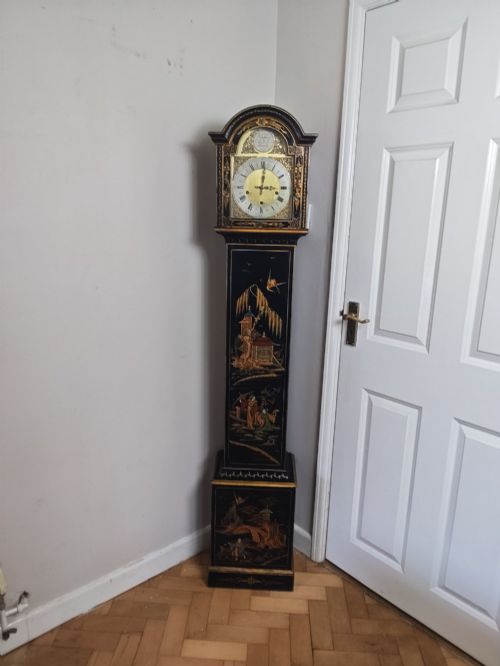
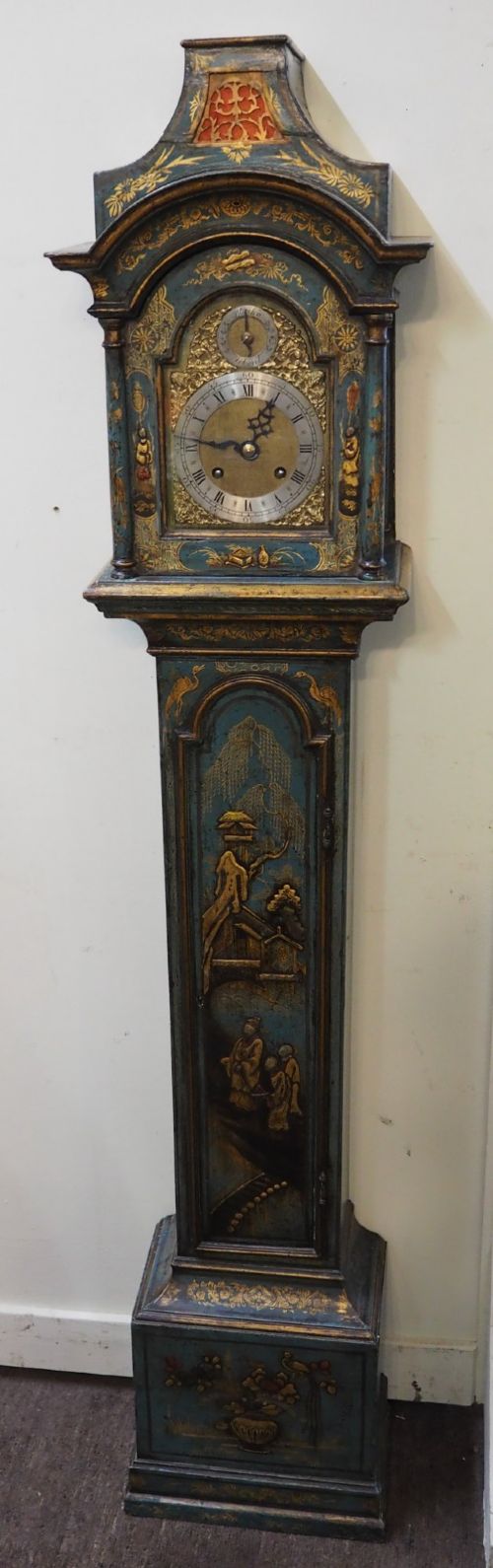


Chinoiserie Tallcase Clock
These chinoiserie tallcase clock pieces bring painted lacquer and striking mechanics together across Georgian and revival periods.
Chinoiserie Tallcase Clock
A chinoiserie tallcase clock represents a major case furniture form housing precision timekeeping mechanics within an upright wooden trunk. Examples span the Georgian era alongside later revival pieces from the twentieth century.
Buyers encounter traditional grandfathers and smaller grandmother clocks sharing decorated surfaces of lacquer. Origins reach from London and Reading to Edinburgh workshops.
Forms vary from standard timekeepers to musical models and automaton pieces featuring rocking figures. Surfaces showcase blue, green, and cream lacquer grounds beneath decorative figures.
How they were made
Craftsmen built tall wooden carcases using wood substrates prepared for lacquer decoration and applied gold leaf accents. Brass components form the internal movements and dial fittings.
Surfaces received layers of lacquer in shades including dark green, blue, and cream, embellished with japanned decoration. Glass protects the dial face within the hood.
Father Time rocks eternally on select eighteenth-century dials.
What varies in quality
Distinction lies in the execution of the lacquered surface and the original integrity of the decorated case. Master makers integrated detailed figures and gilt work that survived centuries of domestic use.
Mechanical sophistication separates standard timepieces from automata and musical movements housed within the trunk. Original finishing and surface depth dictate the standing of each piece.
William Kipling London·Wise of Reading·Robert Berry
The Chinoiserie Tallcase Clock Glossary
- Tallcase clock
- An upright wooden case enclosing clock weights and a pendulum, frequently known as a grandfather clock. These standing timepieces house brass movements behind glass-fronted dials.
- Japanned wood
- European wood furniture finished with varnishes imitating East Asian lacquer techniques. Artisans built raised pictorial designs using metallic powders and gold leaf.
- Automaton
- A mechanical device integrated into a clock face that moves independently of the timekeeping hands. Rocking figures represent common examples found on select movements.
- Grandmother clock
- A scaled-down version of the traditional tallcase clock produced during later revival periods. These smaller timekeepers occupy less floor space while retaining similar decorative traits.
- Dial
- The circular or square face displaying the hours and minutes via metal hands. Brass constitutes the primary material for these engraved and silvered plates.
Chinoiserie Tallcase Clock: Frequently Asked Questions
How do I date a chinoiserie tallcase clock?
Dating relies on stylistic clues within the lacquered decoration, case proportions, and the signature inscribed upon the brass dial. Eighteenth-century examples contrast with twentieth-century revival pieces through construction details and material ageing.
Examining the movement type and the specific style of the japanned motifs provides further chronological context for each upright timekeeper.
Where were these clocks made?
Production centred in major British horological hubs including London, Reading, and Edinburgh. Skilled cabinetmakers and clockmakers collaborated to build the wooden carcases and intricate brass movements.
Regional workshops adapted metropolitan styles to create distinct regional variations in proportion and lacquering technique.
How do musical and automaton clocks work?
Automaton and musical clocks incorporate auxiliary mechanical cylinders or gear trains alongside the standard timekeeping mechanism. These additions power movement on the dial face, such as rocking figures.
The secondary trains operate independently to activate visual displays while the clock tracks the hours.