
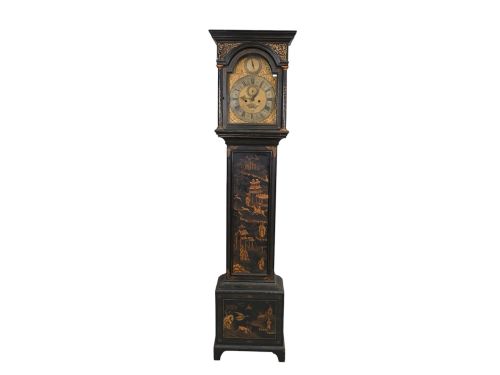


Black Lacquer Grandfather Clock
A black lacquer grandfather clock brings rich Chinoiserie decoration and substantial presence into a room.
Black Lacquer Grandfather Clock
When you search for a black lacquer grandfather clock, you are looking at tall floor-standing timepieces housed in wooden cases decorated with orientalist motifs. The examples you meet on this page span the eighteenth century and the Georgian period, alongside occasional later interpretations from the twentieth century.
Most pieces you encounter are longcase clocks, though you also find variants described as long case or grandmother clocks. Their origins are rooted in eighteenth-century craftsmanship, capturing the period taste for Japanned and Chinoiserie decoration on tall clock cases.
The visual character relies on dark lacquered surfaces adorned with gilt and painted scenes of figures, landscapes, and fauna. These tall forms dominate a hallway or living space, serving both as functional timekeepers and as decorative focal points.
Materials and construction
These clocks combine wooden carcases treated with lacquer finishes and applied gilt decoration. Makers built the tall wooden cases to house delicate mechanical movements behind glass-fronted doors.
The faces frequently incorporate brass and silvered brass dials that contrast with the dark exterior. Japanning techniques involved building up layers of varnish on wood to create a smooth, dark surface ready for raised or flat painted designs in the Chinoiserie taste.
Listings feature pieces from the eighteenth century, the Georgian era, and the nineteen-twenties, constructed in wood, lacquer, brass, and glass.
Judging the work
Quality in a black lacquer grandfather clock lies in the depth and preservation of the Chinoiserie decoration on the wood case. The finest examples show crisp detail in the gilt and painted motifs, with harmonious proportions across the tall body.
The distinction between ordinary and superior pieces also depends on the integration of the brass dial with the cabinet work. Cases retaining their original surface finish and well-executed japanning hold greater visual coherence than those with later repainting.
Wise of Reading·Thomas Utting of Yarmouth·Gardner of London·Robert Berry
The Black Lacquer Grandfather Clock Glossary
- Japanned Wood
- Wood treated with European-made varnishes in imitation of Asian lacquerwork. This technique produced the dark, glossy backgrounds typical of Chinoiserie furniture.
- Chinoiserie
- European artistic style reflecting Chinese and East Asian motifs. It appears on these clock cases through painted scenes of pagodas, figures, and imaginary landscapes.
- Longcase Clock
- A tall pendulum clock enclosed in a wooden case consisting of a trunk and a hood. Often referred to colloquially as a grandfather clock.
- Silvered Brass
- Brass treated to produce a silver-coloured finish, commonly used for the dial chapters and maker nameplates on eighteenth-century clock faces.
- George III
- The period of British history spanning the late eighteenth and early nineteenth centuries. Clocks from this era display characteristic stylistic refinements of the Georgian age.
Black Lacquer Grandfather Clock: Frequently Asked Questions
How do I tell an 18th century clock apart from later ones?
Eighteenth-century examples display period construction methods, hand-painted Chinoiserie motifs, and traditional brass dials. Later twentieth-century versions, such as grandmother clocks with Westminster chimes, reflect twentieth-century manufacturing standards.
Examining the wood preparation, the style of the painted decoration, and the construction of the interior movement helps clarify the period of production.
Where should I place a longcase clock?
These tall clocks require a stable, upright position against a solid wall to ensure the pendulum swings correctly. Hallways, landings, and spacious living rooms provide suitable locations.
Keep them away from direct sunlight and strong sources of heat to protect the lacquer finish and wooden structure from environmental stress.
What materials make up the case and dial?
The cases are constructed from wood finished with lacquer and Japanned decoration, often enhanced with gilt details. Dials are typically made from brass and silvered brass.
Glass panels protect the dial face within the hood, while the trunk door opens to allow access to the pendulum and weights.