
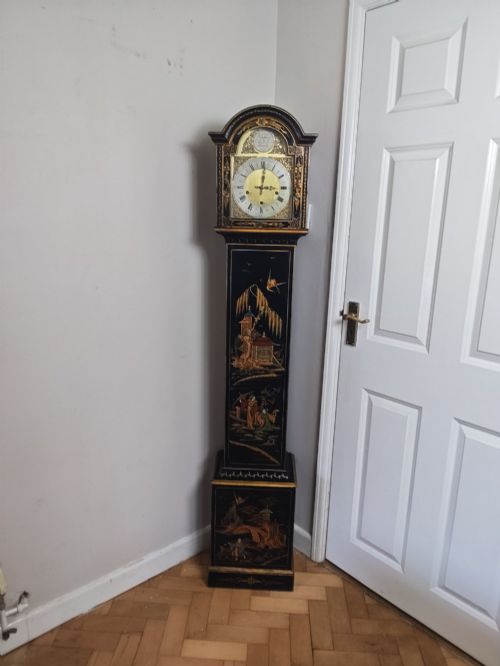


Black Lacquered Floor Clock
A black lacquered floor clock brings remarkable Chinoiserie artistry and a commanding presence to a hallway, offering both mechanical precision and striking visual depth.
Black Lacquered Floor Clock
A black lacquered floor clock represents a tall timepiece designed to stand directly on the ground, combining functional clockwork with decorative cabinetry. When searching for a black lacquered floor clock, collectors encounter tall case designs often referred to as longcase, grandfather, or grandmother clocks.
The examples available here span from the early Georgian period and 1750 up to the 1920 and 1930 revivals. These pieces frequently exhibit Chinoiserie decoration, displaying intricate raised motifs upon a dark lacquered wood ground.
Most entries originate from the Georgian era or the 18th century, alongside later 20th-century musical iterations. Makers such as Wise of Reading, Thomas Utting of Yarmouth, Gardner of London, and Robert Berry anchor these historical timepieces.
How they were made
Makers constructed the tall wooden cases using timber capable of taking a smooth finish for dark lacquering and Japanned decoration. Artisans applied successive layers of lacquer before embellishing the surface with gilt or painted oriental scenes.
The mechanical movements relied on brass and silvered brass for dials, gear trains, and motion work. Protective glass doors enclosed the dial face, allowing clear visibility of the swinging pendulum and weights within the trunk.
What varies in quality
The refinement of the Chinoiserie decoration dictates much of the visual merit, separating flat painted surfaces from deeply built, gilt-detailed relief work. Finer cases display harmonious proportions across the hood, trunk, and base.
The sophistication of the internal movement also sets examples apart, particularly where makers incorporated musical chimes or specialised striking trains alongside standard timekeeping. Signed dials by established regional or London makers add significant distinction to an individual clock.
Wise of Reading·Thomas Utting of Yarmouth·Gardner of London·Robert Berry
The Black Lacquered Floor Clock Glossary
- Longcase clock
- A tall pendulum clock enclosed in a wooden case that stands directly on the floor. These timepieces are frequently known colloquially as grandfather or grandmother clocks.
- Japanned wood
- European furniture finished with varnishes and lacquers intended to emulate East Asian lacquerware. The technique involves raised ornamentation built up in gesso and finished with metallic leaf or paint.
- Silvered brass
- Brass treated with a silver compound to produce a bright, contrasting metallic surface. This technique was commonly utilised on clock dials to highlight engraved chapter rings and maker signatures.
Black Lacquered Floor Clock: Frequently Asked Questions
What is a black lacquered floor clock?
A black lacquered floor clock is a tall timepiece housed in a wooden cabinet finished with dark lacquer and often decorated with Chinoiserie motifs. These pieces function as both accurate horological instruments and major decorative furniture items.
Most examples stand over six feet tall and incorporate brass movements driven by weights and a pendulum. The dark finish provides a dramatic backdrop for gilt or painted oriental scenes.
How do I tell an 18th-century clock from a later revival?
Eighteenth-century examples, such as those from the Georgian period, display hand-engraved brass dials and traditional weight-driven movements built by regional or metropolitan clockmakers. The cabinet construction methods and patination on the lacquer reflect Georgian cabinetmaking standards.
Later pieces from the 1920s and 1930s often include mechanical updates like Westminster chimes and differ in dial construction and internal framing. Examining the movement type and signature helps clarify the exact production era.
Where should I place a floor clock at home?
Floor clocks require a stable, level surface against a solid wall to ensure the pendulum swings evenly and keeps accurate time. Hallways, landings, and principal reception rooms traditionally house these tall timepieces.
Placement should avoid direct sunlight and rapid temperature fluctuations, which can affect the wooden case and the integrity of the lacquered surface over time.
What is the difference between a grandfather and a grandmother clock?
Grandfather clocks are the standard full-size longcase timepieces, typically measuring well over six feet in height to accommodate long drops for the driving weights. Grandmother clocks are scaled-down versions introduced in later periods, such as the 1930s.
Despite their reduced proportions, grandmother clocks retain similar mechanical complexity and decorative finishes, including Chinoiserie lacquer and musical movements.