
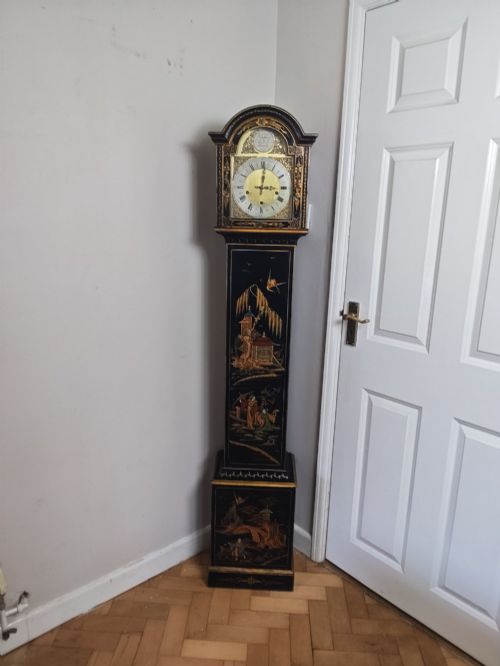
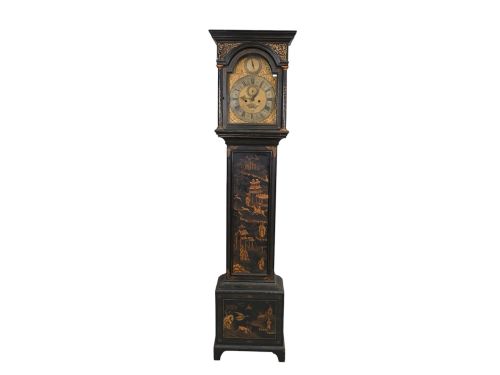


Black Japanned Longcase Clock
A black japanned longcase clock brings dark lacquer and gilt chinoiserie decoration into a room, offering both traditional timekeeping and striking visual depth.
Black Japanned Longcase Clock
A black japanned longcase clock stands as a substantial floor-standing timekeeper, combining timber construction with raised metallic decoration. These pieces bring height and presence to a room through their upright proportions.
Most examples found here date from the 18th century, including Early Georgian and George III periods, alongside a later 1930 musical interpretation. Makers such as Wise of Reading, Thomas Utting of Yarmouth, Gardner of London, and Robert Berry represent the regional and metropolitan craft behind these items.
The aesthetic relies heavily on Chinoiserie motifs, applying gilt figures, pavilions, and floral scenes onto dark lacquered wood. This decorative scheme defines the visual identity of a black japanned longcase clock across different centuries of production.
Materials and construction methods
The construction of a black japanned longcase clock relies upon wood treated with specialised lacquer to create a dark, glossy surface finish. Artisans then applied gilt detailing to build up raised pictorial scenes in the Chinoiserie taste.
Clock faces typically feature brass components, sometimes incorporating silvered brass elements for the dial work and chapter rings. Protective glass doors enclose the dial, shielding the brass movement and hands from dust.
The listings span 18th Century, Georgian, 1750, 1930, and 1800 periods, constructed from materials including brass, glass, lacquer, wood, and gilt.
Distinctions in craftsmanship and decoration
Quality in a black japanned longcase clock emerges through the crispness and depth of the gilt Chinoiserie decoration applied to the lacquered wood. Finer examples display intricate, well-preserved pictorial scenes that retain their relief work and metallic lustre across the case.
The integration of the dial with the movement further separates pieces, particularly where signed brass work by known makers demonstrates higher standards of horological execution. The proportion and execution of the wooden cabinetry itself dictate the overall architectural presence.
Wise of Reading·Thomas Utting of Yarmouth·Gardner of London·Robert Berry
The Black Japanned Longcase Clock Glossary
- Japanned wood
- Wood finished with a European imitation of East Asian lacquer techniques, typically utilising dark grounds and raised gilt decoration. This process creates the characteristic glossy surface seen on these cases.
- Chinoiserie
- European decorative style reflecting Chinese artistic motifs, featuring imagined landscapes, figures, and pavilions. It forms the primary illustrative style on these clock cases.
- Longcase clock
- Tall pendulum clock enclosed in a wooden case designed to stand directly on the floor. These items are also frequently referred to as grandfather or grandmother clocks.
- Silvered brass
- Brass treated with a silver solution to create a pale, metallic dial surface that contrasts with darker numerals and hands. This technique enhances legibility on the clock face.
Black Japanned Longcase Clock: Frequently Asked Questions
What is a black japanned longcase clock?
A black japanned longcase clock is a tall floor-standing timepiece featuring dark lacquered woodwork adorned with gilt Chinoiserie decoration. These items combine mechanical timekeeping with elaborate pictorial casework.
They serve as both functional horological objects and prominent decorative furnishings within domestic interiors.
Where should I place a black japanned longcase clock?
These clocks require a stable, upright wall position with adequate floor space to support their height and weight safely. Placing them away from direct sunlight and damp environments helps protect the dark lacquer and gilt finish.
Rooms with stable ambient temperatures suit mechanical movements best, ensuring consistent operation of the pendulum and weights.
How do grandfather and grandmother clocks differ?
Grandfather clocks represent the standard full-size longcase clock, whilst grandmother clocks are smaller, more compact scaled-down versions. Both styles utilise similar mechanical principles and cabinetry.
The listings here include both substantial 18th-century grandfather clocks and a more compact 1930 musical grandmother variant.