


German Porcelain Urns
German porcelain urns are decorative vessels shaped by nineteenth-century European revivalism, offering ornate focal points for classical mantelpieces and drawing rooms.

German Porcelain Urns
German porcelain urns encompass lidded vases, ginger jars, and clock sets originating from notable nineteenth-century manufactories and regional decorating studios. These decorative objects emerge primarily from the 19th Century, spanning periods around 1880, 1890, 1900, and extending into the 1930s.
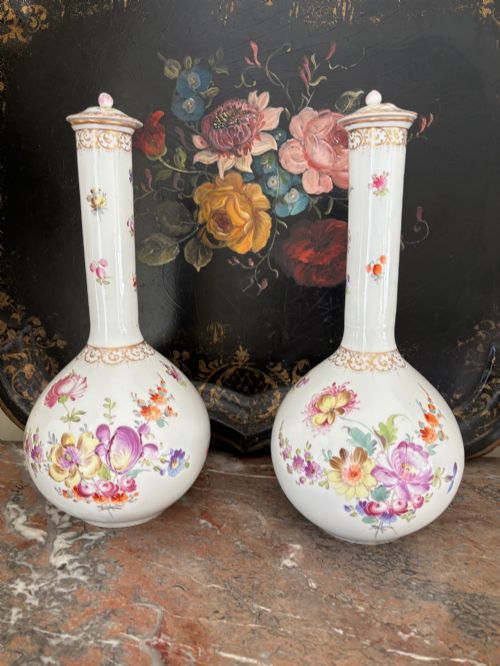
The forms on display follow historical design paths, predominantly embracing Rococo Revival, Neoclassical Revival, Victorian, and Art Nouveau styles. Buyers encounter bulbous lidded shapes, two-handled vessels, and gourd vases designed for display rather than functional storage.
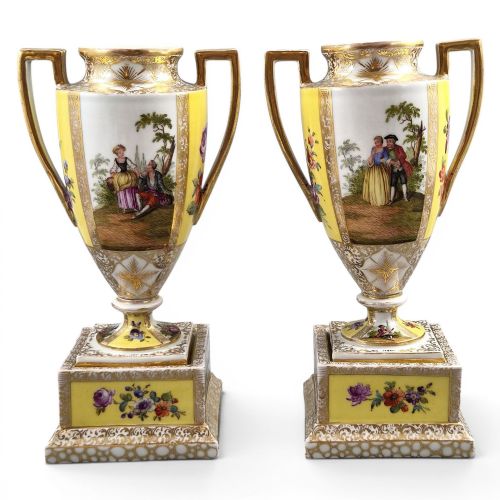
Origin points across the listings focus on well-known production centres like Meissen, Dresden, Berlin, Sitzendorf, and Bonn. Pieces often arrive as matched pairs featuring covers, hand-painted scenes, and rich ground colours.
How they were made
Manufactories shaped these vessels using hard-paste porcelain and ceramic bodies, fired at high temperatures to achieve a dense, durable base. Artisans then applied colourful enamel paints by hand, often depicting floral compositions or figural Watteau scenes.
Finishing touches involved gold leaf, detailed gilding, and occasional brass mounts to accent handles, rims, and covers. Cobalt blue grounds and royal yellow enamel frequently served as the primary backdrop for these painted details.
Some nineteenth-century ginger jars wear royal yellow coats just to brighten a dreary parlour corner.
What varies in quality
Quality rests in the precision of the hand-painted decoration, where finely rendered figural scenes and crisp floral motifs distinguish superior studio work from simpler output. The complexity of the porcelain form, such as sculpted handles and well-fitted covers, also plays a defining role.
The application of gilding and gold leaf separates standard decorative items from finer productions. Intricate cobalt or yellow ground colours paired with secure factory marks indicate careful execution by skilled painters.
Sitzendorf·Helena Wolfsohn·Meissen·Berlin·Augustas Rex·KPM Berlin·Royal Bonn
The German Porcelain Urns Glossary
- Hard-paste porcelain
- A durable ceramic material fired at very high temperatures, composed of kaolin and petuntse. It provides a dense, vitrified body that resists scratching and holds bright enamel colours.
- Gilding
- The application of gold leaf or powdered gold to porcelain surfaces, used to highlight rims, handles, and panel borders. It adds a reflective metallic sheen to the finished piece.
- Ginger jar
- A ceramic vessel with a bulbous body and a fitted lid, originally designed for spices. Nineteenth-century European makers adopted this Asian shape for decorative porcelain display.
- Potpourri
- A perforated lidded vase designed to hold dried scented plant material. These vessels allowed fragrant aromas to diffuse through nineteenth-century domestic interiors.
German Porcelain Urns: Frequently Asked Questions
What periods do these urns come from?
These decorative porcelain items date primarily from the nineteenth century, with specific examples recorded around 1880, 1890, 1900, and extending into the 1930s.
Most pieces reflect historical revival movements popular across European production centres during this era.
How were these urns used originally?
German porcelain urns served primarily as decorative showpieces for mantelpieces, sideboards, and formal drawing rooms. Lidded vases and ginger jars held ornamental status rather than everyday utility.
Some variants, such as potpourri vessels, functioned to diffuse pleasant scents through domestic spaces.
How do I identify different styles?
Styles range from the curved, ornate scrollwork of Rococo Revival to the structured symmetry of Neoclassical Revival and the flowing lines of Art Nouveau.
Examining the painted scenes, handles, and surface gilding helps reveal which historical aesthetic the maker sought to emulate.
Are these pieces usually found as pairs?
Many listings feature large matched pairs of lidded vases or urns designed for symmetrical placement on a mantel or sideboard.
Individual pieces and three-piece clock sets also appear among the available inventory.