


Victorian Dresden Urns
Victorian dresden urns are ornate porcelain vessels brought home from the continent to grace British mantelpieces with painted romance.

Victorian Dresden Urns
When you search for Victorian dresden urns, you encounter nineteenth-century lidded vases, ginger jars and potpourri containers made in the Continental tradition. The pieces appearing here span the 1880s and the broader nineteenth century, capturing a Victorian fascination with elaborate domestic ornament.
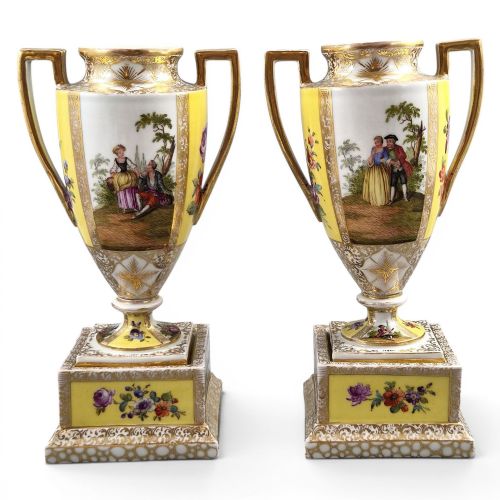
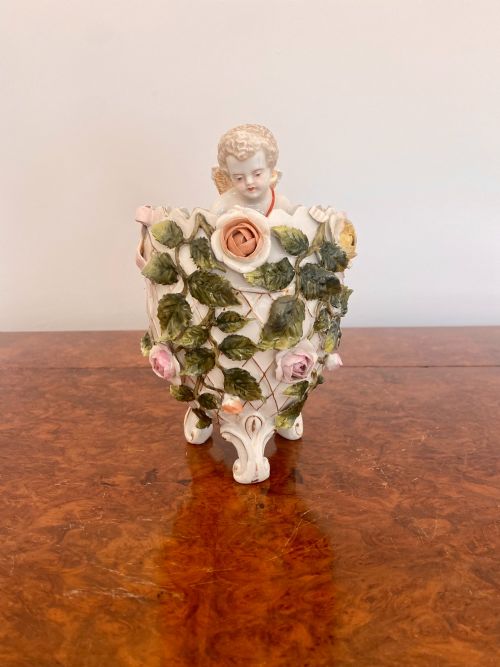
You are most likely to meet pairs of lidded vases and ginger jars dressed in the Rococo Revival style. These vessels often feature cobalt blue or royal yellow grounds, decorated with Watteau scenes and delicate figural elements such as cherubs.
The objects stem from workshops associated with the Dresden decorating tradition, including Helena Wolfsohn, Augustus Rex and Sitzendorf. Alongside these named makers, the selection includes Meissen-style gourd vases and unmarked continental pieces of the same era.
How They Were Made
Makers shaped hard-paste porcelain and standard ceramic bodies into complex vessel forms, adding lids and applied elements like cherubs. Artisans then applied rich enamel pigments to the surfaces, hand-painting figurative vignettes and pastoral scenes.
Gilding completed the process, using gold leaf and gilt accents to highlight handles, rims and panels. This meticulous combination of ceramic moulding, enamel painting and gold leaf application defined late nineteenth-century Continental workshop production.
Listings feature hard-paste porcelain and ceramic vessels decorated with enamel and gold leaf, spanning the 1880s and the wider nineteenth century.
What Varies in Quality
The distinction between ordinary and exceptional pieces lies in the precision of the hand-painted detail and the crispness of the porcelain moulding. Finely executed Watteau scenes with expressive figures and intricate floral reserves elevate a piece far above generic transfer-printed decoration.
The richness of the gilding and the depth of the enamel ground colour dictate visual impact. Intact gold leaf and vibrant royal yellow or deep blue grounds demonstrate superior workshop execution.
Helena Wolfsohn·Sitzendorf
The Victorian Dresden Urns Glossary
- Hard-Paste Porcelain
- A durable ceramic material fired at very high temperatures, composed of kaolin and petuntse. This body forms the sturdy foundation for nineteenth-century decorative urns.
- Watteau Scenes
- Painted pastoral groupings depicting figures in eighteenth-century court dress at leisure. These romantic vignettes appear frequently on Dresden and Meissen-style porcelain.
- Potpourri
- A mixture of dried petals and spices held within a lidded vessel pierced to release scent. In Victorian interiors, such urns served both an aromatic and a decorative purpose.
- Gilding
- The application of gold leaf or powdered gold to ceramic surfaces. It accentuates borders and handles, adding a warm metallic contrast to the painted enamel.
- AR Mark
- A monogram associated with Augustus Rex wares, often hand-painted in blue under the glaze. Collectors look for this cipher as an indicator of nineteenth-century Continental heritage.
Victorian Dresden Urns: Frequently Asked Questions
What are Victorian dresden urns?
These pieces are nineteenth-century porcelain vessels, including lidded vases, ginger jars and potpourri containers, originating from Continental European workshops.
They reflect the Victorian taste for elaborate ornamentation, often drawing on Rococo Revival styles and historic decorating traditions.
How were these urns used?
Victorian households displayed these decorative urns on mantelpieces, side tables and cabinets to showcase refinement and wealth.
Some variants, such as potpourri jars, held scented dried botanicals to freshen the air in formal rooms.
How do I spot Helena Wolfsohn pieces?
Helena Wolfsohn pieces frequently feature royal yellow or blue grounds paired with detailed Watteau scenes and floral panels. Many carry monogram marks on the base, reflecting the output of her nineteenth-century Dresden workshop.
The painting style leans heavily into the Meissen tradition, combining careful enamel work with generous gilding.
What is hard-paste porcelain?
Hard-paste porcelain is a robust ceramic body created by firing kaolin and petuntse at exceptionally high temperatures. It provides a bright, vitreous surface that holds enamel colours and gold leaf securely.
This material allowed nineteenth-century makers to cast intricate shapes like cherubs and gourd vases without losing structural integrity.