




Georgian Silver Tea Pot
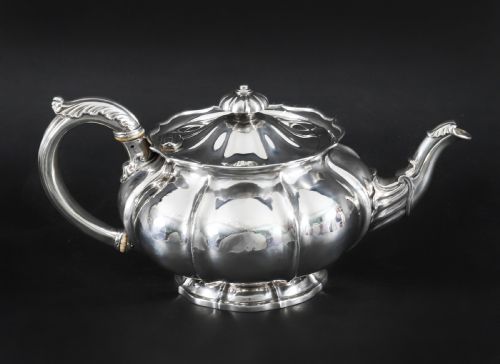
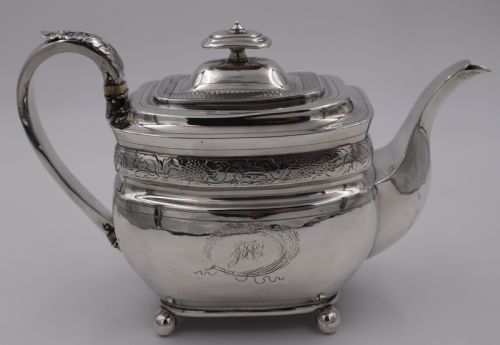
A georgian silver tea pot brings genuine weight and silver-gilt warmth to the table, shaped by silversmiths working through the eighteenth and nineteenth centuries.
Georgian Silver Tea Pot
A georgian silver tea pot sits at the centre of tea and coffee services or stands alone as a principal vessel on the table. The forms range from oval and bombe profiles to melon shapes decorated with acanthus designs.
Makers produced these vessels in sterling silver alongside Old Sheffield plate and silver-gilt versions. Many pieces retain matching stands, trays, or complete four-piece services incorporating coffee pots and water jugs.
Materials and Construction
Silversmiths constructed these vessels from sterling silver, copper fused with silver in Old Sheffield plate, and silver-gilt. Handles frequently incorporate wood for insulation, while finials utilise bone or detailed cast motifs such as coronets.
The body work involves hammering, casting, and fluting techniques, often paired with engraved crests and repoussé foliage. Makers marked their output with town marks, date letters, and maker stamps.
Sea spume and melon shapes occasionally collide on the same teapot, proving silversmiths took inspiration from botanical gardens and the ocean.
Judging Quality and Craftsmanship
The distinction between ordinary and exceptional pieces lies in the crispness of the chased decoration, such as acanthus leaves and fluting. Heavy gauge silver yields a solid feel in the hand, avoiding the flex found in lighter metal.
Renowned silversmiths brought superior hand-finishing to handles, spouts, and finials, elevating utilitarian vessels into sculptural objects. The presence of a matching hallmarked stand further separates standard items from collector pieces.
Paul Storr·Hester Bateman·Robert Hennell·John Bridge·Daniel Pontifex·Peter and Ann Bateman·Joseph Craddock·William and Patrick Cunningham
The Georgian Silver Tea Pot Glossary
- Sterling silver
- An alloy containing ninety-two point five percent silver by mass, forming the primary metal for higher-grade teapots.
- Old Sheffield plate
- A material created by fusing a thin sheet of silver to a thicker copper base, common in tea vessels from the late eighteenth and early nineteenth centuries.
- Finial
- The small decorative knob attached to the lid of the teapot, often shaped as a flower or coronet.
- Silver-gilt
- Silver that has been coated with a thin layer of gold on its surface, adding a warm yellow tone to the interior or exterior.
- Repoussé
- A metalworking technique where the silversmith hammers the design from the reverse side to form a raised pattern on the front.
Georgian Silver Tea Pot: Frequently Asked Questions
How do I date a Georgian silver teapot?
Examine the hallmarks stamped on the base or rim, which typically include a leopard's head for London, a lion passant for sterling standard, and a specific letter corresponding to the assay year.
Makers' marks alongside these symbols narrow the production period down to a specific decade or year within the Georgian era.
Did all teapots originally include stands?
Tea pot stands were manufactured as separate trays to protect polished wooden tables from heat damage. Many survived alongside their teapots, though numerous vessels were sold independently.
Matching stands share the same maker's mark and hallmarked date as the main pot.
Why do some teapots have wooden handles?
Silver conducts heat rapidly, making bare metal handles uncomfortable to grip when pouring boiling water. Silversmiths fitted insulated wooden or bone handles secured with sockets to prevent heat transfer.
These elements were shaped as scrolls or loops to match the body contour.