






Engraved Silver Tea Service
An engraved silver tea service brings the weight of Georgian and Victorian parlours straight to the table.
Engraved Silver Tea Service
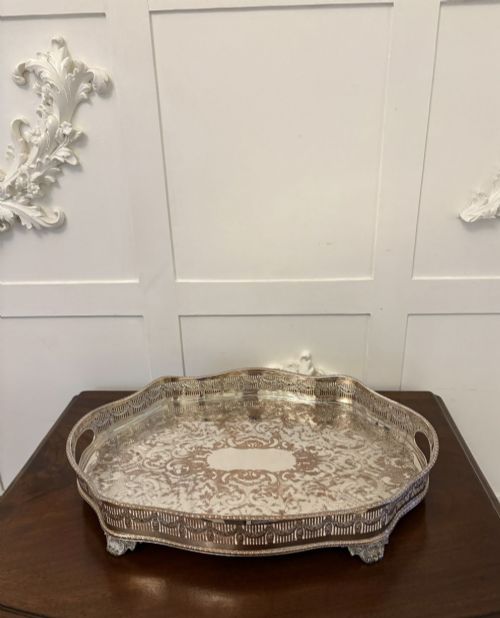
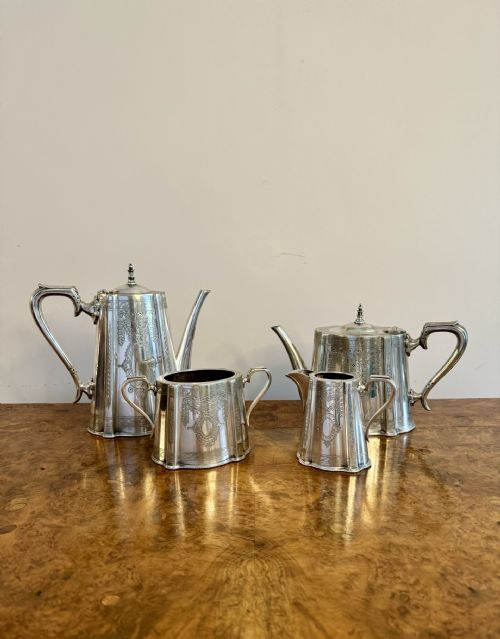
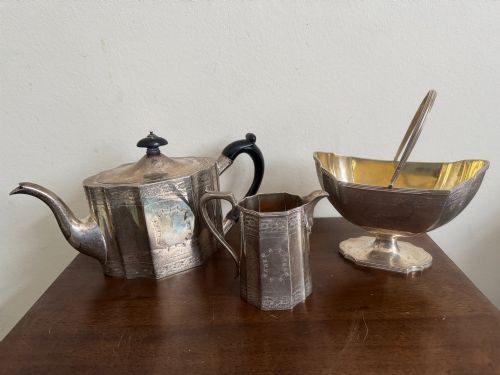
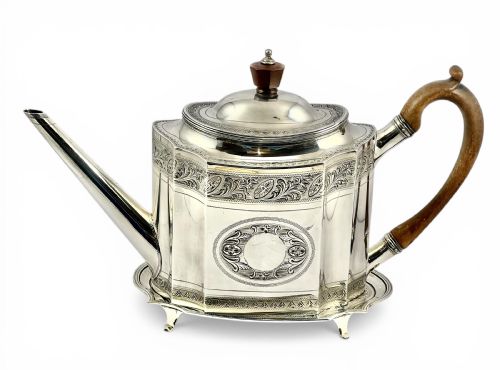
An engraved silver tea service unites pots, jugs, and trays under a single decorative hand. When searching for an engraved silver tea service, collectors encounter complete four-piece sets alongside individual teapots, cream jugs, sugar baskets, and spirit kettles on stands.
The materials span solid sterling silver and silver plate, including electroplated nickel silver, accompanied by contrasting details in wood, ebony, bone, and copper. Pieces emerge from Georgian, Victorian, and Edwardian eras, reflecting neoclassical styles and provincial English workshops.
Materials and construction
Silversmiths shaped sterling silver and plated metals through hammering, casting, and spinning. Hand engraving incised floral, geometric, and foliate motifs directly into the metal surface.
Handles and insulators incorporated organic materials such as bone and ebony to prevent heat transfer during use. Spirit kettles relied on dedicated metal stands and burners to maintain water temperature.
Listings feature sterling silver and silver plate alongside organic handle materials like ebony and bone.
Evaluating the standard
The clarity and depth of the hand engraving distinguish finer services from simpler production. Crisp lines and balanced composition across every component in a set indicate superior workshop output.
The integrity of maker marks and hallmarks confirms origin and period authenticity. Matching components within a service retain greater cohesion than assembled suites gathered later.
Walker and Hall·Robert Hennell I·John Emes·Peter and Ann Bateman·Frederik Ellis Tim and Co
The Engraved Silver Tea Service Glossary
- Hallmark
- Official stamps struck into precious metal to indicate purity, maker, and year of assay. These marks provide definitive evidence of date and origin.
- Electroplated nickel silver
- A base metal alloy coated with a layer of silver via an electrical process. This technique became common for larger items like trays and kettles.
- Spirit kettle
- A water kettle mounted on a metal stand above a small spirit burner. It kept water hot for refilling the teapot during extended tea services.
- Provincial silver
- Items made and assayed outside London in regional British cities such as Newcastle or Glasgow. Provincial pieces often display distinct local maker signatures.
Engraved Silver Tea Service: Frequently Asked Questions
What pieces comprise a full set?
A complete tea service typically unites a teapot, cream jug, and sugar basin, often accompanied by a matching tea tray or a spirit kettle on a stand.
Individual components such as cream jugs or teapots also appear independently, reflecting how services were used and expanded over time.
How do I distinguish sterling from plated pieces?
Sterling silver items bear official hallmarks stamped into the metal by an assay office, indicating the specific standard of silver purity.
Silver plate relies on base metals underneath, which may occasionally show wear where the outer silver layer has thinned over generations of polishing.
How were these services used originally?
These vessels formed the centrepiece of formal domestic hospitality in Georgian and Victorian drawing rooms, where the hostess brewed and served tea.
Spirit kettles provided a continuous supply of boiling water at the table, while trays kept the matching components organised and protected polished wooden furniture.
How should I care for silver on display?
Regular dusting with a soft cloth prevents dust accumulation in the engraved recesses of the metal. Occasional gentle cleaning with a suitable silver polish maintains the reflective surface without removing the fine detail of the hand engraving.