
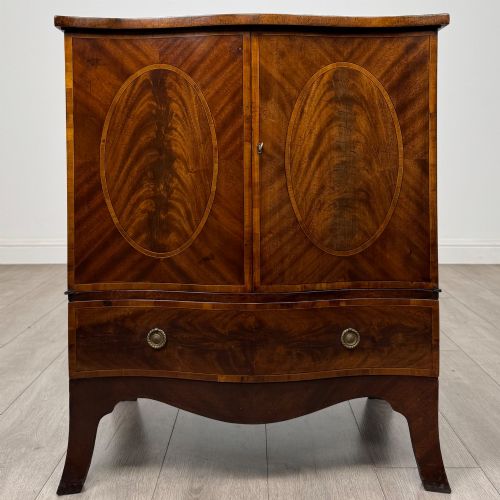
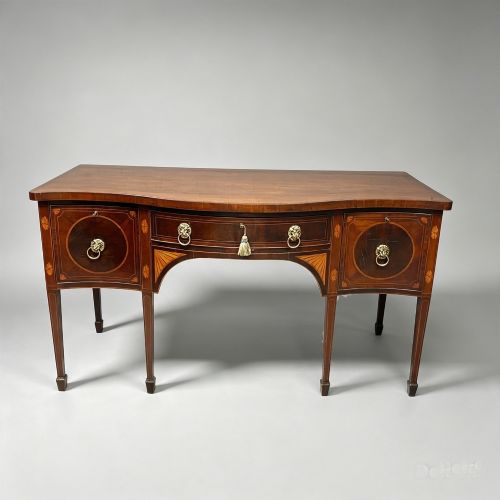
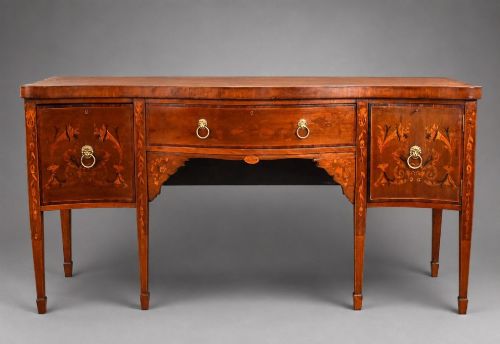
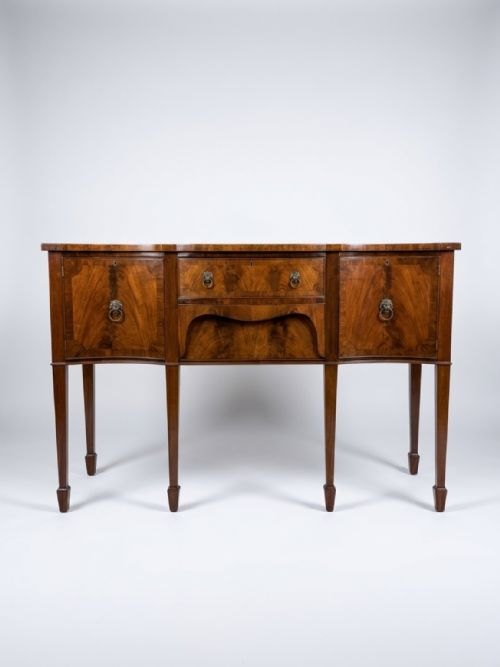


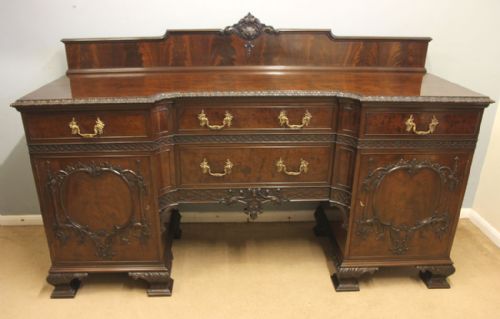

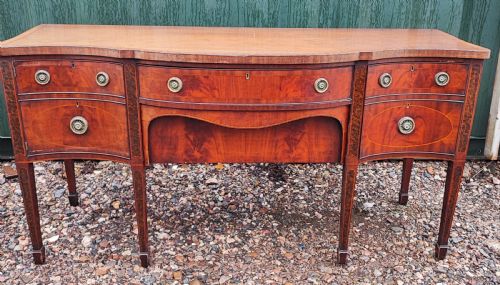

Georgian Serpentine Sideboard
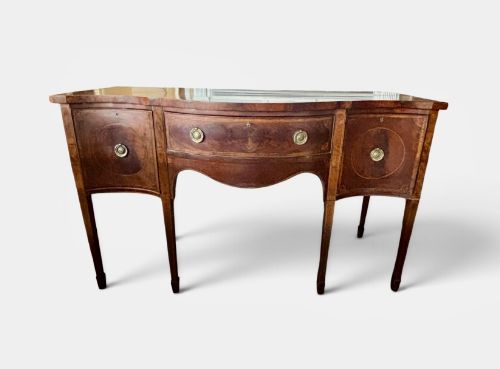
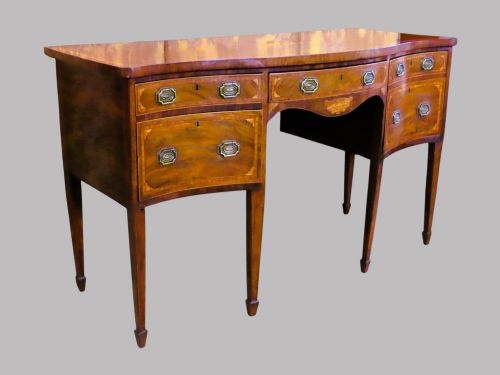
A georgian serpentine sideboard brings fluid, undulating lines and rich timber into a dining room.
Georgian Serpentine Sideboard
A georgian serpentine sideboard combines a sweeping, undulating front with substantial storage for dining rooms, originating primarily in the eighteenth century. These serving pieces stand on tapering legs and present a convex centre flanked by concave curves.
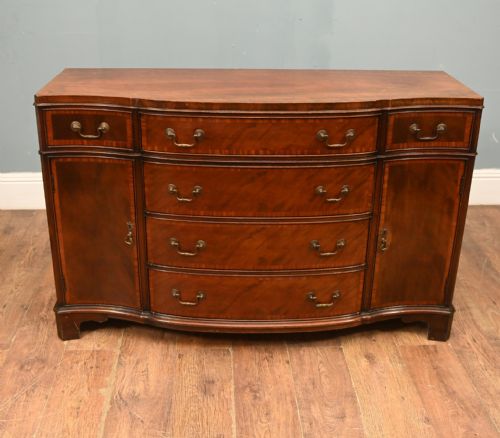
The versions met most frequently on this page date from the Georgian period and its later revivals in the Edwardian era. Makers constructed these dining room pieces in varying scales, from large formats down to narrow sideboard designs.
Materials and Construction
Cabinet makers utilised solid mahogany as the primary structural timber, often selecting flame mahogany veneer to achieve striking visual depth across the curved drawer fronts. Craftsmen applied boxwood and satinwood inlay to define borders and panels.
Brass hardware such as handles and escutcheons punctuate the polished timber surfaces, while secondary timbers provide internal framing for drawers and cupboards.
Listings feature mahogany, satinwood, and boxwood across periods ranging from the eighteenth century through the Edwardian revival.
Craftsmanship and Proportion
Quality rests upon the precision of the serpentine curve and the selection of figured veneers that follow the contours of the timber without distortion. Superior examples display crisp boxwood inlay and well-balanced proportions that maintain elegance from every angle.
Later revival pieces show differing standards of joinery and timber selection, distinguishing eighteenth century originals from subsequent Edwardian interpretations.
Gillow
The Georgian Serpentine Sideboard Glossary
- Serpentine
- A curved furniture front characterised by a convex centre flanked by concave wings. This shape requires advanced woodworking skill to construct accurately.
- Flame mahogany
- A veneer cut from timber where the branch joins the main trunk, producing a rippling flame pattern. Cabinet makers prize this grain for formal dining furniture.
- Inlay
- A technique where contrasting woods such as boxwood and satinwood are inserted into recesses in the primary timber. This creates decorative borders and geometric motifs.
- Cross-banded
- A border treatment where veneer strips run perpendicular to the main grain of the top surface. This frames the primary panel of the sideboard.
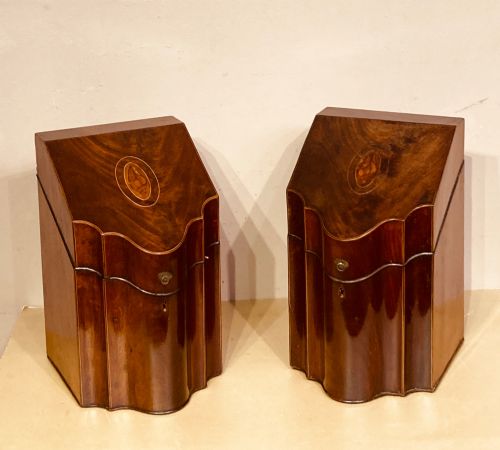
- Knife box
- A specialised container designed to hold cutlery upright, often shaped with a sloping lid to match the period dining room aesthetic.
Georgian Serpentine Sideboard: Frequently Asked Questions
How do I date a serpentine sideboard?
Examine the timber selection, secondary woods inside the drawers, and the style of the inlay. Eighteenth century pieces display hand-cut dovetails and period specific brass hardware.
Revival pieces from the Edwardian era often utilise machine-sawn elements and brighter satinwood contrasts while mimicking earlier George III proportions.
Where should I place a sideboard?
These serving pieces suit dining rooms and large hallways where the curved front can be viewed without obstruction. Ensure adequate wall space allows the undulating proportions to remain visible.
Keep wooden surfaces away from direct heat sources and strong sunlight to protect the mahogany veneer and polish.
What is the difference between a sideboard and a serving table?
A sideboard incorporates integrated drawers and cupboards designed for storing dining linen and cutlery. Serving tables typically offer an open framework beneath the top surface without enclosed cabinet storage.
Both forms utilise the serpentine front to create a decorative focal point in a dining room.
How do I care for mahogany veneer?
Dust the timber regularly with a soft, dry cloth and apply a quality beeswax periodically to nourish the polished surface. Avoid silicone based polishes that build up over time.
Maintain stable room humidity to prevent the veneer from lifting along the curved edges.