




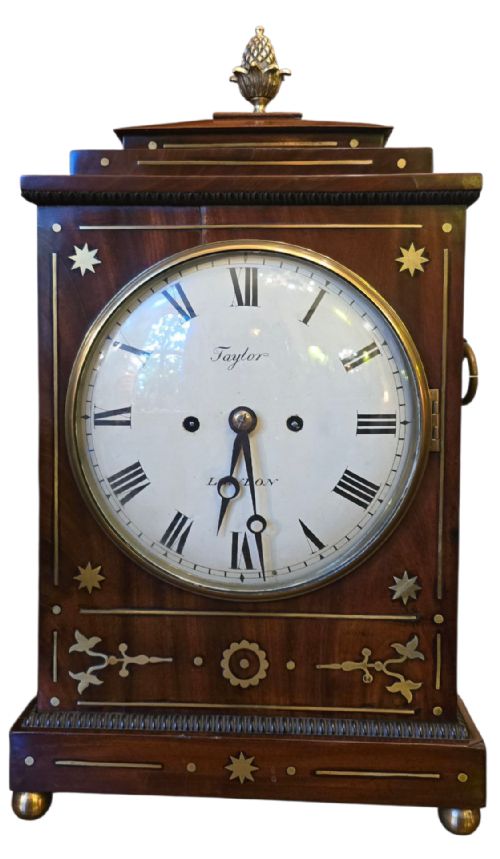


Georgian Mahogany Timepiece
A georgian mahogany timepiece brings architectural warmth and steady precision into a room through rich timber and brass detail.
Georgian Mahogany Timepiece
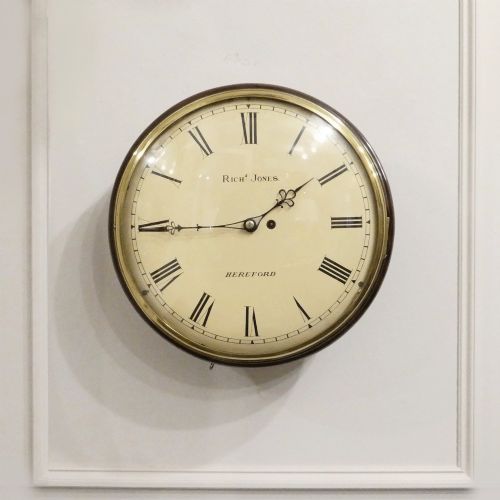
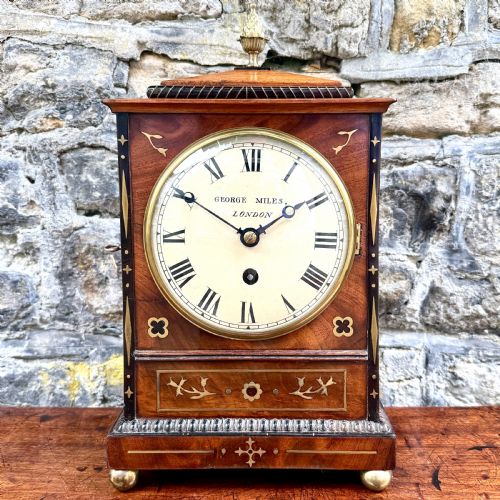
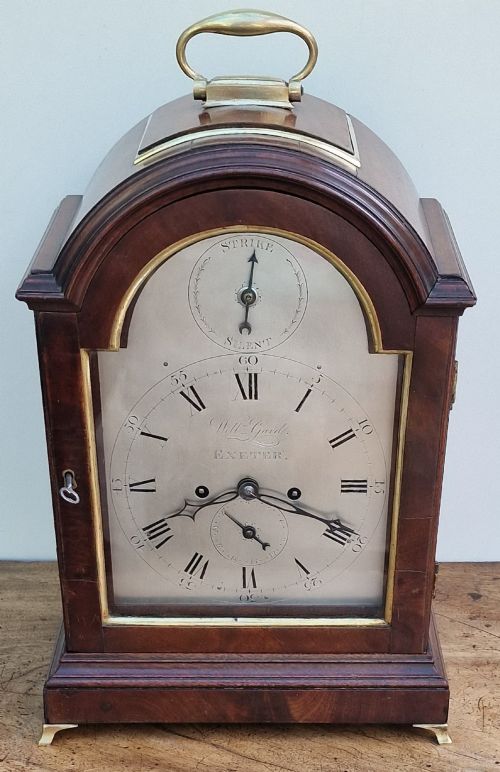
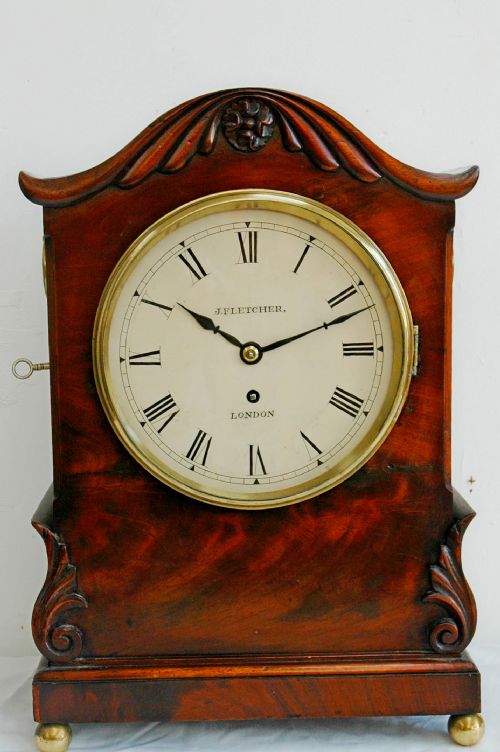
A georgian mahogany timepiece typically takes the form of a bracket clock, wall dial or library clock housed in rich timber. The pieces seen here span wall clocks, mantel clocks and bracket clocks produced during the Georgian, Regency and 19th Century periods.
Makers such as Richard Jones of Hereford, Bush of London and John Thwaites represent the domestic scale of production where mahogany casework dominates. Buyers encounter dial clocks with wooden or painted faces alongside compact table and library pieces.
Materials and construction
Casework relies upon solid mahogany, frequently enhanced with satinwood or boxwood inlay to define the borders and plinths. Brass mounts, bezels and swing handles provide structural contrast against the dark timber.
Movements utilise fusee mechanisms for steady power delivery, paired with enamel dials, glass viewing panels and steel hands. Iron and brass components govern the escapement and striking trains housed within the wooden bodies.
Listings combine mahogany with brass, glass, enamel, steel, iron, satinwood and boxwood across multiple centuries.
What separates the tiers
Quality rests in the precision of the cabinetwork and the reputation inscribed upon the dial. Sharply cut chamfers, clean boxwood stringing and well-proportioned brass brackets separate workshop output from standard production.
Signed movements by noted makers command attention through the crisp execution of the plates and escapement. The legibility of the painted face and the integrity of the original mahogany grain dictate the standing of each clock.
Richard Jones of Hereford·Bush of London·Webster Cornhill London·Hyde of Salisbury·Taylor of London·Agar Of Malton·McCabe London·Haley and Milner London·John Thwaites·Valiant Paris·Mitchell and Russell of Glasgow
The Georgian Mahogany Timepiece Glossary
- Fusee
- A conical pulley used in older clock movements to equalise the pull of the mainspring as it winds down. This mechanism ensures consistent force reaches the escapement.
- Bracket clock
- A portable clock designed to sit on a bracket, shelf or table rather than stand on the floor. Many feature carrying handles on top.
- Dial clock
- A wall-mounted clock featuring a prominent circular face shielded by glass and a brass bezel. These were standard in offices, halls and large rooms.
- Verge escapement
- An early type of escapement mechanism regulating the speed of a clock. It works in conjunction with a balance spring or pendulum.
- Chamfer top
- A sloping edge cut away at an angle along the top corners of a clock case. This detail adds architectural refinement to Georgian and Regency designs.
Georgian Mahogany Timepiece: Frequently Asked Questions
What is a fusee movement?
A fusee movement uses a conical drum to maintain even tension on the gear train as the mainspring unwinds.
This clever mechanical device ensures the clock maintains steady timekeeping from the moment of full wind until it runs down.
Where were bracket clocks placed?
Bracket clocks sat upon dedicated wall brackets or sturdy tables in principal rooms, allowing their owners to move them between chambers.
Their brass carrying handles made relocation practical despite the heavy timber and internal metalwork.
How do I identify a Georgian clock?
Georgian examples display classic proportions, dark mahogany timber, and restrained brass mounts without excessive Victorian ornamentation.
Inscribed dial signatures and fusee movements often confirm the period alongside traditional dial configurations.
Are dial clocks wall mounted?
Dial clocks mount directly to walls using secure rear hanging points and drop cases designed for easy viewing.
Their clear painted faces and wooden bezels made them ideal for communal spaces and domestic hallways.