
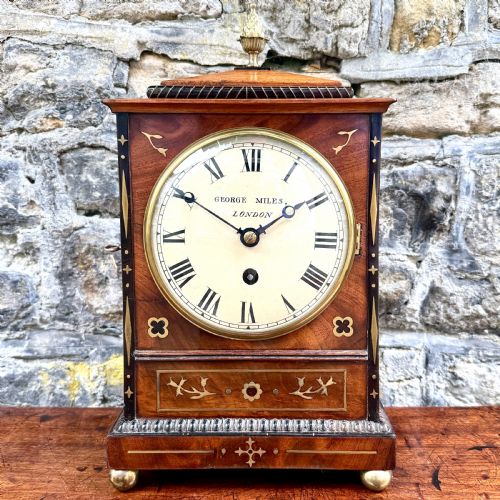


Mahogany Library Clock
A mahogany library clock brings warmth and precise mechanical movement to a room, offering both traditional weight and functional design.
What a mahogany library clock is
A mahogany library clock is a dependable timekeeper traditionally housed in rich timber cases designed for study spaces and drawing rooms. The selection includes architectural mantel forms, substantial five-glass examples, and compact miniature timepieces.
The objects span multiple eras, appearing in Georgian, Regency, and Victorian styles alongside late nineteenth-century iterations. Most pieces function as reliable timepieces or mantel clocks rather than striking clocks, relying on timber such as mahogany paired with glass and metal dials.
How they were made
Cabinetmakers constructed these clock cases using solid and veneered mahogany, often highlighting the natural grain of the wood. Brass details, shaped tops, and bevelled glass panels were incorporated to protect the delicate movements within.
Internal mechanisms utilised brass and steel components, frequently featuring fusee movements designed to maintain even tension as the mainspring unwound. Dials were commonly produced in silvered metal or painted finishes, protected behind hinged glass bezels.
Retail Price Guide 2026
Typical UK retail prices for mahogany library clock, calculated from the Sellingantiques database of over a million retail prices indexed since 2003. This retail price guide relies exclusively on Sellingantiques data; no external sources or auction records are used, so the figures do not describe the wider market.
Listings feature mahogany library clocks spanning the Georgian, Regency, and Victorian periods, constructed with brass, glass, and silvered metal.
What varies in quality
Quality rests upon the refinement of the cabinetwork and the reputation of the horologist whose signature appears on the dial. Cases with crisp mouldings, select mahogany timber, and well-executed bevelled glass panels stand apart from plainer utility pieces.
The mechanical sophistication of the movement dictates the upper tier of the range, particularly single fusee mechanisms signed by notable makers. Simpler spring-driven movements or later German imports represent a different tier of production.
Bush of London·Walker·Dent·McCabe London·Barraud and Lunds·Darling Edinburgh
The Mahogany Library Clock Glossary
- Fusee
- A conical pulley used in clock movements to maintain even power as the mainspring unwinds. This mechanism improves timekeeping accuracy across the power reserve.
- Timepiece
- A clock that measures and indicates the time without striking bells or gongs. Many library clocks omit striking trains to ensure quiet operation in a study.
- Bevelled glass
- Glass with edges cut and polished at an angle before insertion into brass panels or doors. It adds a refined optical quality to the case.
- Silvered metal
- A brass or copper dial face treated with a silver compound to create a matte metallic finish. Graduations and maker signatures are typically engraved into this surface.
Frequently Asked Questions
How do I wind a library clock?
Most fusee movements require a matching winding key inserted into the dial face to tension the mainspring.
Care must be taken not to overwind the mechanism, stopping as soon as resistance is felt.
Where should I place a library clock?
These clocks suit stable surfaces such as mantelpieces, desks, or bookcases away from direct sunlight and damp conditions.
A level surface ensures the pendulum or balance wheel maintains an even beat.
How do I tell a Georgian clock from a Victorian one?
Georgian and Regency examples tend to feature restrained classical proportions and rich mahogany patination.
Victorian pieces often introduce larger glass panels, shaped tops, and heavier architectural detailing.
Do all library clocks strike the hour?
Many examples are strictly timepieces that record the hours without sounding any chimes.
Some larger mantel clocks incorporate ting-tang or striking trains, depending on the specific model.