
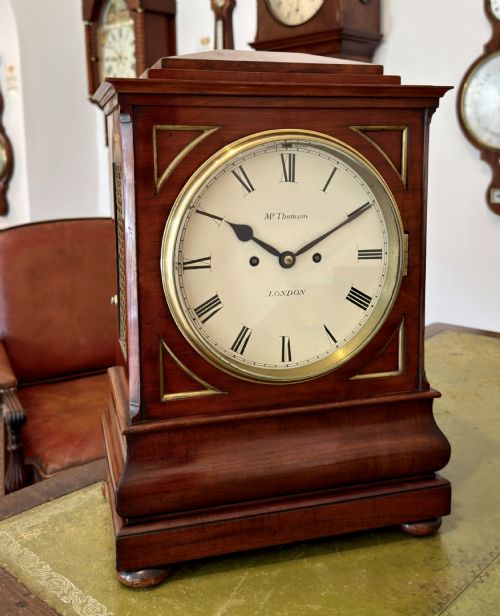
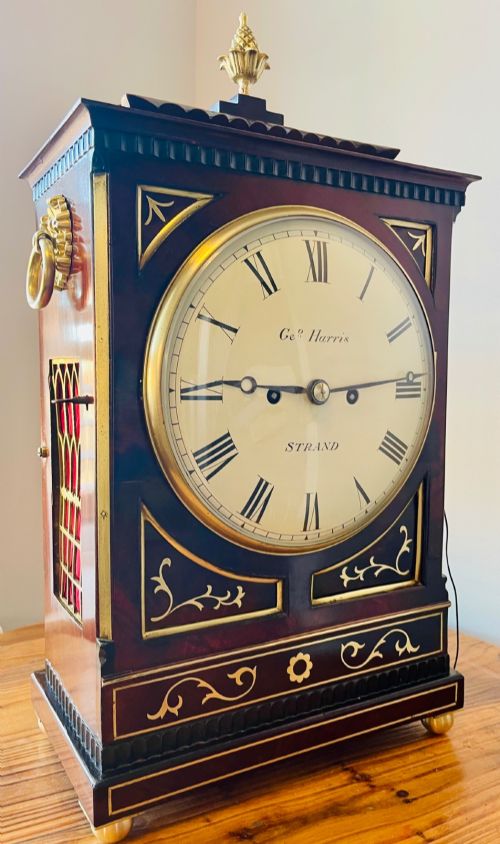
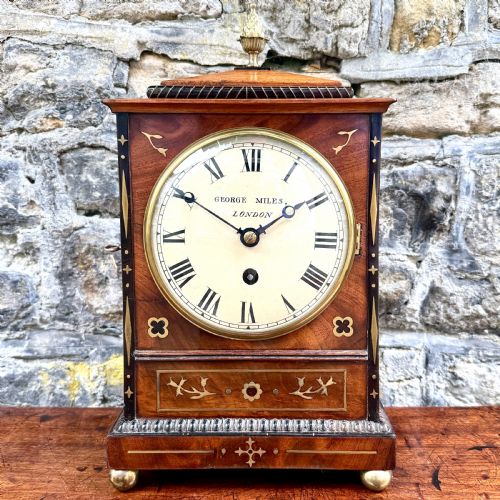
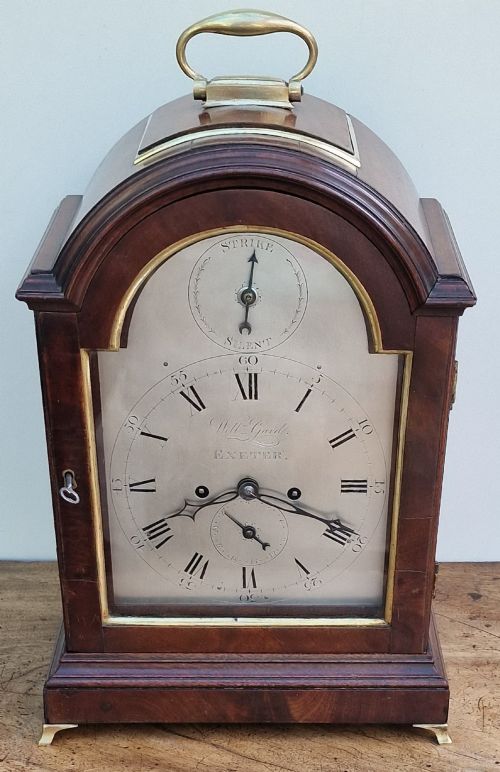
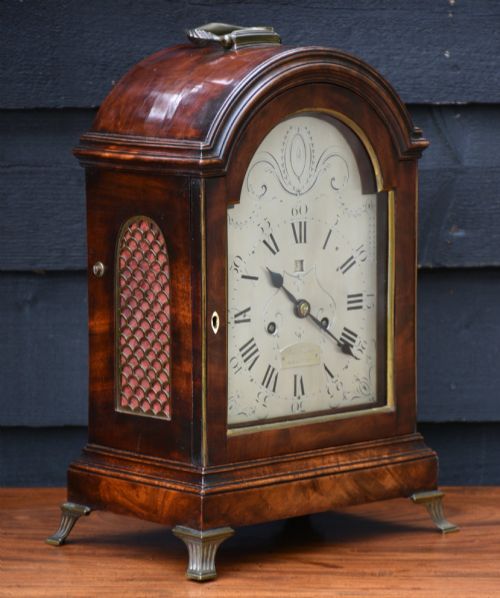
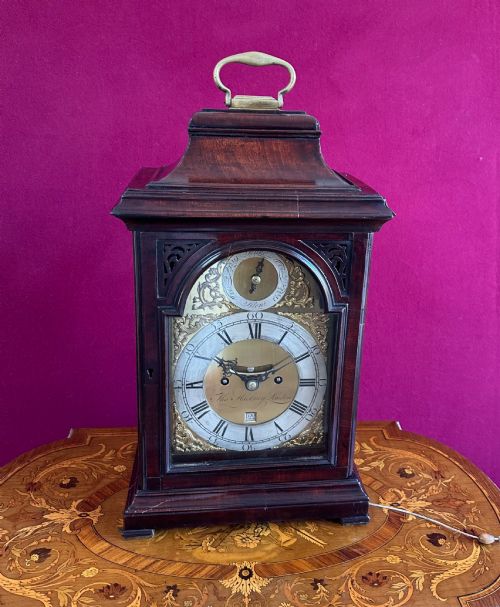
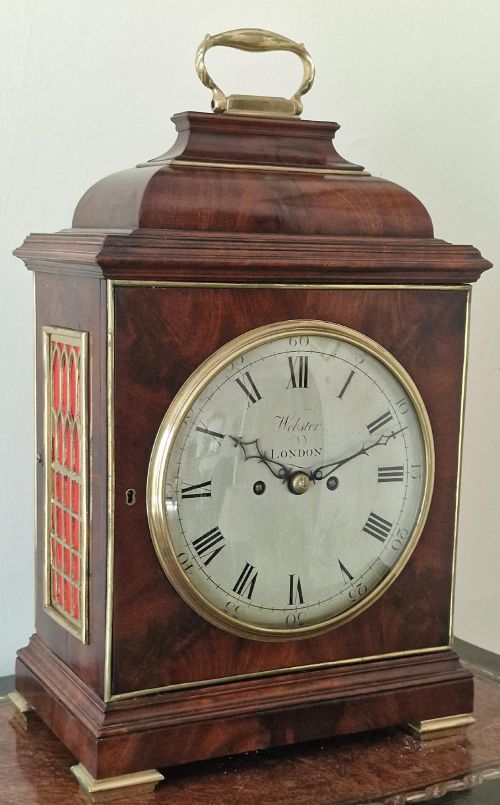

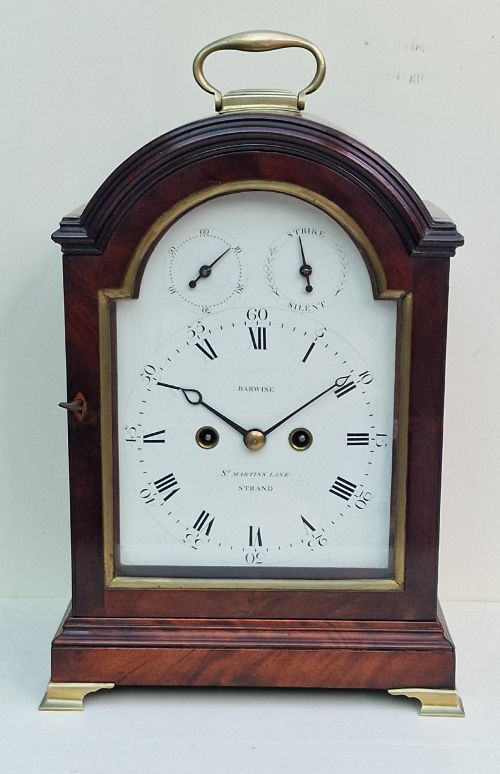



Georgian Mahogany Bracket Clock
A georgian mahogany bracket clock brings domestic horology into the room, combining rich timber cases with precision movements made for table or bracket placement.
Georgian Mahogany Bracket Clock
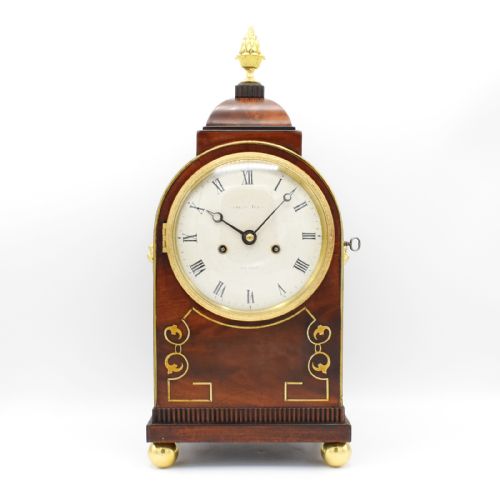
A georgian mahogany bracket clock is a portable timepiece housed in a wooden enclosure designed to sit upon furniture or dedicated wall shelves. These items appear chiefly across eighteenth and nineteenth century periods, spanning Georgian, Regency, and later Victorian revivals.
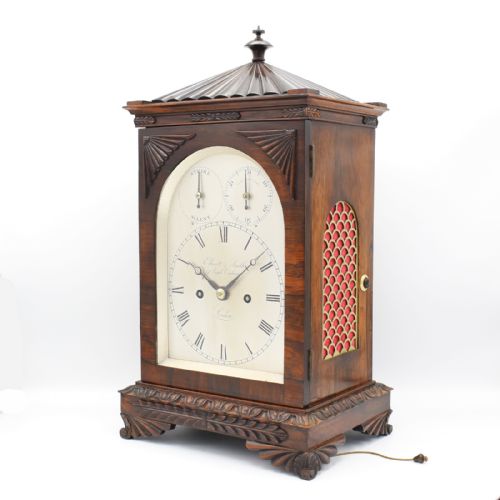
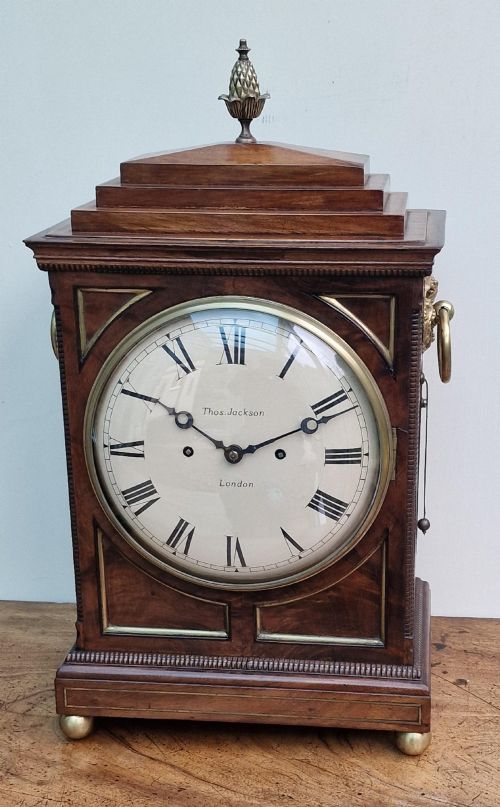
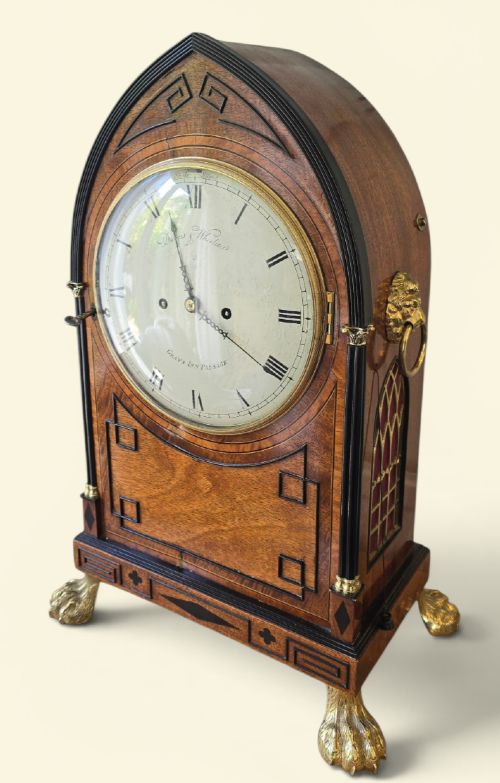
The architectural silhouettes vary from simple lancet and arch tops to bell tops, pad tops, and balloon cases. Most examples encountered here utilise the classic dark timber housing paired with contrasting dial elements.
Makers ranged from provincial watchmakers to prominent London clockmakers, producing both eight-day fusee movements and simpler timepieces for domestic settings.
Materials and Construction
Cases are built primarily from solid and veneered mahogany, frequently decorated with brass inlay, ebony stringing, or cast brass sound frets and feet. Dial construction typically employs painted enamel, engraved silvered metal, or brass plates behind protective glass doors.
Internal mechanics rely on brass wheel trains driven by steel pivots, steel springs, and fusee or verge escapements. Silk suspension threads and pendulum regulations govern the timekeeping, while secondary materials like silk backing behind sound frets manage acoustic output.
Listings feature mahogany cases paired with brass, enamel, and silvered metal across Georgian and Regency periods.
Quality and Execution
The refinement of a georgian mahogany bracket clock rests in the architectural harmony of the case and the complexity of its movement. Fine examples display crisp brass inlay, well-proportioned mouldings, and substantial cast mounts rather than plain timber surfaces.
Movement quality is determined by the precision of the escapement, whether verge or fusee, and the reputation of the maker inscribed on the dial or backplate. Engraved detail on brass movement backplates and musical or repeating complications separate standard timepieces from masterwork productions.
Thomson of London·William Gard·Webster·Mappin & Webb·Barwise·Charles Pratt·Ellicott & Smith·Thomas Jackson·Bush of London·Desbois & Wheeler·L. Vick·Webster Cornhill·Francis Perigal·Thomas Moss·Cording of London·Wilkinson Leicester·Barrett London·Paul Philip Barraud·Hyde of Salisbury·Hampson & Son·WH&Sch·Atkins of London·Gravell & Tolkien·Roskell of Liverpool·Grant of London
The Georgian Mahogany Bracket Clock Glossary
- Fusee
- A conical pulley used in clock movements to maintain an even pull on the gear train as the mainspring unwinds. This mechanism helps ensure consistent timekeeping across the duration of the wind.
- Verge escapement
- An early type of escapement mechanism that controls the release of the gear train via a crown wheel and pallets. It is commonly found in eighteenth-century examples.
- Lancet top
- A pointed, gothic-arch shape utilised for the upper portion of certain clock cases. This silhouette became particularly popular during the Regency period.
- Pad top
- A raised, domed central panel finishing the top of a wooden clock case above the main cornice. It offers a distinct profile compared to flat or bell-top variants.
- Silvered metal
- A brass dial plate treated with a silver coating and subsequently engraved with numerals and maker details. This technique provides a clear, high-contrast face.
Georgian Mahogany Bracket Clock: Frequently Asked Questions
What is a bracket clock?
A bracket clock is a portable spring-driven timepiece historically designed to sit on a wall bracket or table. They were built for easy movement between rooms rather than permanent wall mounting.
Most feature carrying handles on top and glazed side panels to let light reach the internal movement.
How do fusee movements work?
A fusee movement uses a conical pulley connected to the mainspring by a fine chain or cord. As the spring loses tension, the chain pulls on a wider part of the cone to maintain steady power.
This clever mechanical device compensates for the dropping force of an uncoiling spring to keep the clock accurate.
Where were these clocks placed?
Owners placed these timepieces on sturdy tables, mantelpieces, or dedicated wooden wall brackets in principal rooms of the house. Their portability allowed them to serve different living spaces as needed.
The sturdy mahogany cases protected the delicate mechanisms from drafts and dust.
How do I wind my clock?
Winding requires inserting a small key into the winding holes on the dial face and turning it gently until resistance is felt. Care must be taken not to overwind the mainspring.
Many eight-day models require winding just once a week to maintain continuous operation.