
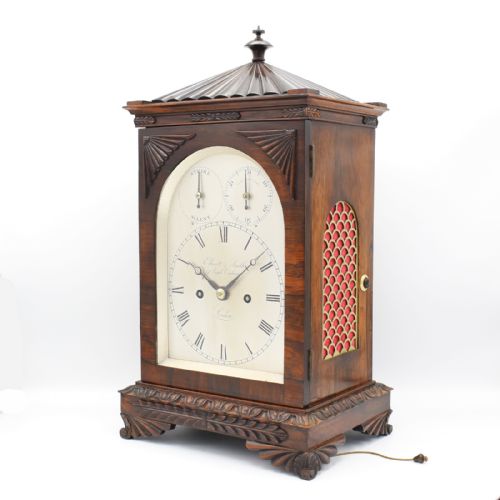
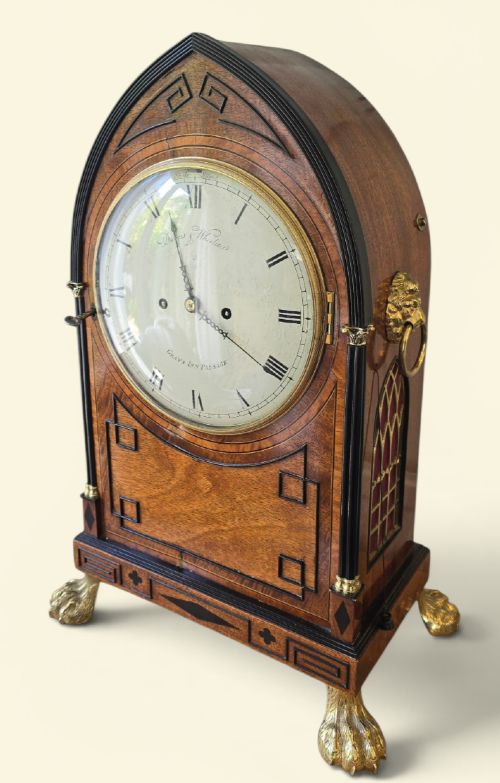

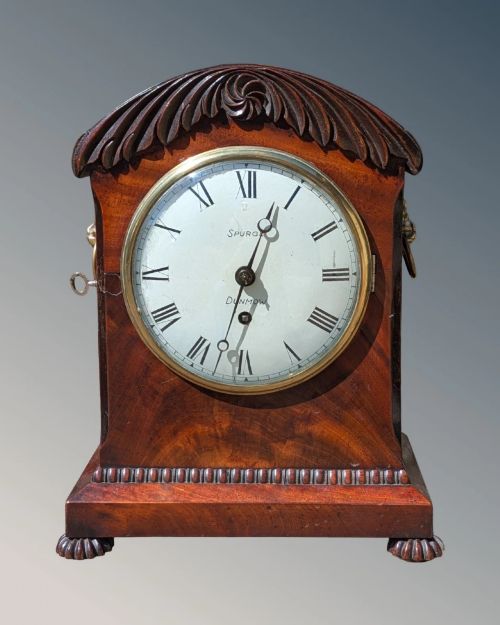


Mahogany Fusee Bracket Clock
A mahogany fusee bracket clock brings traditional horology into a room, combining fine cabinet-making with precise mechanical timekeeping.
Mahogany Fusee Bracket Clock
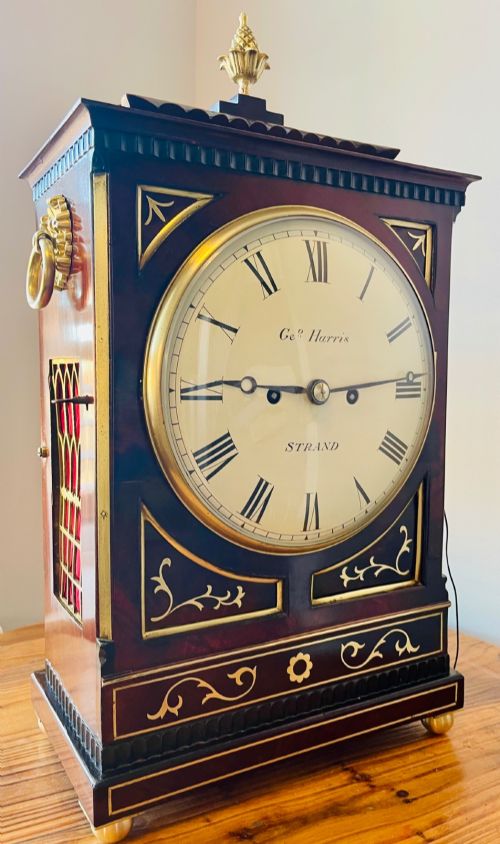
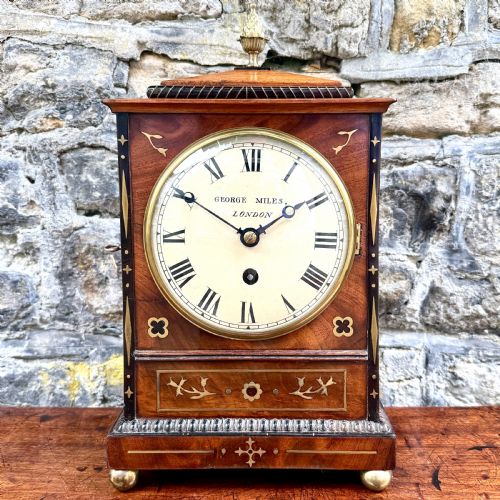
A mahogany fusee bracket clock is a portable timekeeper housed in a wooden case, designed historically to sit on brackets or tables. These pieces range from compact library clocks to larger table models produced during the Georgian, Regency, and Victorian periods.
The most common examples encountered on this page feature rich mahogany timber enclosures with brass details, incorporating single or double fusee movements that drive the gear train with consistent power.
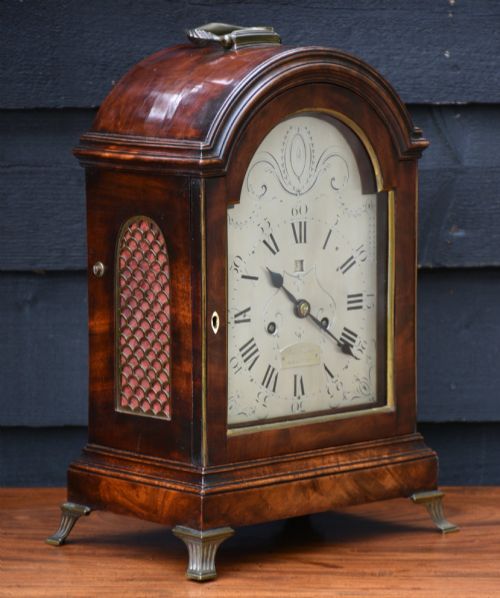
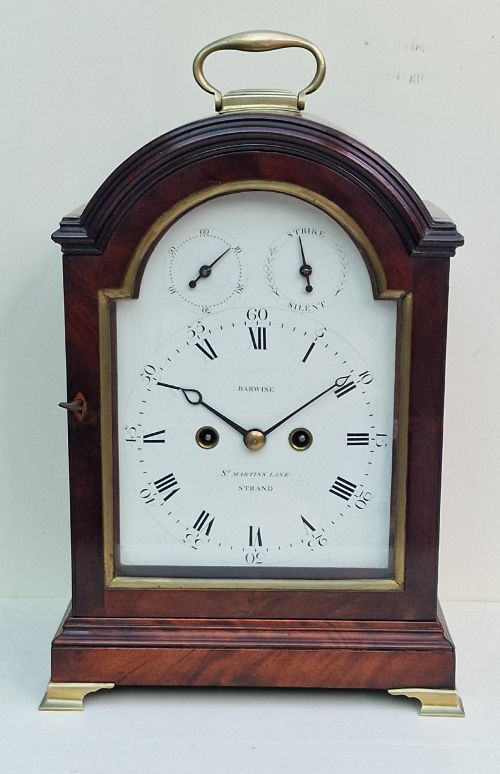
Originating largely from London workshops as well as provincial makers, these clocks vary in silhouette from traditional pad-top and lancet shapes to arched and balloon cases.
How They Were Made
Cabinet-makers constructed the architectural cases using dense mahogany, frequently incorporating brass inlay, delicate fretwork sound frets at the sides, and glazed doors to protect the dial. Inside, intricate brass and steel mechanical components formed the gear train.
The fusee mechanism itself, a conical pulley connected to a cord or chain, compensated for the declining tension of the mainspring to ensure steady timekeeping across the duration of the wind.
Several clocks carry the names of provincial makers in quiet market towns, proving that excellent timekeeping reached far beyond the capital.
What Varies in Quality
Quality rests significantly on the sophistication of the internal movement, distinguishing simple timepieces from complex models featuring double fusee striking systems, quarter chiming, or repeat mechanisms. Engraved backplates and signed dials by noted makers elevate the standing of a piece.
The execution of the mahogany case, the crispness of any brass mounts, and the preservation of original surfaces also define the upper tier of these horological works.
Barwise London·Ellicott And Smith·Desbois And Wheeler·Webster Cornhill London·Spurge Dunmow·Mappin And Webb·W Burton·Geo Carter Hackney·Wilkinson Leicester·Barrett London·J Kingerley Manchester·Thomas Connold Alysham·Taylor Of London·Joseph Jump London·Budgen Croydon·Funnell Of Brighton·John Durden London·Marks Of London·Robert Roskell Son Liverpool·Perigal Of London·Brockbank And Atkins·P Forrester Hull·Chadwick Of Liverpool·G Searle London·Sowter London
The Mahogany Fusee Bracket Clock Glossary
- Fusee
- A conical pulley designed to equalise the power of the mainspring as it unwinds. This clever device ensures the clock maintains an even force throughout its running period.
- Bracket clock
- A portable household clock originally built to rest upon a wall bracket or table. Despite the name, many examples survive without their original matching wall supports.
- Silvered metal
- A brass dial plate treated with a silver compound to produce a bright, matte finish. Numerals and maker signatures are typically engraved and blackened for legibility.
- Pad top
- A raised, domed section on the upper portion of a wooden clock case. This architectural feature is frequently seen on Georgian and Regency examples.
- Lancet top
- A pointed, Gothic-arch silhouette shaping the upper portion of the wooden enclosure. It became particularly popular during the early nineteenth century.
Mahogany Fusee Bracket Clock: Frequently Asked Questions
What is a fusee movement?
A fusee movement uses a conical pulley and chain to regulate the pull of the mainspring. This mechanism maintains equal tension on the gear train as the spring winds down.
Such engineering ensures the clock maintains steady accuracy over its entire operational cycle between windings.
Where were bracket clocks placed?
Bracket clocks were designed as portable timekeepers for desks, tables, or dedicated wall brackets around the home. Their smaller scale allowed owners to move them easily between rooms.
Enclosed dials and sturdy wooden cases protected the delicate internal mechanics during transport.
How do I date a mahogany clock?
Dating relies on stylistic details in the mahogany case, dial materials, and the signature of the maker inscribed on the movement. Georgian and Regency pieces often feature simpler lines and brass inlay, while Victorian examples introduce heavier proportions and more elaborate carvings.
Movement construction also evolved over the nineteenth century, shifting from verge escapements to anchor or platform escapements.
Do all bracket clocks strike the hour?
Not all pieces include a striking mechanism, as many simpler models operate purely as timepieces without bells or gongs. Double fusee configurations typically drive both the timekeeping train and a separate striking train.
Some advanced examples incorporate quarter-chiming or repeat functions to sound the time on demand.