
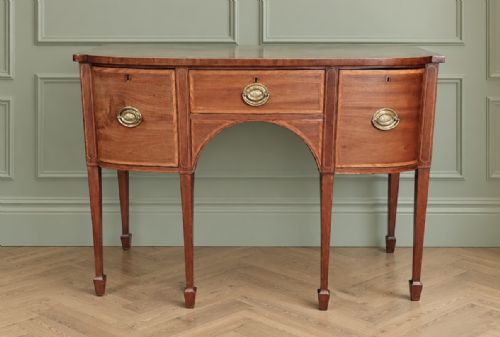
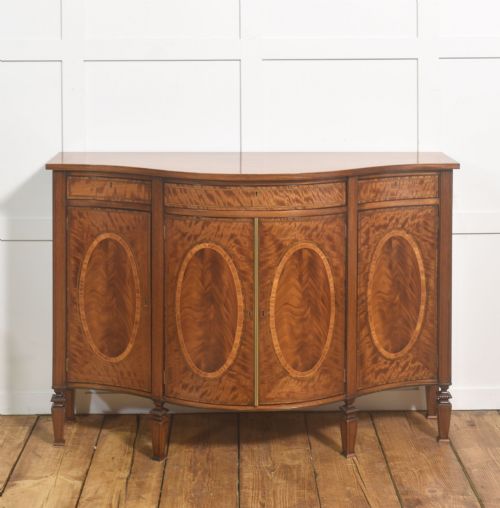
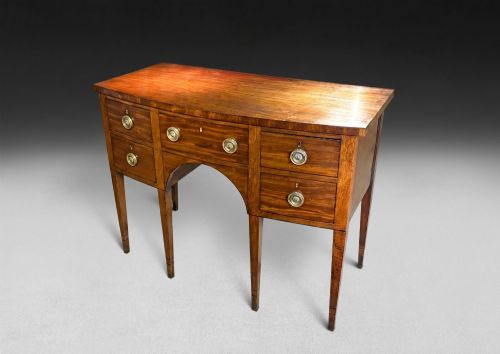
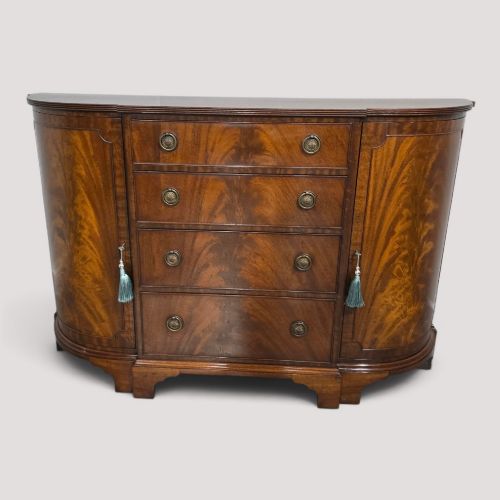
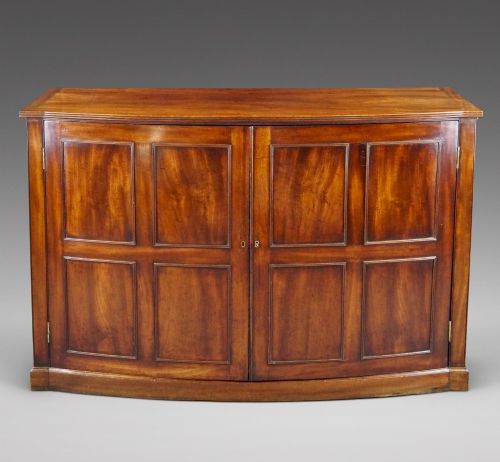
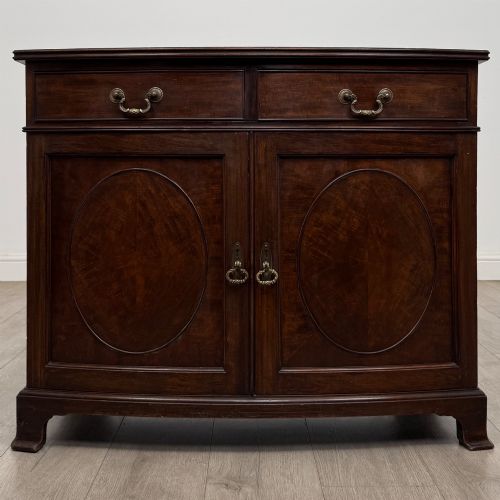
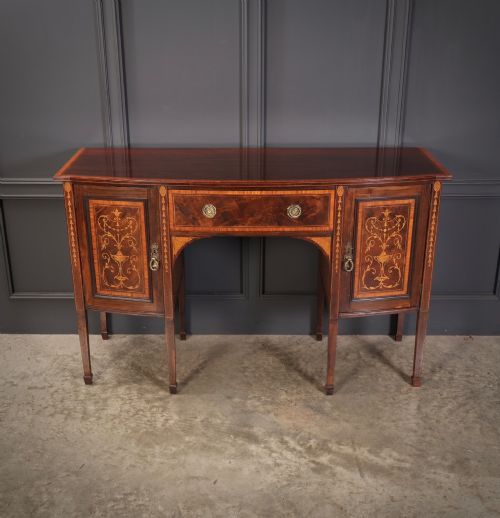
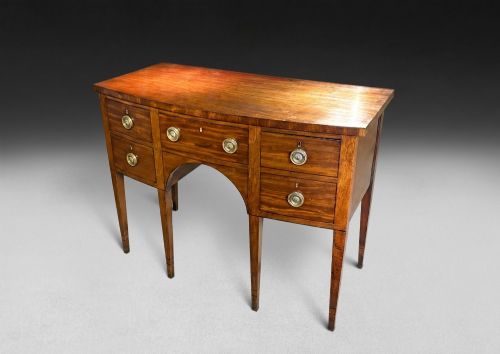
Georgian Mahogany Bowfront Sideboard
A georgian mahogany bowfront sideboard brings architectural curve and cabinetmaker skill to a dining room, offering deep storage beneath a sweep of figured timber.
Georgian Mahogany Bowfront Sideboard
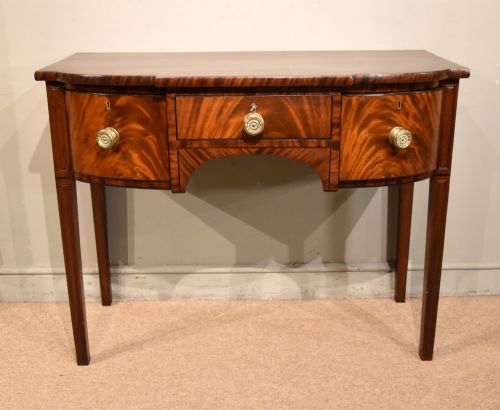
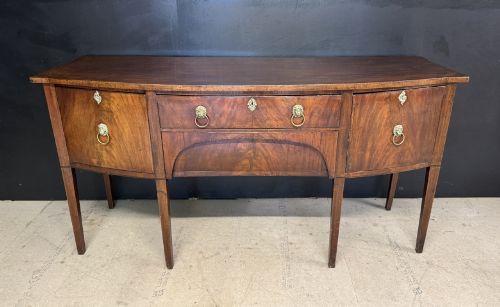
A georgian mahogany bowfront sideboard stands as a major dining room storage piece, designed with a convex curved front that softens the linear geometry of a traditional interior. The pieces appearing most frequently on this page date from the eighteenth century and the regency period, alongside later nineteenth-century interpretations and twentieth-century revival pieces.
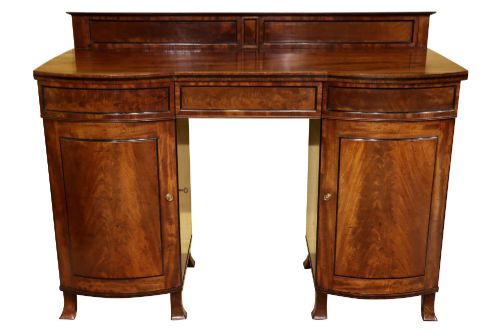
Makers shaped these servers as low, long cabinets fitted with drawers and cupboards to hold dining silver, linen, and bottles. While standard forms sit on four or six legs, variations include pedestal configurations, breakfront designs, and smaller scaled examples suited for compact spaces.
The aesthetic bridges utility and display, drawing on george iii, sheraton, and regency design vocabularies. Surviving examples range from authentic eighteenth-century originals to later edwardian and twentieth-century reproductions built in the same cabinetmaking tradition.
How they were made
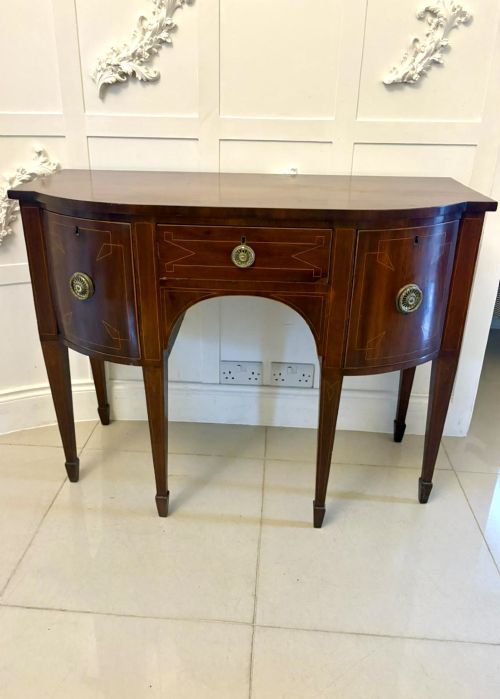
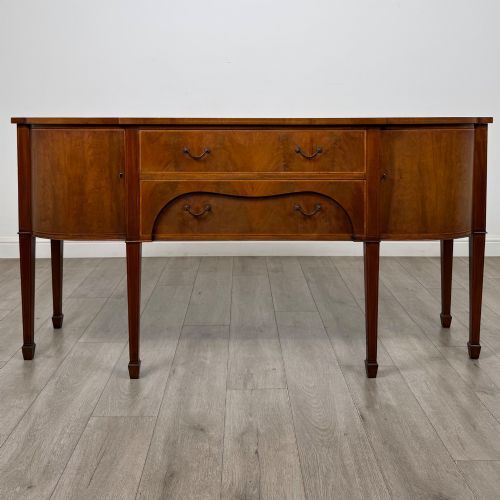
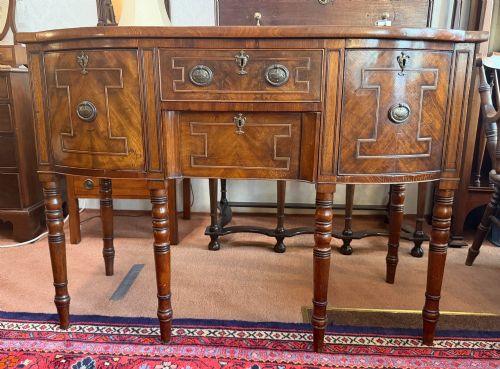
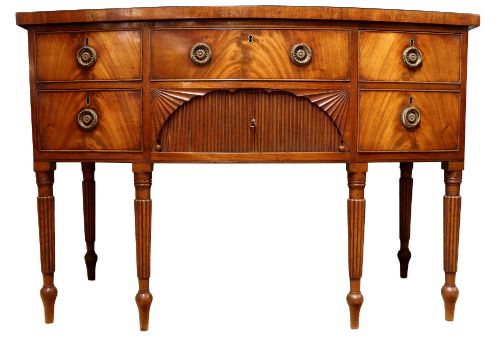
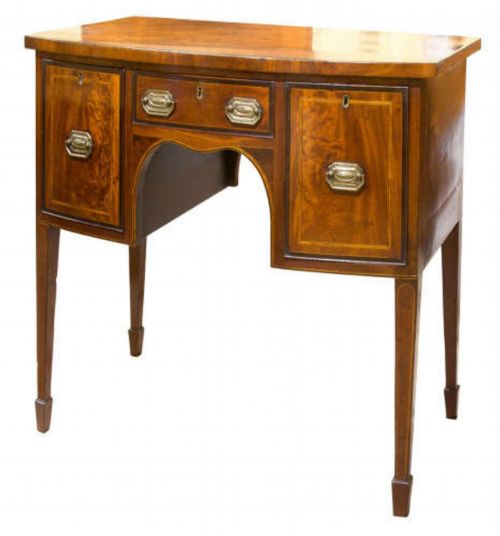
Cabinetmakers built the primary carcase and drawer fronts from solid mahogany or applied flame mahogany veneer over a secondary wood base, selecting boards to emphasise the natural grain pattern. They added contrasting detail by incorporating boxwood, satinwood, and purpleheart stringing or geometric inlays around the borders and drawer edges.
Structural hardware relied on brass drawer pulls and escutcheons, often cast in backplates typical of the period. Joinery techniques included hand-cut dovetails for drawer construction and pegged frame joints to support the weight of the curved front.
Listings feature periods spanning the eighteenth, nineteenth, and early twentieth centuries, constructed in mahogany, satinwood, and brass.
What varies in quality
The quality of a georgian mahogany bowfront sideboard rests in the selection of the timber veneers and the precision of the inlay work. Finer examples display symmetrical flame mahogany figuring across the drawer fronts, matched with crisp boxwood stringing that follows the exact curve of the bow.
Proportion and leg structure also determine the standard of the piece, with tapered spade legs or six-legged configurations offering better balance than heavier, unrefined bases. The crispness of the hand-cut dovetails and the weight of the original brass hardware separate workshop standards.
The Georgian Mahogany Bowfront Sideboard Glossary
- Bowfront
- A convex curved front that projects outward in an arc. This shape defines the primary profile of these sideboards.
- Flame mahogany
- A veneer cut from the fork of a mahogany tree where the branch joins the trunk. It creates a distinctive, flickering flame pattern.
- Stringing
- Thin inlaid lines of contrasting light wood, such as boxwood, used to edge drawer fronts and tabletops.
- Dovetail
- A traditional interlocking joint used to join drawer corners together securely without metal fasteners.
- Pedestal sideboard
- A form where end cabinets stand separate from or attached to a central serving table section, typical of the regency period.
Georgian Mahogany Bowfront Sideboard: Frequently Asked Questions
How do I spot an original eighteenth-century piece?
Examine the secondary woods inside the drawer construction and the hand-cut dovetails, which show irregular tool marks rather than uniform modern machine cuts. Look for the natural oxidation of the mahogany beneath the drawers and inside the carcase.
Check the timber veneers for hand-sawn thickness and verify that the backboards match the period construction methods of georgian workshops.
What is the difference between george iii and regency styles?
George iii pieces generally feature restrained classical proportions with straight tapered legs and subtle boxwood stringing. Regency designs introduce bolder architectural elements, heavier brass mounts, and occasionally pedestal ends.
Maker influences shifted from sheraton and hepplewhite restraint toward grander neoclassical interpretations during the early nineteenth century.
How do I fit a large sideboard into a modern dining room?
Measure the clearance space along the wall and account for the outward curve of the bowfront when planning chair placement. These cabinets work well against long, flat walls where their curved silhouette provides a visual contrast to square rooms.
Utilise the interior depth for storing table linen and flatware while keeping the top surface clear for serving dishes or display objects.
What maintenance does antique mahogany require?
Apply traditional beeswax polish periodically to nourish the dry wood and maintain the natural lustre of the mahogany surface. Avoid placing the cabinet near direct heat sources or strong sunlight to prevent veneer splitting and fading.
Clean brass hardware gently with a dry cloth, avoiding harsh metal cleaners that can damage the surrounding wood grain.