
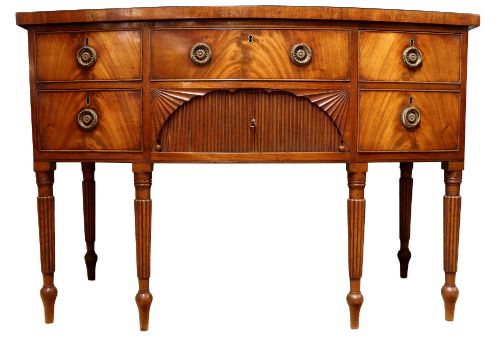
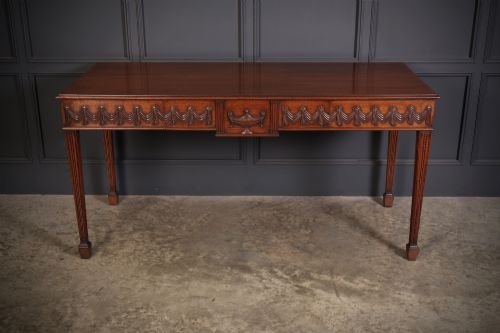
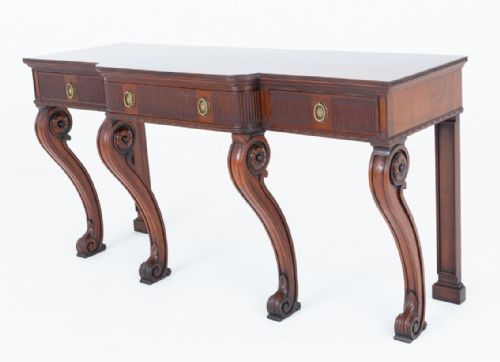


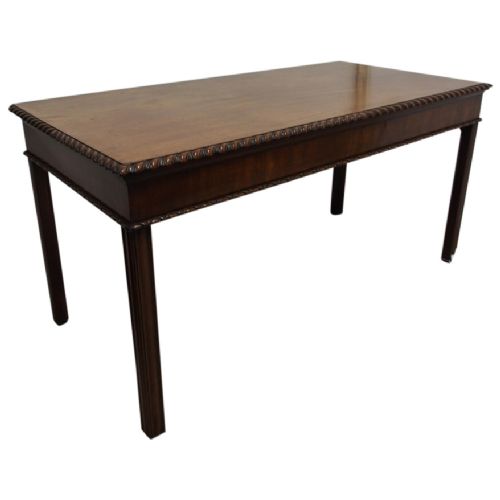

Georgian Fluted Leg Sideboard
A georgian fluted leg sideboard brings timeless proportion to a dining room, offering deep drawers and smooth timber surfaces for hosting.
Georgian Fluted Leg Sideboard
A georgian fluted leg sideboard brings together classic storage and serving utility from the eighteenth and nineteenth centuries. These pieces appear in forms such as bow fronted sideboards, serpentine serving tables, and compact servers.
Buyers will most frequently encounter mahogany structures, often enhanced with flame veneer or satinwood stringing, sitting upon slender legs. The forms range from grand Irish Regency serving tables down to sideboards of small proportions.
How they were made
Cabinet makers constructed these pieces using solid timbers and carefully selected veneers, relying heavily on mahogany as the primary structural wood. Brass fittings such as handles and rails added functional contrast to the dark timber.
Decorative detailing involved precision techniques including carving, inlay, and gesso work. Surfaces frequently displayed flame mahogany veneer or satinwood accents to create visual depth across the front and top boards.
Some sideboards were built with secret cellaret drawers designed to keep wine bottles cool and safe from thirsty staff.
What varies in quality
Quality rests in the crispness of the carving and the selection of the timber grain. Finer examples display lively flame mahogany veneer matched carefully across the drawers and doors.
Proportion and execution set the finer pieces apart from standard workshop output. Superior joinery ensures the drawers run smoothly and the legs maintain structural integrity over centuries of use.
The Georgian Fluted Leg Sideboard Glossary
- Bow front
- A convex curved cabinet front that projects outward in a smooth arc. This shape softens the room and maximises internal storage space.
- Serpentine
- A front edge shaped with a central convex curve flanked by two concave curves. It requires advanced cabinet making skill to execute cleanly.
- Flame mahogany veneer
- A sliced layer of timber taken from where a branch joins the trunk, showing a distinctive flickering grain pattern. Cabinet makers used it to create decorative panels on drawer fronts.
- Satinwood
- A pale, dense hardwood native to the tropics, prized for its golden sheen. It appears frequently in stringing and contrasting inlay work.
- Gesso
- A plaster based mixture applied to wood surfaces and carved or gilded. It provided a smooth base for painted and decorated details on eighteenth century tables.
Georgian Fluted Leg Sideboard: Frequently Asked Questions
Where should I place a sideboard?
These pieces fit naturally against the main dining room wall where they can serve food and hold tableware during meals. Their depth requires a room with sufficient floor space to allow drawers to open freely.
In smaller rooms, a server or a sideboard of small proportions works well without dominating the living space. They also function effectively in grand hallways as serving or display tables.
What is the difference between a sideboard and a serving table?
A sideboard traditionally incorporates enclosed cupboards and multiple drawers designed for storing linen, cutlery, and glassware. It provides comprehensive storage alongside its surface utility.
A serving table is typically an open frame structure with a flat top and one or more drawers beneath, built primarily for holding food and dishes during a meal. The evidence shows both forms frequently overlapping in style and proportion.
How can I tell a genuine period piece from a revival?
Examine the secondary woods inside the drawers and the construction methods used on the frame. Period pieces from the eighteenth or early nineteenth century show hand tool marks and timber shrinkage consistent with age.
Revival pieces, such as those built in the later nineteenth or early twentieth century, often utilise machine sawn timbers and more uniform internal construction. Both categories hold distinct merit depending on what you want for your interior.