
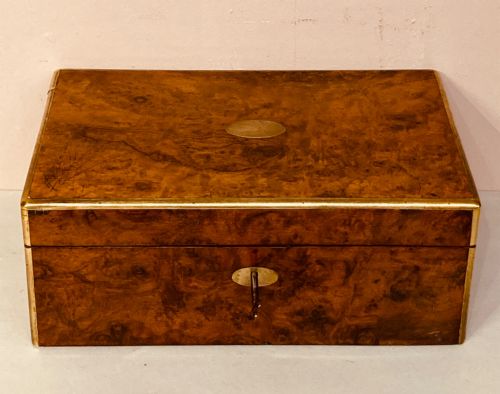


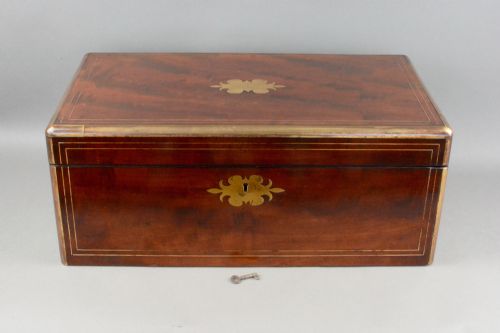


Georgian Brass Bound Slope
A georgian brass bound slope is a portable writing desk designed for travel, combining solid timbers with robust metal mounts for durability on the move.
Georgian Brass Bound Slope
A georgian brass bound slope brings together portable desk forms from the Georgian, Regency, and 19th Century periods, frequently constructed as folding boxes with hinged lids. These pieces were built for officers and travellers who needed a stable writing surface away from home.
Mahogany and rosewood dominate the surviving examples, often fitted with recessed brass corners and straps to protect the timber during transit. Walnut and burr walnut appear alongside these primary timbers, giving a varied palette of rich grain patterns.
The interior typically folds down to reveal a sloping writing surface lined with leather, accompanied by compartments for inkwells, pens, and paper. Secret drawers concealed behind false partitions or hidden release mechanisms are a common feature of the form.
Quality and craftsmanship
The weight and thickness of the brass mounts distinguish finer examples from standard production pieces, with high-quality boxes featuring flush-fitting hardware and hand-engraved details. The choice of timber also dictates quality, particularly where book-matched veneers or choice burr walnut figures are employed.
Internal refinement separates standard writing boxes from superior ones, visible in the complexity of secret drawers, the quality of the leather writing surface, and the presence of original fittings like slope batons and candle sconces.
Listings for these slopes record both mahogany and rosewood as primary materials, alongside walnut, burr walnut, and iron.
Austin
The Georgian Brass Bound Slope Glossary
- Slope baton
- A small wooden strip that slots into the lower edge of the writing surface to prevent paper from sliding off when the desk is angled. This component is often lost over time.
- Campaign style
- Furniture designed to dismantle or fold easily for military transport, characterised by recessed brass handles and reinforced corners. These pieces prioritise portability alongside domestic elegance.
- Bi-fold writing slope
- A box featuring a hinged lid and a folding writing surface that opens flat to reveal internal stationery compartments. It forms the standard layout for portable desks of the period.
- Secret drawers
- Concealed storage compartments hidden behind removable panels or activated by internal latches within the desk. They provided secure storage for valuables during travel.
Georgian Brass Bound Slope: Frequently Asked Questions
How were these slopes used?
Travellers and military officers placed these portable desks on dining tables or camp stands to write correspondence while away from home. The fitted interior kept ink, quills, and paper secure during transit.
When opened, the hinged lid laid flat to form a firm writing plane covered in leather. The compartments beneath stored letters, wax seals, and personal documents.
Are secret drawers common?
Many writing slopes include hidden drawers behind false compartment walls or accessible only by lifting internal partitions. Makers integrated these spaces to safeguard currency and confidential letters.
Finding these compartments often requires removing ink bottles or sliding specific wooden dividers. They represent a characteristic touch of period cabinetwork.
How do I care for the leather?
Leather writing surfaces benefit from minimal moisture and gentle cleaning to preserve the original material without lifting it from the timber base. Avoid modern chemical treatments that might darken or stain the hide.
Keeping the box in a stable environment with moderate humidity prevents the wood from shrinking and cracking the old leather insert. Gentle dusting is usually sufficient for ongoing maintenance.