
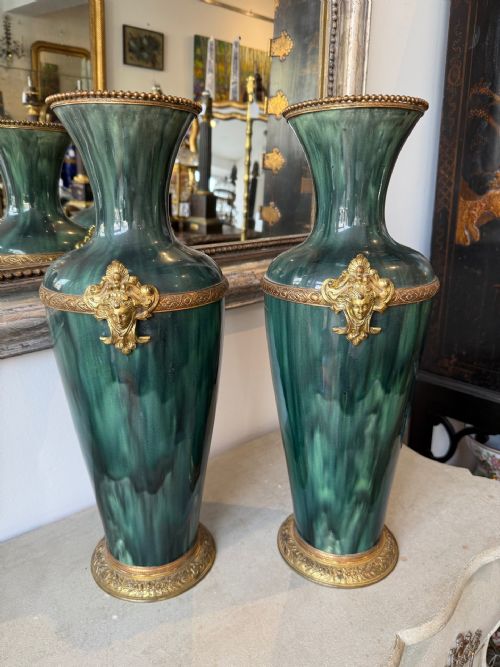


French Porcelain Mantel Vases
French porcelain mantel vases bring ornate nineteenth-century decorative craft to a room, frequently arriving as matched pairs or three-piece garniture sets.
French Porcelain Mantel Vases
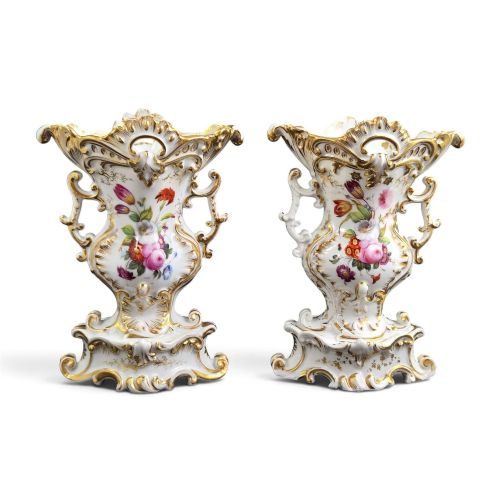
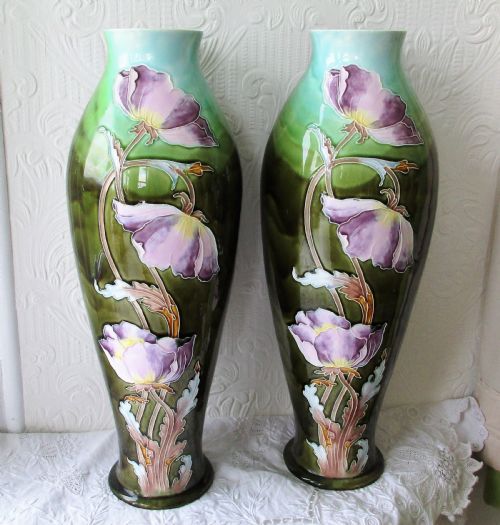
French porcelain mantel vases encompass decorative vessels, urns, and clock garniture sets designed for display on mantelpieces during the nineteenth century. These pieces emerge in styles ranging from Rococo Revival and Neoclassical to Empire and Art Nouveau.
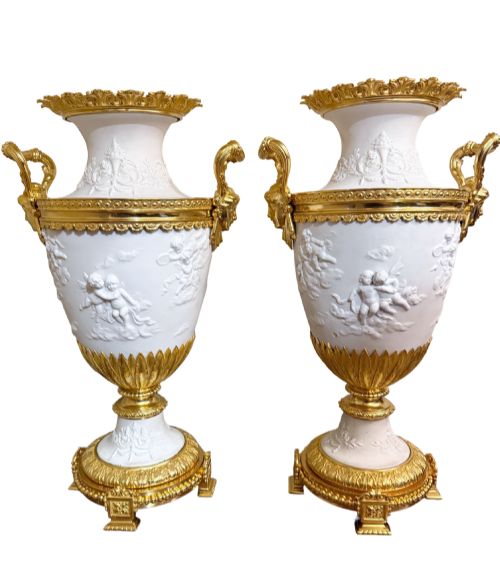
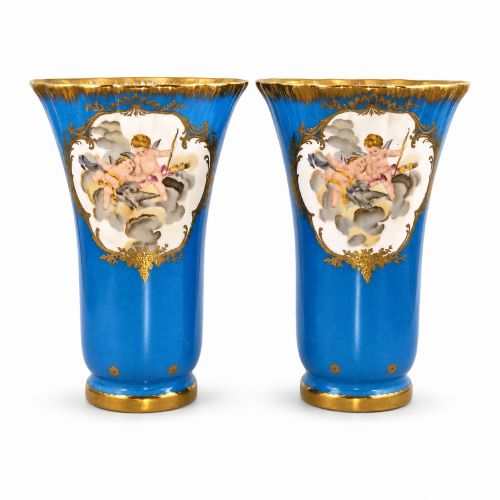
The version most commonly encountered on this page is the Sevres style porcelain vase, often paired with gilt bronze or ormolu mounts and hand-painted scenes. Makers such as Jacob Petit and Samson of Paris also appear frequently alongside unmarked Old Paris productions.
Forms span from classical Medici shapes and lidded urns to specialised forms like the Vase de Mariée. They bridge the gap between functional vessels and monumental interior ornaments.
How They Were Made
Potters shaped the bodies from fine ceramic paste, frequently applying glazes in bleu celeste, white, or mottled green before adding hand-painted floral motifs and raised white enamel. Kiln firing fixed these colours alongside intricate gilding.
Metalworkers combined ormolu, gilt bronze, and brass to frame the porcelain bodies with cast handles, rims, and bases. These mounts required precise fitting to complement the curves of the ceramic urns and vases.
Makers painted flowers so meticulously that even nineteenth-century dust settled with botanical accuracy.
What Varies in Quality
Quality rests in the precision of the hand-painted details and the crispness of the cast ormolu mounts. Finer examples display delicate brushwork in floral scenes and secure, well-chased bronze mountings that integrate cleanly with the porcelain.
Subtleties in ceramic body preparation and the richness of the gilding separate standard workshop pieces from monumental creations. The weight and definition of the metal fittings often signal the tier of the original manufacture.
Jacob Petit·Samson Paris·Vion And Baury
The French Porcelain Mantel Vases Glossary
- Garniture set
- A matched group of three or more ornamental vases or urns designed to sit together on a mantelpiece. These typically consist of a central lidded vase flanked by two smaller matching vessels.
- Ormolu
- Gilt bronze mounts cast and chased to frame or support porcelain bodies. This decorative metalwork characterises much nineteenth-century French output.
- Bleu Celeste
- A vivid turquoise blue glaze associated with high-end Sevres porcelain production. Makers in the nineteenth century frequently emulated this tone.
- Old Paris
- A blanket term for porcelain manufactured by various independent workshops and factories operating in Paris before and during the nineteenth century. These pieces often lack factory marks but display high technical skill.
- Medici vase
- A bell-shaped urn form with a footed base, derived from classical antiquity and revived during the nineteenth century in porcelain and metal.
French Porcelain Mantel Vases: Frequently Asked Questions
What is a clock garniture?
A clock garniture is a matching set composed of a mantel clock accompanied by two side vases or urns. They were designed to create a symmetrical display across a fireplace.
The pieces share decorative motifs, materials such as porcelain and ormolu, and stylistic periods to form a unified arrangement.
Where were Old Paris vases made?
Old Paris vases were produced by numerous independent workshops scattered throughout Paris during the nineteenth century. These factories operated outside the official royal monopoly.
Because multiple studios produced them, the pieces vary widely in design, ranging from plain white porcelain to heavily gilded and painted examples.
How do I care for antique porcelain?
Antique porcelain and gilt bronze mounts require gentle dusting with a soft, dry cloth. Avoid chemical cleaning agents that can damage fragile enamel or strip nineteenth-century gilding.
Keep the vases away from direct sunlight and dramatic temperature shifts to protect both the ceramic glaze and the metal fittings.