



French Brass Hearth Curb
A French brass hearth curb frames the fireplace with solid metalwork, protecting the room and grounding the hearth.
French Brass Hearth Curb
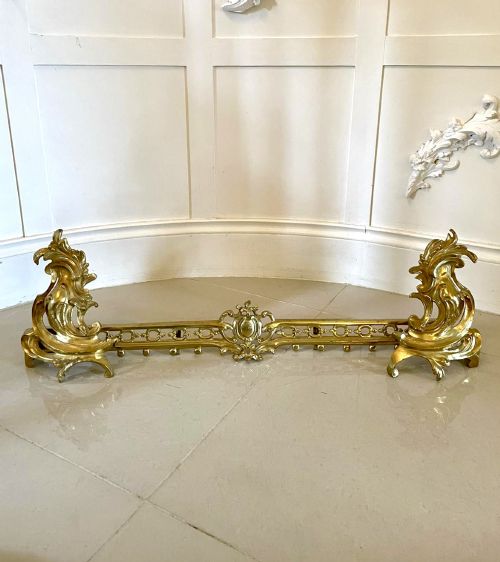
A French brass hearth curb takes the form of a fender or fender base that sits directly on the floor around the hearth. These pieces define the fireplace opening and keep embers safely contained within the hearth area.
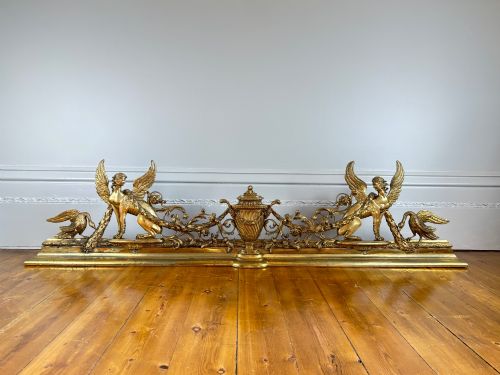
Victorian and nineteenth-century periods dominate the selection, often carrying French Rococo or Neoclassical Revival styling. Buyers encounter cast brass, gilt bronze, and ormolu combined occasionally with cast iron or polished steel.
Materials and construction methods
Makers shaped these curbs using heavy cast brass, gilt bronze, and dore bronze, sometimes pairing the bright metalwork with structural cast iron or polished steel. Surface enrichment involved fire gilding or ormolu application to achieve a rich metallic lustre.
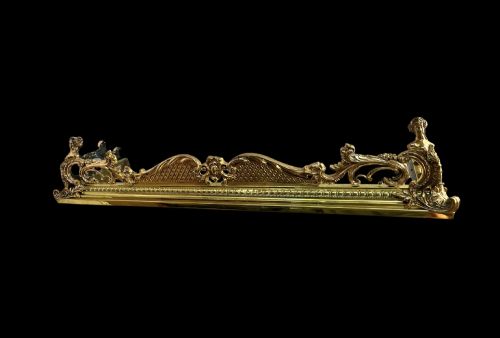
Many examples incorporate adjustable mechanics that allowed the metal frame to slide and extend to the required hearth dimensions. Decorative elements such as cherubs, scrolling foliage, and classical motifs were cast separately and fixed to the main fender body.
Listings feature items dated between 1850 and 1920, predominantly spanning the Victorian era and the late nineteenth century.
Assessing quality in hearth furnishings
Quality rests upon the weight and crispness of the metal casting, where deeper relief work and sharper chased details distinguish finer items. Heavy gauge brass and thick gilt bronze retain their structural integrity and surface finish far better over decades of use.
The sophistication of the stylistic revival work, whether Louis XV, Louis XVI, or French Empire, dictates the overall character. Finer pieces demonstrate careful hand-finishing on decorative mounts and smooth operation on adjustable extending frames.
E F Caldwell New York
The French Brass Hearth Curb Glossary
- Ormolu
- Gilded bronze produced by applying a mercury and gold amalgam to a bronze base. This technique creates a durable golden finish seen on finer French metalwork.
- Chenet
- An alternative term for an andiron used at the front of the hearth. These often accompany or match the stylistic vocabulary of the fender.
- Louis XV Style
- A decorative aesthetic characterised by asymmetrical scrollwork, C-scrolls, and naturalistic floral motifs. It forms the basis of many nineteenth-century Rococo revival fireplace accessories.
- Neoclassical Revival
- A style drawing on classical Greek and Roman architecture and ornamentation. Pieces show symmetrical arrangements, urns, and strict geometric proportions.
French Brass Hearth Curb: Frequently Asked Questions
What is a French brass hearth curb used for?
These metal guards sit around the base of the fireplace to stop burning embers from rolling onto the floorboards or carpet. They establish a clear boundary for the hearth while adding a decorative metallic accent to the fireplace.
Historically, they also served to protect long dresses and heavy fabrics from coming too close to the open flames during the nineteenth century.
How do adjustable fenders work?
Many nineteenth-century examples feature a multi-part sliding mechanism where the side sections telescope into the main front piece. This allows the guard to widen or contract to fit different hearth dimensions snugly.
Buyers should check that the sliding elements move smoothly without binding or scraping the metal surfaces.
How do I clean brass and bronze hearth furnishings?
Maintenance requires gentle dusting and occasional cleaning with a soft cloth to remove soot and surface grime. Avoid abrasive cleaners or harsh metal polishes that can strip away historic gilt layers or ormolu.
Preserving the original surface patina is generally preferred over achieving a bright, modern shine.
How can I tell the period of a fender?
Dating relies on examining the casting techniques, fastening screws, and stylistic details such as Rococo revival curves or Neoclassical symmetry. Nineteenth-century pieces often display heavier cast components and hand-finished joints compared to later reproductions.
The materials listed, including gilt bronze and cast iron, help anchor the item within the 1850 to 1920 timeframe seen in the records.