



Neoclassical Hearth Guard
A neoclassical hearth guard stands before an open fire, bringing architectural balance and metalwork to a fireplace.
Neoclassical Hearth Guard
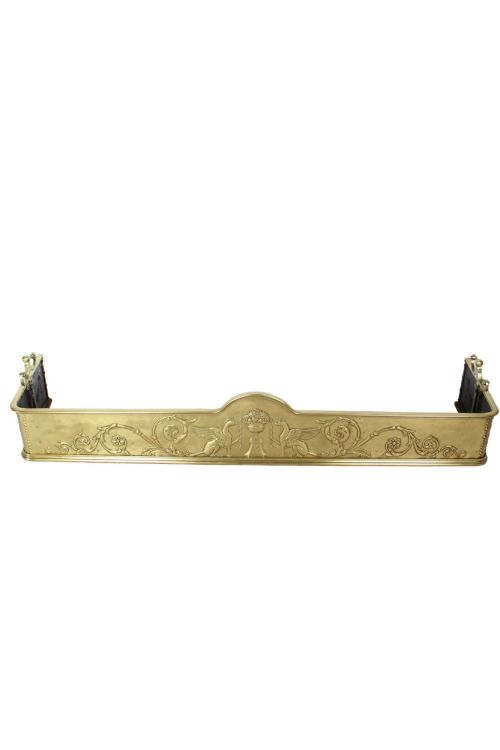
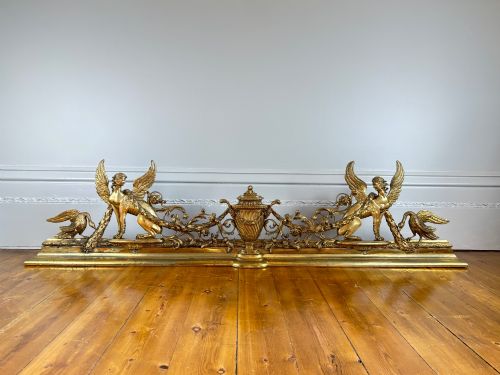
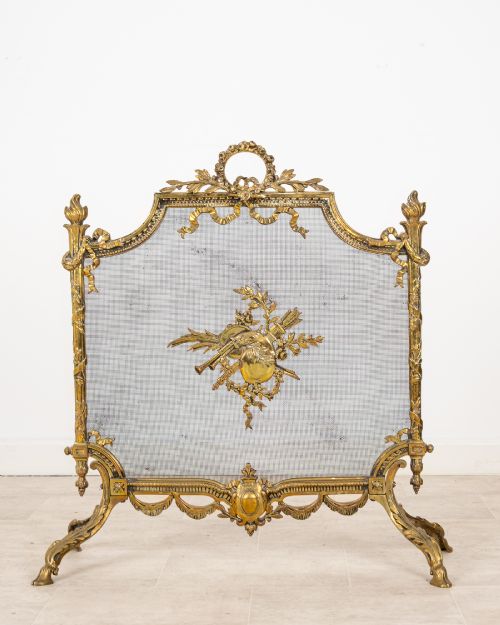
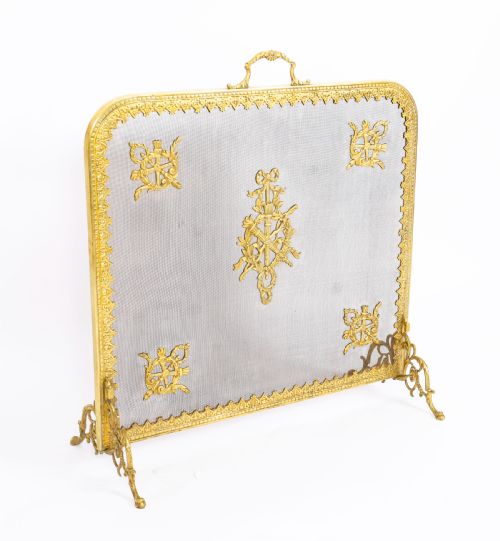
A neoclassical hearth guard provides a physical barrier and an ornamental centrepiece for a fireplace, taking the form of low fenders or standing fire screens. These pieces appear across several periods including Georgian, Victorian, Edwardian, and the broader nineteenth century. Forms range from linear steel and brass fenders to gilt bronze and ormolu fire screens bearing classical trophies.
The version most commonly met on this page is the brass or gilt bronze fender or screen, often finished with wire mesh or detailed crests. Makers and designers looked to Louis XVI styles, French Empire revivals, and Adam-inspired motifs for their architectural geometry and symmetry. Buyers encounter these accessories in various lengths and metals designed to fit nineteenth-century and early twentieth-century domestic hearths.
Materials and construction
Makers utilised metals such as brass, gilt bronze, ormolu, steel, and iron to construct the frames and protective mesh of each guard. Gilt brass and dore bronze surfaces received careful finishing to highlight the neoclassical motifs cast or applied to the metal.
Wire mesh and perforated metal panels were integrated into frames to contain sparks while maintaining visibility of the fire behind. Steel components provided structural rigidity for serpentine fenders, while bronze and brass added decorative weight to standing screens.
Neoclassical Hearth Guard Retail Price Guide 2026
Typical asking prices for neoclassical hearth guard among the pieces listed under this phrase on Sellingantiques today, from the lower quarter to the upper quarter. They describe what is for sale here now, not the wider market.
Listings feature periods spanning from Georgian and Victorian eras through Edwardian times, utilising materials such as gilt bronze, wire mesh, and polished brass.
Quality and execution
The distinction between standard production and finer work lies in the crispness of the cast bronze or brass ornament and the weight of the metal. Pieces executed after specific designers or in French Empire revival styles often display superior detailing in their classical trophies and borders.
Materials and surface finishes dictate the visual impact of the metalwork, with polished brass and mercury gilt or dore bronze retaining a richer depth than simpler plated alternatives. The structural integrity of the frame and the quality of the wire mesh contribute to the longevity of the guard.
E F Caldwell New York
The Neoclassical Hearth Guard Glossary
- Fender
- A low metal guard placed on the hearth in front of an open fireplace to contain rolling embers and sparks. Fenders define the perimeter of the hearth.
- Fire screen
- A movable panel designed to shield a room from the radiant heat of an unlit or dying fire. These screens often feature decorative metal frames and mesh.
- Ormolu
- Gilt bronze ornament applied to furniture and metalwork, created through a mercury gilding process popular in French-influenced design. The technique produces a warm, durable golden finish.
- Serpentine
- A curved line or shape featuring a convex centre flanked by concave ends, frequently seen in Georgian and later hearth fenders. This contour adds movement to rigid metal forms.
- Trophy
- A decorative grouping of arms, musical instruments, or agricultural implements carved or cast in relief as a classical motif. Trophies appear frequently on French Empire revival screens.
Neoclassical Hearth Guard: Frequently Asked Questions
What is a neoclassical hearth guard?
A neoclassical hearth guard is a protective metal accessory placed around a fireplace opening, combining functional safety with classical design elements. These pieces include low floor fenders and upright screens made from brass, bronze, and steel.
They reflect historical revivals from the Georgian, Victorian, and Edwardian eras, incorporating symmetrical ornamentation, urns, and architectural borders inspired by antiquity.
How were these fire guards used?
These guards served to protect rooms from stray sparks, falling embers, and excessive radiant heat from coal or wood fires. Fenders bounded the hearth area while upright screens blocked heat when the fire burned low.
Beyond safety, they acted as prominent decorative furnishings in the principal rooms of nineteenth-century and early twentieth-century homes.
How do I identify a Victorian piece?
Victorian examples often employ heavy cast brass or gilt brass with robust construction, sometimes measuring several feet in length to fit larger coal grates. They frequently combine traditional neoclassical motifs with the heavier proportions favoured during the reign.
Makers of this period utilised polished brass, iron, and wire mesh to balance ornamentation with utility.
What is the difference between a fender and a screen?
A fender is a low, horizontal barrier that sits directly on the floor around the hearth perimeter to keep logs and embers inside the fireplace. It remains in place permanently during use.
A screen is a vertical panel on feet or a stand that can be positioned in front of the opening as needed to block heat or conceal an empty grate.