


Four Glass Table Clock
A four glass table clock stands as a refined architectural timepiece, offering all-round visibility of the delicate movement within.
Four Glass Table Clock
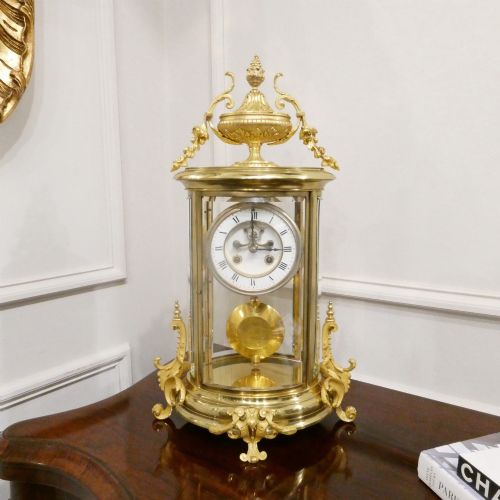
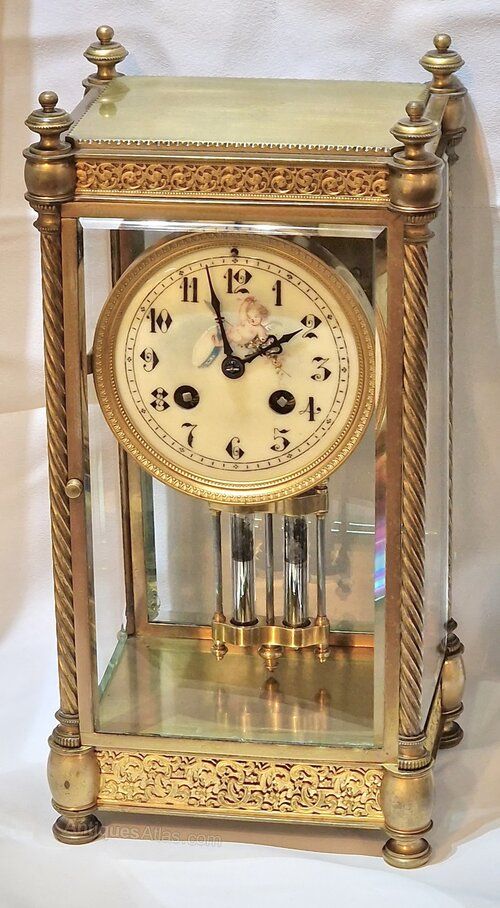
A four glass table clock is a mantel timepiece enclosed by glazed panels on four sides, allowing the internal pendulum and escapement to be seen from multiple angles. These pieces predominantly originate from the nineteenth century, with French workshops producing the vast majority of surviving examples.
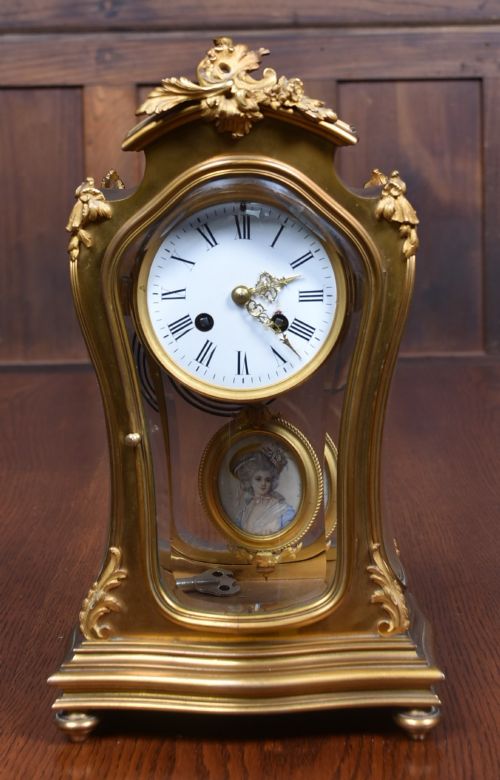
Buyers will frequently encounter mantel clock formats featuring gilt brass, ormolu, or bronze frames, often built to house striking movements or simpler timepieces. Variations include oval cases, bow-fronted designs, and occasional garniture sets complete with side ornaments.
Originating largely from the Victorian era and the Belle Epoque period, these clocks serve as formal interior furnishings designed for prominent display on mantelpieces, desks, or brackets.
What Varies in Quality
The refinement of the cast bronze or gilt brass framework establishes the primary distinction in quality, with crisper chasing and heavier metalwork marking superior examples. Movement complexity also dictates the tier, ranging from standard timepieces to longer-duration movements and striking mechanisms by recognised makers.
Glass thickness and the precision of the bevelling contribute significantly to the visual weight and integrity of the piece, alongside the artistry found on the enamel dial and the presence of signed components.
Materials documented across the pieces include gilt brass, rouge marble, green onyx, golden oak, and bevelled glass.
Samuel Marti·TIFFANY·AD MOUGIN·L Epee France·John Massey·JAPY FRERES·Fabrique of Paris
The Four Glass Table Clock Glossary
- Crystal regulator
- A term commonly applied to French four glass clocks featuring an exposed mercury or mercurial-style pendulum and transparent panels. These pieces became popular during the late nineteenth century.
- Garniture
- A set comprising a central clock flanked by matching decorative objects such as urns or candelabra. Such suites were designed to sit harmoniously on a mantelpiece.
- Ormolu
- Gilt bronze produced by applying a gold amalgam to a bronze base and heating the metal to evaporate the mercury. This technique imparts a rich, lasting golden surface to the clock frame.
- Escapement
- The mechanical linkage that controls the release of power in a clock movement while maintaining the swing of the pendulum. Its visible operation is a defining feature of these timepieces.
- Fusee
- A conical pulley used in certain clocks to maintain equal force on the gear train as the mainspring unwinds. This mechanism improves timekeeping accuracy across the duration of the wind.
Four Glass Table Clock: Frequently Asked Questions
How do I wind a four glass clock?
Most of these timepieces require a matching winding key inserted into arbors on the enamel dial to tension the internal springs. Care must be taken not to overwind the movement.
Striking models may possess separate arbors for the timekeeping train and the striking train, each requiring attention according to the duration of the movement.
Where should I place a four glass table clock?
These clocks require a stable, level surface such as a mantelpiece, sideboard, or sturdy bracket to ensure the pendulum swings evenly. Avoiding direct sunlight helps preserve the enamel dials and gilt finishes.
Because the movement is visible from all sides, placing the piece where light can pass through the glass panels enhances the visual display.
How do I tell an 1880 clock from a 1900 clock?
Stylistic shifts offer the clearest indicators, moving from ornate Neoclassical and Rococo Revival gilt bronze casts in the 1880s towards simpler crystal regulator forms by 1900. Maker marks and registration numbers stamped on the back plates also assist in dating.
Enamel dial designs and the shape of the brass bezels evolved subtly across these decades, reflecting broader changes in decorative arts.
What is the difference between a timepiece and a clock?
In horological terms, a timepiece is a clock that simply tells the time without a striking mechanism or musical function. This format often results in a simpler internal movement.
A clock typically includes additional mechanisms to strike the hours and half-hours on a bell or gong.