


Floral Cloisonne Urn
A floral cloisonne urn brings complex metalwork and bright enamel into a room, offering striking pattern and tangible weight.
Floral Cloisonne Urn
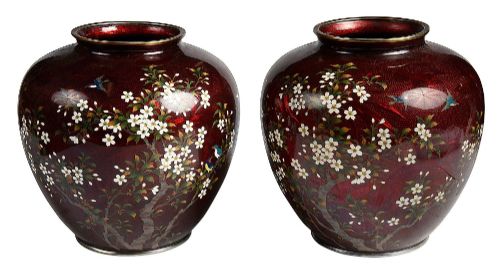
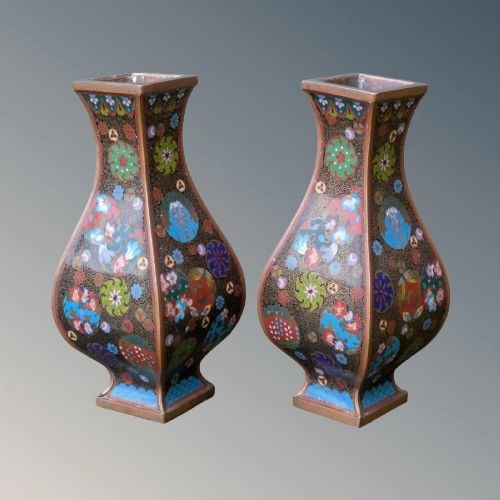
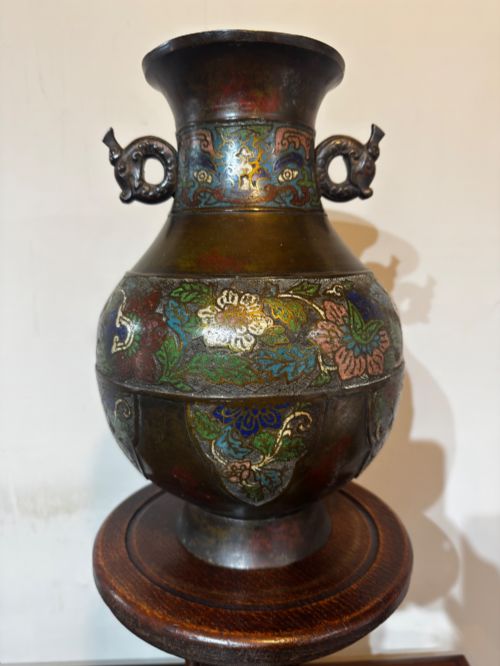
A floral cloisonne urn combines cast metal foundations with vitreous enamel decoration to form vessels, ginger jars, and jardinieres. When searching for a floral cloisonne urn, collectors encounter pieces originating primarily from Japanese Meiji workshops and Chinese Qing dynasties, spanning the nineteenth and early twentieth centuries.
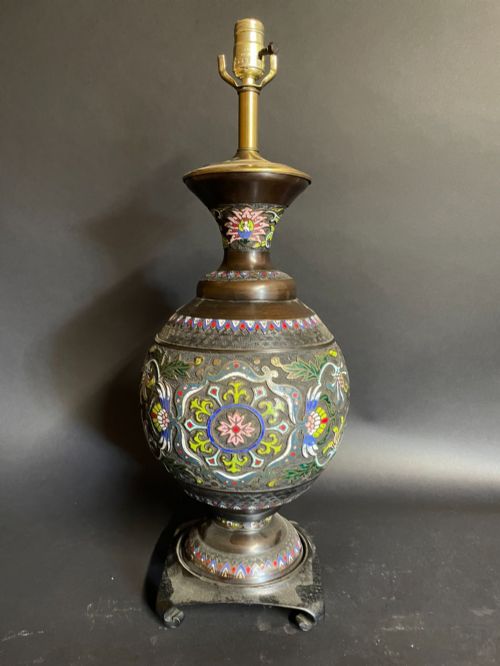
The physical forms vary from miniature pairs and lidded jars to large jardinieres and table lamps converted from original vases. The nineteenth-century examples dominate the selection, often presenting intricate botanical motifs across copper and bronze bodies.
Materials and technique
Craftsmen construct these pieces by soldering thin metal wires, usually copper or brass, onto a metal base to form raised compartments that outline the floral designs. These bounded cells are subsequently filled with coloured enamel pastes before the entire vessel undergoes firing and polishing.
Gilt bronze, silver foil, and hardwood stands appear as supplementary elements supporting the main enamelled bodies. The metal foundations provide the structural weight, while the enamel surface delivers the characteristic polished finish.
Materials recorded across the listings comprise copper, brass, bronze, hardwood, and silver foil.
Distinctions in execution
Quality rests upon the precision of the wirework and the density of the enamel fill within each cell. Finer examples display immaculate wire alignments that delineate petals and leaves without distortion or bubbling in the fired glass.
The weight of the base metal and the crispness of the finishing polish separate standard production from exceptional studio output. Older pieces often reveal subtle hand-worked irregularities that distinguish them from later, more uniform items.
The Floral Cloisonne Urn Glossary
- Cloisonne enamel
- A technique where metal wires are applied to a metal body to create cells that hold coloured enamel pastes.
- Champleve
- A method where troughs are gouged directly into a thick metal surface to receive enamel rather than building soldered wire walls.
- Jardiniere
- A large ornamental pot or bowl designed to hold plants or flowers, often displayed on a dedicated stand.
- Meiji period
- The era of Japanese history spanning from eighteen sixty-eight to nineteen twelve, known for exceptional metalwork and enamel production.
- Qing Dynasty
- The final imperial dynasty of China, lasting from sixteen forty-four to nineteen twelve, associated with rich decorative arts.
Floral Cloisonne Urn: Frequently Asked Questions
How are these urns displayed?
These vessels suit prominent placement on side tables, mantelpieces, or stands where light catches the polished enamel surface.
Larger jardinieres function effectively on low furniture or dedicated wooden bases to anchor a room's decor.
What metals lie beneath the enamel?
Makers typically used copper, brass, or bronze as the structural foundation for the enamelled body.
These metals provide the rigidity required to support the fired glass cells and lend the pieces their characteristic heft.
How do I identify Meiji period pieces?
Japanese work from this era often exhibits exceptionally fine wirework depicting naturalistic flora against dark enamel grounds.
Craftsmen focused heavily on botanical accuracy and symmetrical balance during this period of production.
Are these items waterproof?
Most of these vessels function primarily as decorative objects rather than practical containers for holding water.
Using them with a hidden liner prevents moisture from reaching the ancient interior metal and enamel.
Can I convert a vase to a lamp?
Makers sometimes adapted antique vases into table lamps during the twentieth century to suit modern domestic lighting needs.
Such pieces combine traditional metalwork with contemporary electrical fittings while retaining their original decorative body.