
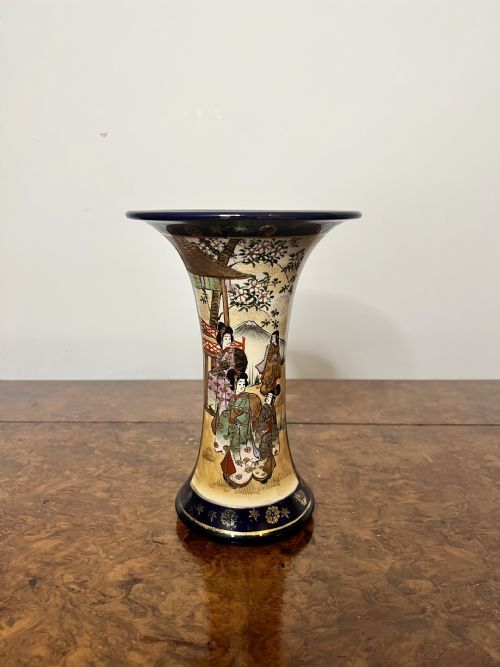


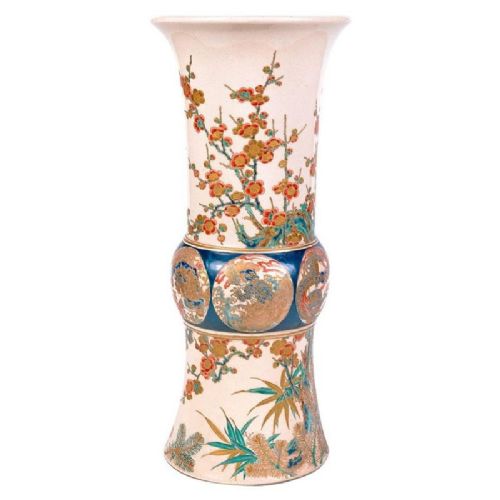


Flared Ceramic Vase
A flared ceramic vase opens at the rim to display its interior and commands attention on a table through its silhouette.
Flared Ceramic Vase
A flared ceramic vase is a vessel designed with an outwardly expanding neck or rim, appearing across multiple periods including the nineteenth century and the early twentieth century. When you search for this phrase, you encounter forms that range from Japanese Imari and Kutani wares to English Secessionist pottery and French faience.
The pieces on this page include porcelain and earthenware vessels, often decorated with hand-painted details, cobalt glaze, or lacquer over black paint. These objects serve as decorative centerpieces or display pieces, reflecting the distinct aesthetic movements of their respective origins.
How they were made
Makers shaped these vessels from porcelain, earthenware, and faience, applying techniques such as hand painting and crystalline glaze. Potters threw or moulded the clay before subjecting it to kiln firing to set the body.
Surface ornamentation involved cobalt glaze, enamel, gold leaf, and lacquer layered over paint. Workshops in Europe and Asia utilised distinct firing methods and pigment mixtures to achieve their characteristic finishes.
Japanese Satsuma and Kutani forms appear alongside European Art Nouveau and Secessionist styles.
What varies in quality
The refinement of the painted decoration and the control shown in the glaze determine the standing of an individual piece. Artisans who executed precise brushwork and even crystalline or cobalt glazes produced work that remains distinct from simpler commercial output.
The harmony between the flared neck and the body proportions also marks the distinction between standard vessels and finer examples. Superior specimens display balance in their silhouette and crisp execution in their decorative motifs.
Ruskin Pottery·J R Mally & Co·Christopher Dresser·Rozenburg
The Flared Ceramic Vase Glossary
- Flared neck
- A rim that gradually widens outward from the upper body of the vessel. This shape directs the eye upward and allows for wider arrangements.
- Crystalline glaze
- A ceramic finish that encourages the growth of crystal formations during the cooling process in the kiln. This produces unique star-like patterns across the surface.
- Imari
- A style of Japanese porcelain decorated in underglaze blue and iron red, often supplemented with gold and other enamel colours. It originated in the town of Arita.
- Faience
- Tin-glazed earthenware produced in Europe, particularly associated with French traditions. It provides an opaque white surface suitable for painted decoration.
- Secessionist
- An early twentieth-century style characterised by stylized floral motifs and geometric forms. It reflects the broader rejection of traditional historicism in design.
Flared Ceramic Vase: Frequently Asked Questions
How do I clean a ceramic vase?
Dust the surface gently with a soft, dry cloth to remove daily particles without disturbing delicate enamel or lacquer.
Avoid submerging pieces with lacquer or gold leaf in water, as moisture can damage historical surface treatments.
Can these vases hold water?
Many older ceramic vessels are porous or feature repairs that make them unsuited for holding fresh water directly.
Utilise a small glass insert inside the vessel if you wish to display fresh stems safely.
What defines a flared neck?
A flared neck widens progressively from the narrowest point of the throat toward the upper rim.
This contour distinguishes these vessels from straight-sided cylinders or constricted bottle shapes.