
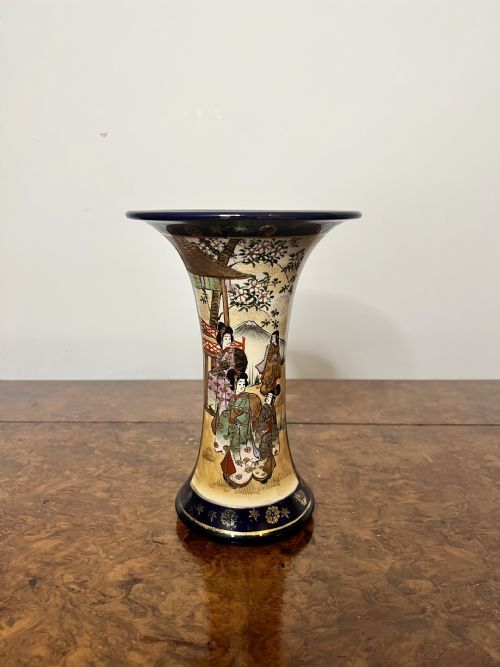


Japanese Geisha Vase
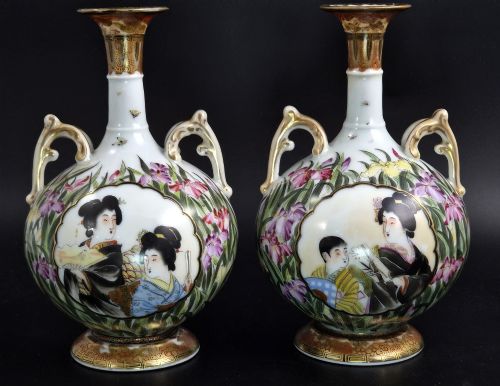
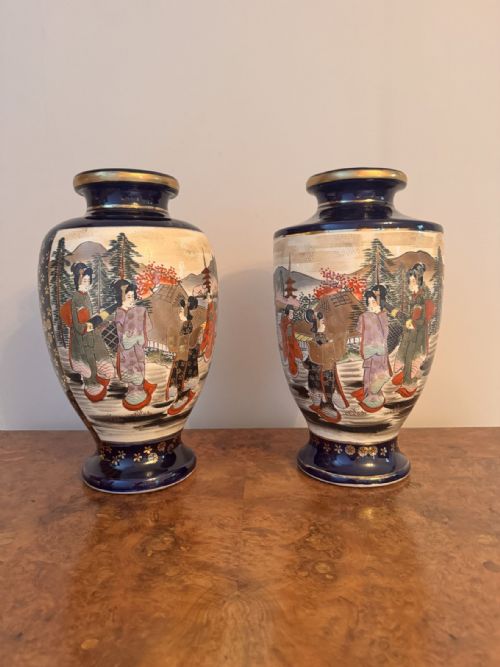
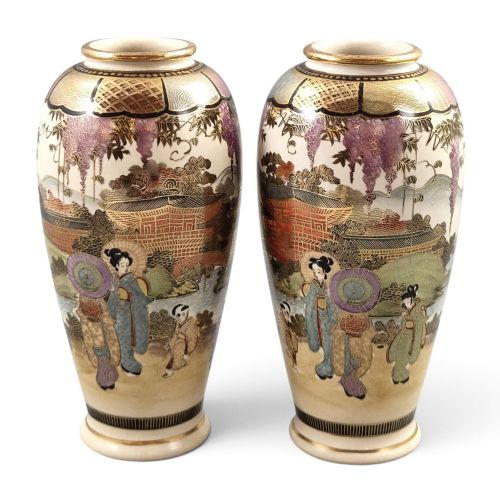
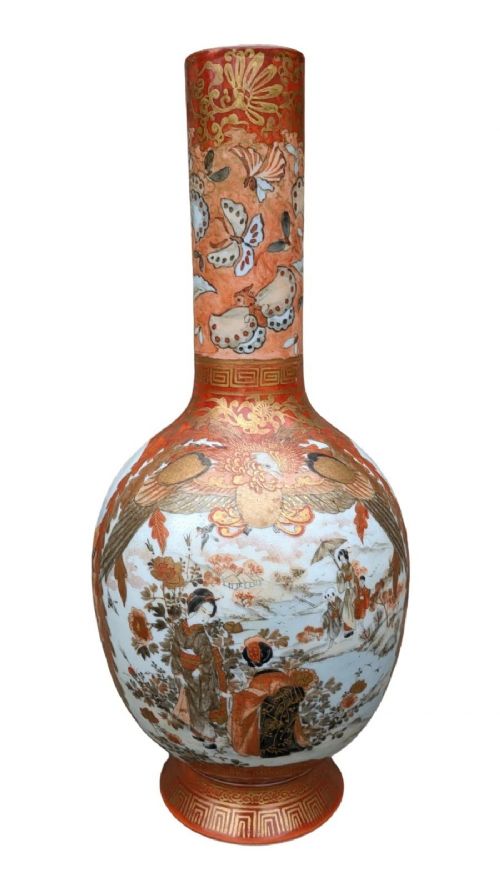
These Japanese geisha vase pieces offer hand-finished enamelled porcelain and earthenware decorated with court figures, bringing Meiji era artistry directly to your cabinet.
Japanese Geisha Vase
When you search for a japanese geisha vase, you are looking at decorative vessels featuring women, children, and court figures. The pieces on this page span the Victorian and Edwardian eras, reaching back into the nineteenth century.
You will most frequently meet Satsuma earthenware and Kutani or Imari porcelain pieces here. These export items range from bottle shapes to shaped vases finished with intricate hand-painted details.
The decorative schemes often showcase cobalt grounds, gilt accents, and raised moriage work. Each item reflects the distinct aesthetic of Japanese export production intended for Western collectors.
Materials and manufacture
Potters shaped these vessels from earthenware and porcelain before applying detailed enamel decoration. Artisans then integrated gold leaf and raised moriage techniques to build up rich textures on the surface.
The finishing process relied on careful hand-painting to render court figures, women, and children with precise colouring. Kiln firing fixed the enamel pigments and gilding securely to the ceramic body.
The listings here encompass pieces in both earthenware and porcelain, featuring Meiji period styles alongside Victorian and Edwardian dates.
Markers of quality
Quality rests in the precision of the hand-finishing and the complexity of the figural scenes. Finer examples display meticulous brushwork in the faces and garments of the figures rather than repetitive stencilling.
The application of gold leaf and the crispness of the raised moriage distinguish superior pieces from standard production. Rich cobalt grounds and balanced composition across bottle-shaped or shaped bodies also elevate a piece.
Shozan Satsuma·Nanzan mark·Kinkozan Kyoto Satsuma
The Japanese Geisha Vase Glossary
- Moriage
- A type of raised slip decoration applied to ceramics to create textured patterns and dimensional details. This technique stands proud of the glaze, adding a tactile element to robes and floral motifs.
- Satsuma
- A style of Japanese earthenware featuring a pale, ivory-coloured cracked glaze decorated with enamel and gold. It remains one of the most recognisable wares found in export collections.
- Kutani
- Japanese porcelain known for vibrant enamel palettes, particularly iron red and gold. These ceramics originated in Ishikawa prefecture and frequently depict traditional scenes.
- Imari
- A traditional style of Japanese porcelain characterised by underglaze blue, iron red, and gold ornamentation. The palette creates a striking contrast across the surface of plates and vases.
- Meiji Period
- The era in Japanese history spanning from 1868 to 1912, marked by extensive international trade and artistic exchange. Pieces from this time often cater specifically to Western aesthetic tastes.
Japanese Geisha Vase: Frequently Asked Questions
How do I identify Satsuma ware?
Satsuma pieces are characterised by a distinctive ivory-coloured earthenware body covered in a fine, network-like crackle glaze. Artisans painted these surfaces using rich enamels and heavy gilding.
Many examples feature figures such as court ladies and children rendered with careful attention to costume. Maker marks on the base often help pinpoint specific workshops.
What is moriage decoration?
Moriage is a decorative technique where clay slip is piped onto the ceramic body before glazing and firing to create raised, three-dimensional patterns. It adds distinct texture to robes, foliage, and architectural elements.
On finer pieces, this raised work receives additional highlighting in gold leaf. The resulting surface offers a rich contrast to smooth cobalt grounds.
How should I display these vases?
These decorative vessels suit placement on sturdy mantelpieces, sideboards, or within enclosed cabinets where their fine details remain visible. Avoid positioning them in direct sunlight to protect the enamel and gold leaf from fading over time.
Pairing matching vases on either side of a central object preserves the symmetry intended by their original manufacture.