

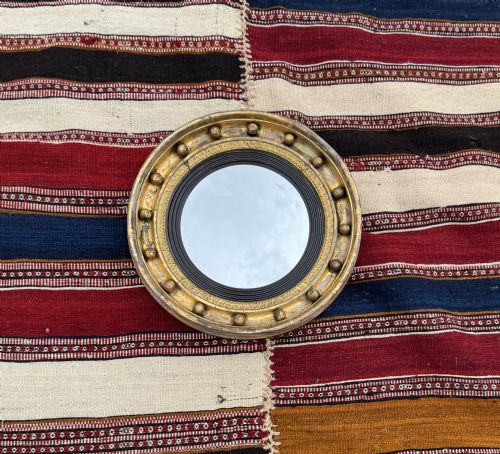
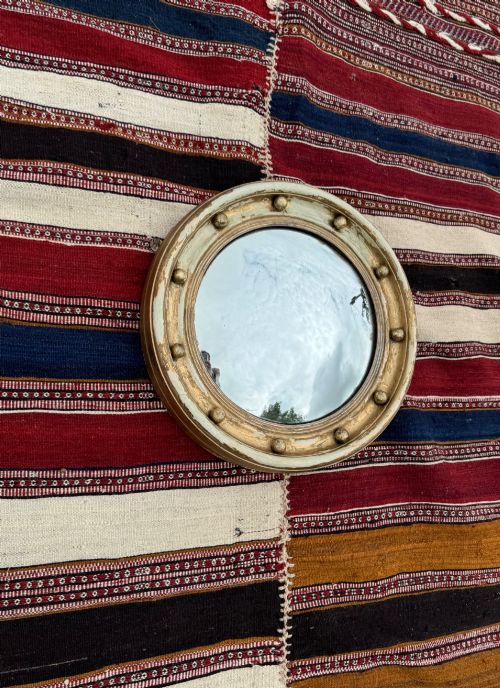


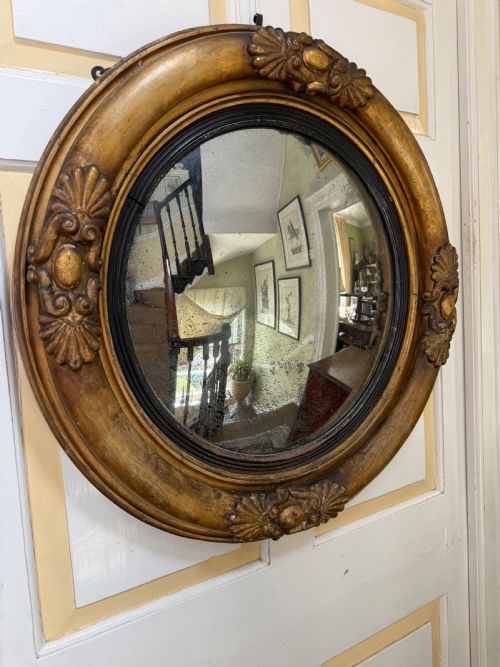


Fish Eye Mirror
A fish eye mirror distorts the room in a spherical globe of glass, offering a compact view of a space through its bulging circular frame.
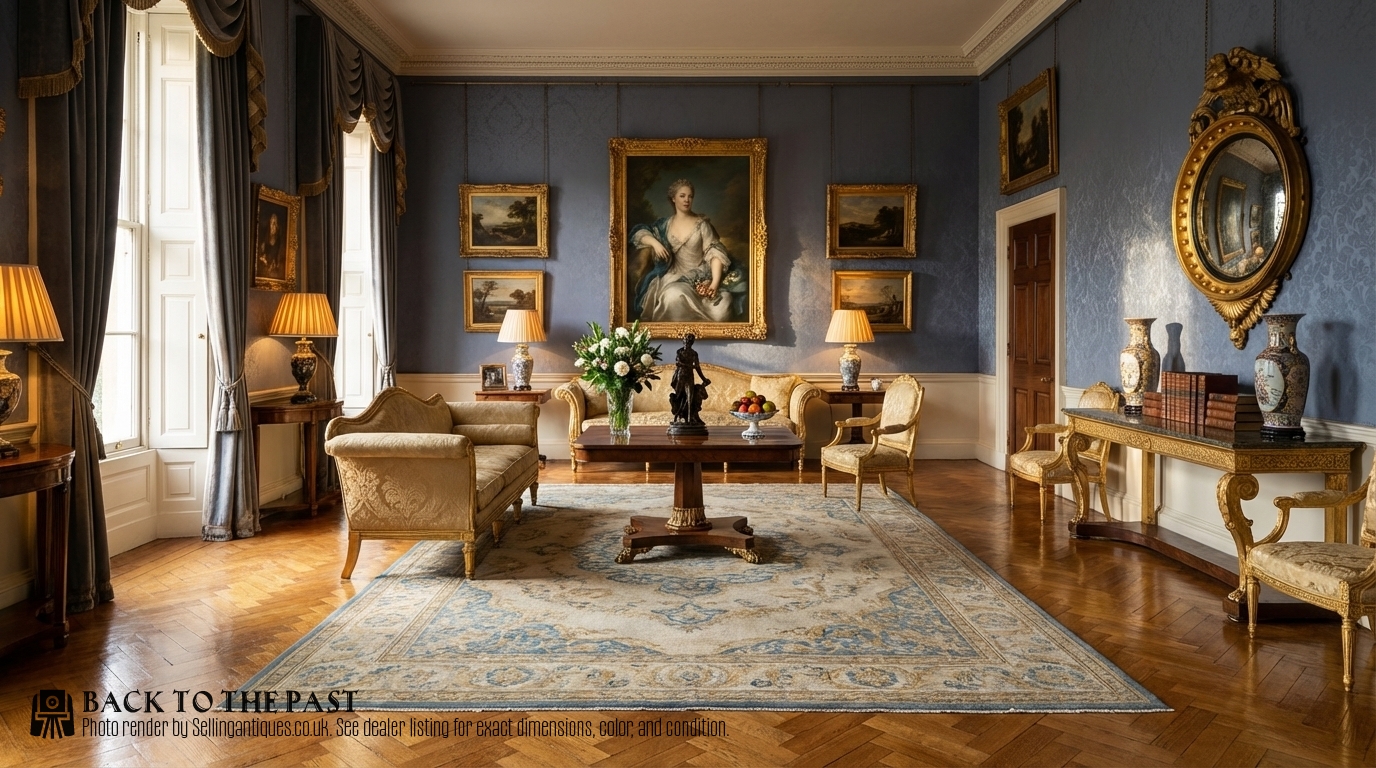
Fish Eye Mirror
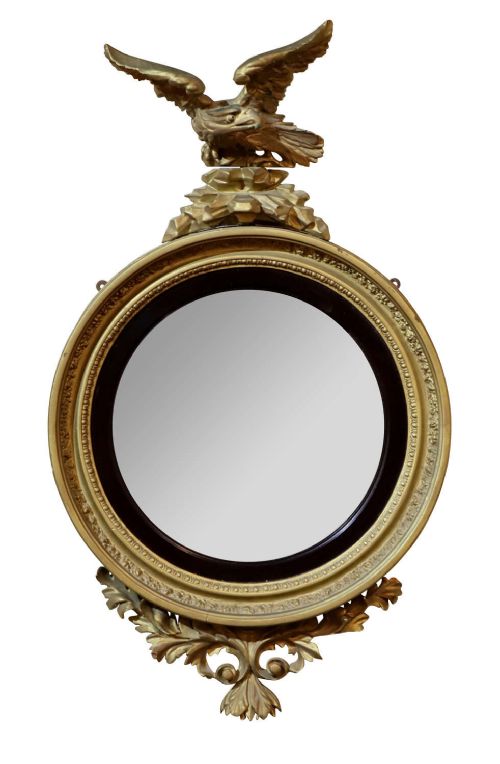
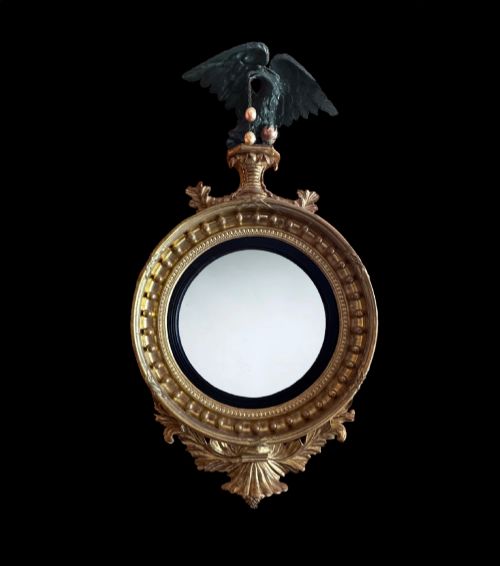
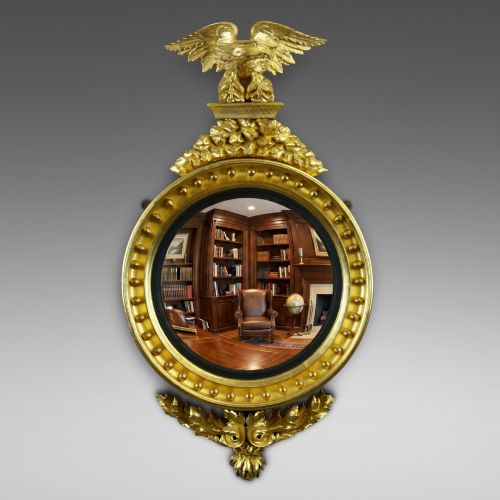
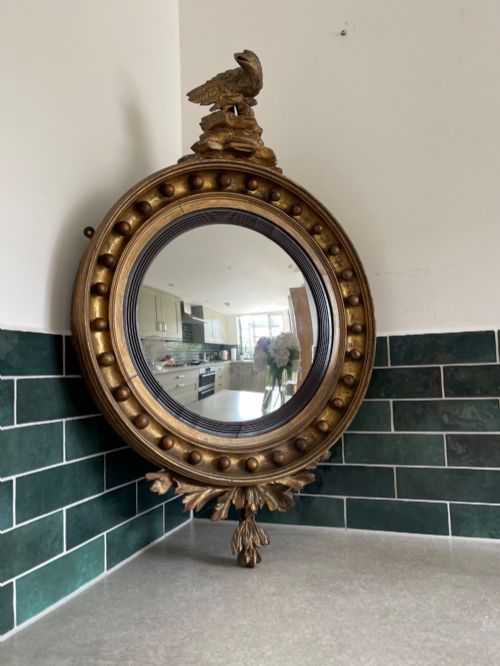
When you search for fish eye mirror, you encounter circular wall mirrors featuring a convex plate glass that projects outwards. These optical pieces capture a wide, curved reflection of an interior, often known historically as convex or butler's mirrors.
The versions most frequently met on this page belong to the Regency period and the 19th century, alongside later revivals. They appear most commonly as wall mirrors framed in giltwood or gesso, occasionally bearing crests like eagles.
How they were made
Makers fashioned the characteristic bulging glass by blowing spheres or slumping glass plates into curved forms before silvering the reverse. This technique created the distinct wide-angle reflection that defines the type.
Frames rely on carved wood, gesso, and ebonised wood, finished with gold leaf or giltwood. Carvers shaped intricate details such as rope-twist borders, balls set into frames, and carved crests to adorn the circular wooden carcasses.
Fish Eye Mirror Retail Price Guide 2026
Typical asking prices for fish eye mirror among the pieces listed under this phrase on Sellingantiques today, from the lower quarter to the upper quarter. They describe what is for sale here now, not the wider market.
Butler's mirrors let staff watch diners from afar, meaning generations of Regency guests unknowingly dined under the fish eye gaze.
What varies in quality
The clarity and depth of the convex mirror glass set the standard for a piece, alongside the preservation of the original silvering. Distortions in the glass vary from crisp panoramic reflections to heavy waviness.
Frame construction and carving depth distinguish finer examples. Crisp gilding over gesso and well-defined carved details like eagle mounts or reeded ebonised slips separate the superior objects from simpler wall mirrors.
The Fish Eye Mirror Glossary
- Convex mirror
- A round mirror with an outward-curving glass plate that produces a circular, wide-angle reflection of a room. This optic form is the defining characteristic of the search phrase.
- Giltwood
- Wood coated with a thin layer of gold leaf or gilt paint. It is the predominant material for framing these round wall mirrors across the Georgian and Regency periods.
- Gesso
- A plaster-like mixture applied to wooden frame bases and carved into detailed ornaments. It provides the smooth white ground necessary for subsequent gilding.
- Ebonised wood
- Timber treated with a chemical stain or finish to imitate ebony. It frequently appears as a dark inner reed moulding within the circular gilded frame.
- Girandole
- A wall mirror equipped with attached candle sconces. The candle arms reflect additional light from the curved glass plate into the room.
Fish Eye Mirror: Frequently Asked Questions
What is a fish eye mirror used for?
Historically, these optical mirrors allowed servants to monitor activity across a large dining room or butler's pantry from a single vantage point. Today, they function primarily as striking decorative wall pieces that expand the visual sense of an interior.
Their curved surface captures an entire room in miniature, offering an unusual perspective that flat plate glass cannot achieve.
How do I date a convex mirror?
Dating relies heavily on the construction of the circular frame, the composition of the gesso, and the characteristics of the mirror plate. Regency and Georgian examples often feature heavier carved wood frames, specific moulding profiles, and old backboards.
Later Victorian and 20th-century revivals generally display machine-sawn timbers, crisper modern backing materials, and different formulations of gold leaf or paint finishes.
Are these mirrors original Regency?
Many examples date from the early 19th century and the Regency period, while others originate from later Victorian revivals and the 20th century. Examining the construction behind the frame reveals the age of the timber and assembly methods.
Period pieces often exhibit shrinkage cracks in the gesso and hand-cut fixings that distinguish them from later reproduction wall mirrors.
Why do some mirrors have eagles on top?
The eagle crest is a traditional decorative motif found on grander Regency convex mirrors. Symbolising power and alertness, the bird was carved from wood or cast in composition and perched atop the circular frame.
These mounted birds often hold chains or balls in their beaks, adding significant vertical height to the overall silhouette of the wall mirror.
How should I hang a heavy gilt mirror?
Due to the substantial weight of the timber carcass and convex glass, these mirrors require secure wall fixings into structural studs or masonry. Using appropriate heavyweight picture wire attached to strong mirror rings is essential for safety.
Professional installation ensures the frame is properly supported without straining the historical wood joints or the hanging loops.