


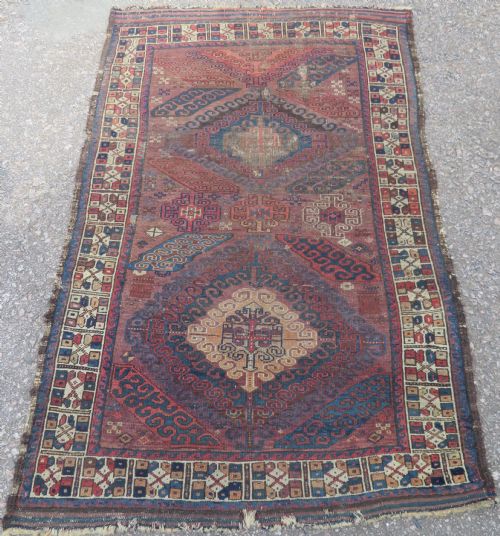


Faded Persian Carpet
A faded Persian carpet brings worn elegance to a room, offering muted tones and traditional motifs shaped by decades of use.
Faded Persian Carpet
A faded Persian carpet represents hand-knotted textile work originating from workshops and tribal regions across Persia, spanning the late nineteenth century and the early twentieth century. These floor coverings arrive in various formats, including large carpets, smaller area rugs, and long runner rugs suited to corridors.
The aesthetic centres on a softened palette where time has subdued the original dyes, creating gentle transitions across traditional field designs and central medallions. Buyers searching for a faded Persian carpet typically encounter regional styles such as Kirman, Sarouk, Tabriz, Ushak, Khamseh, Qashqai, and Kashan.
Examples from this selection date across distinct periods from the nineteenth century up to the nineteen-twenties, showcasing established weaving traditions. Each piece displays the characteristic wear of an antique textile that has lived through generations of domestic use.
Materials and construction
These textiles employ traditional hand-knotting techniques executed primarily using wool for the pile and cotton for the foundation warps and wefts. The combination of resilient wool fibres and sturdy cotton foundations allows large carpets and smaller rugs to retain structural integrity despite extensive age.
Weavers utilised natural dyestuffs applied to hand-spun wool before tying individual knots onto the loom, establishing the intricate patterns seen in traditional Persian, Ottoman, and tribal designs. The resulting fabric develops a distinct distressed character as the wool pile gradually thins and softens over decades.
Current listings feature wool and cotton carpets dated across the nineteenth century, 1900, 1910, and 1920.
Distinctions in quality
Quality rests upon the density of the knotting and the precision of the design execution within regional styles such as Tabriz, Kirman, or Sarouk. Finer knots permit more intricate floral or medallion motifs to remain legible even as the pile wears down.
The harmony of the colour softening influences the visual appeal, distinguishing uniform fading from uneven wear that obscures the underlying structure. The integrity of the cotton foundation and the security of the edges dictate how well the textile holds its form.
The Faded Persian Carpet Glossary
- Pile
- The upright wool loops or tufts that form the usable surface of the carpet. This layer shows the primary wear and pattern.
- Warp
- The vertical cotton threads stretched tightly on the loom that carry the structural weight. The knots are tied directly around these parallel threads.
- Weft
- The horizontal threads passed across the warps between rows of knots to bind the structure together. It keeps the woven fabric secure.
- Medallion
- A large central ornamental design motif placed in the middle of the carpet field. It frequently anchors the surrounding floral or geometric patterns.
Faded Persian Carpet: Frequently Asked Questions
How do I care for a faded Persian carpet?
Vacuum gently without using a rotating brush bar to protect the delicate wool pile and aged cotton foundations from undue strain.
Keep the textile out of direct, harsh sunlight to prevent uneven fading and professional cleaning is recommended when dust accumulates deep within the knots.
Where should I place a runner rug?
Runner rugs suit narrow spaces such as hallways, corridors, and galley kitchens where length takes precedence over width.
Ensure a suitable underlay is placed beneath the carpet to prevent slipping and to cushion the historic fibres against hard flooring.
How can I tell regional carpet styles apart?
Regional styles reveal themselves through distinct design vocabularies, such as the curved floral motifs typical of Kirman and Tabriz versus the geometric tribal patterns found in Qashqai and Khamseh work.
Palettes and medallion structures also vary by origin, reflecting the specific weaving traditions of workshops and nomadic groups across Persia and Ushak.
What causes the distressed look?
Natural ageing, foot traffic, and cumulative washing over decades cause the wool pile to wear down and the saturated colours to soften into muted tones.
This gradual loss of pigment and pile gives antique carpets their characteristic faded appearance and supple handle.