




Enamelled Glass Pitcher
An enamelled glass pitcher brings rich colour and painted detail to the table, combining clear, cranberry, emerald, or Bristol blue glass with hand-applied enamel work.
Enamelled Glass Pitcher
An enamelled glass pitcher encompasses a range of serving vessels from the Georgian period through to Art Deco designs of 1930. The selections found on this page span Victorian green, cranberry, and blue glass jugs, alongside geometric cocktail shakers and decanters from Czechoslovakia.
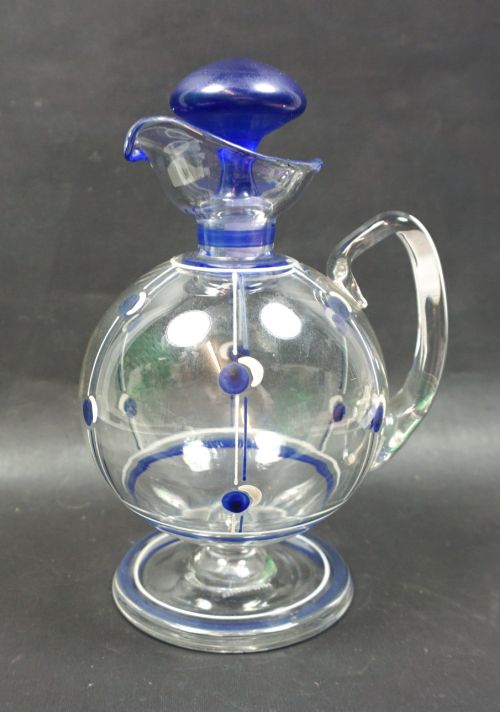
The form shifts from the small Bristol blue cream jugs of 1800 to larger ewers and water jugs from the late nineteenth century. Art Deco examples introduce stylised motifs such as cockerels and roosters rendered in vibrant blue enamel on crystal glass.
Many items serve dual purposes across categories listed as decanters, ewers, and pitchers, reflecting the varied terminology used over the centuries. Buyers encounter both utilitarian table vessels and decorative cabinet pieces created across diverse European workshops.
How they were made
The foundation of each piece is formed from blown or moulded glass, utilising clear crystal alongside coloured varieties such as cranberry and emerald glass. Artisans shaped molten material into pitchers and ewers before applying surface decoration.
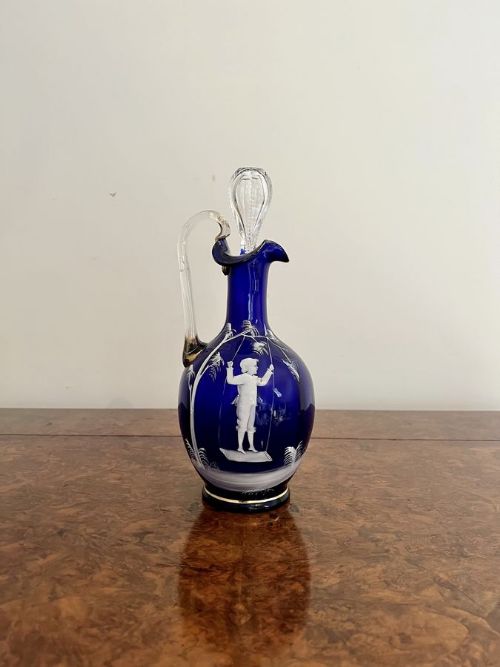
Enamel paint is hand-applied to the exterior, frequently paired with gold leaf detailing or opaque white enamel silhouettes in the style associated with Mary Gregory. Subsequent firing fixes the pigment to the glass body, ensuring durability of the coloured motifs.
Listings feature items spanning the Georgian era, the Victorian period, and Art Deco designs up to 1930.
What varies in quality
The distinction between standard production and superior craftsmanship lies in the precision and depth of the hand-painted enamel. Pieces featuring intricate winter landscapes or well-defined figural scenes display a higher degree of artistic control than simpler geometric bands.
The weight and clarity of the underlying glass, whether clear crystal or saturated Bristol blue, also influence the overall character of the vessel. Original stoppers and intact gilding add significantly to the integrity of surviving jugs and decanters.
Daum
The Enamelled Glass Pitcher Glossary
- Bristol blue
- A deep cobalt blue glass traditionally produced in the English city during the Georgian era. It provides a striking contrast for hand-painted white enamel decoration.
- Cranberry glass
- A rich red glass coloured with gold chloride during the manufacturing process. It became exceptionally popular during the Victorian period for tableware.
- Ewer
- A large jug with a wide spout and flared base, often used as a decorative water pitcher. Many Victorian examples feature applied handles and elaborate enamelling.
- Mary Gregory
- A style of glass decoration characterised by white enamel silhouettes of children in natural settings. The term is widely applied to Victorian green and blue glass pieces.
- Cockerel
- A rooster motif frequently utilised in Art Deco designs. These stylised bird patterns appear on cocktail shakers and jugs from 1930.
Enamelled Glass Pitcher: Frequently Asked Questions
Are these pitchers safe for serving drinks?
Most antique pieces function well for serving cold water, wine, or cocktails at the table. Check the interior for any residue or historical repairs before use.
Acidic beverages should not be left in older vessels for extended periods. Treat them with care to protect the hand-painted enamel from unnecessary wear.
How can I tell Victorian glass from Art Deco pieces?
Victorian jugs typically feature organic motifs, rich cranberry or green glass, and opaque white enamel painting. The shapes tend to be ornate with applied handles and gilded accents.
Art Deco items from 1930 favour clean lines, clear crystal bodies, and stylised geometric or animal decoration in bright blue enamel. The forms include cocktail shakers and matching drinks sets.
What is the difference between a pitcher and a ewer?
A pitcher generally refers to a practical pouring vessel with a handle and a simple spout used for water or milk. They appear across Georgian and Victorian domestic settings.
A ewer is typically more decorative, possessing a distinct theatrical shape with an elongated spout and curved handle. Ewers often served as part of larger toilet sets or decorative displays.