
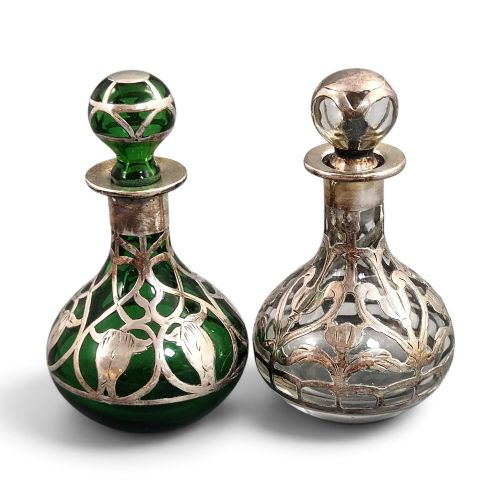


Green Glass Decanter
Richly hued green glass decanters bring deep jewel tones and striking historical character to a table, combining practical service with decorative presence.

Green Glass Decanter
A green glass decanter serves as a container for wine, spirits and liqueurs, appearing frequently across Victorian, Georgian and twentieth-century periods. The selection on this page ranges from tall serving bottles and ships decanters to claret jugs and perfume bottles.
Buyers will encounter deep Bristol green vessels from the nineteenth century alongside later Art Nouveau and Art Deco designs. These pieces often incorporate metal mounts, stoppers and associated glasses for complete barware service.

Materials and construction methods
Many examples rely on hand-blown glass combined with applied metal elements such as sterling silver mounts, silver plate, pewter and brass. Overlay techniques create dual-layer surfaces that makers cut back to reveal the contrasting green body underneath.
Decoration often involves enamel painting, delicate engraving, or applied metalwork in the Art Nouveau and Arts and Crafts styles. Metal components frequently bear hallmarks or maker signatures detailing their origin.
Green Glass Decanter Retail Price Guide 2026
Typical asking prices for green glass decanter among the pieces listed under this phrase on Sellingantiques today, from the lower quarter to the upper quarter. They describe what is for sale here now, not the wider market.
Listings feature green glass items spanning the eighteenth, nineteenth and twentieth centuries, utilising silver overlay, enamel and pewter mounts.
Distinctions in quality and execution
Quality rests upon the clarity and depth of the glass, the precision of hand-cut facets, and the integrity of any metal mounts. Superior pieces display crisp engraving and well-fitted original stoppers that match the body.
The integration of precious metals, such as silver overlay or hallmarked collars, elevates the status of a vessel. Maker attribution, particularly pieces associated with prominent design houses or workshops, distinguishes standard serving bottles from exceptional collector examples.
Gorham·Archibald Knox for Liberty Co·Karl Palda·Moser·Salviati·WMF·Henry Wilkinson Co
The Green Glass Decanter Glossary
- Mell decanter
- A mallet-shaped bottle with a wide base and tapered neck, popular during the Georgian period for secure storage on ships and sideboards.
- Overlay glass
- A technique where a layer of coloured glass is fused over a clear or contrasting body, then carved or cut to expose the underlayer.
- Ships decanter
- A low, wide-based vessel designed with a heavy, spreading foot to prevent tipping during movement at sea.
- Pontil mark
- A rough scar left on the base of hand-blown glassware where the pontil rod was detached after forming.
- Mary Gregory glass
- Victorian glassware decorated with silhouette figures, usually painted in white enamel depicting children in garden settings.
Green Glass Decanter: Frequently Asked Questions
How do I date a green glass decanter?
Dating relies on bottle shape, pontil marks and accompanying metal mounts. Georgian examples often feature mallet profiles, while Victorian pieces frequently incorporate heavy cut patterns and silver collars.
Maker marks, hallmarks on silver mounts and distinct stylistic movements like Art Nouveau or Art Deco further narrow the production window.
Were these decanters meant for daily use?
Historical examples served primarily to decant wine and spirits from bulk containers to the dining table. Their robust glass construction allowed for regular service during formal meals and gatherings.
Today, many collectors continue to utilise them for serving port, claret and liqueurs, provided the interior is cleaned with care.
What is Bristol green glass?
Bristol green refers to a deep, characteristic dark green hue traditionally produced in English glassworks during the eighteenth and nineteenth centuries. It gained popularity for serving and storing wine.
The intense colour protected contents from light exposure while offering an appealing aesthetic on the dining table.
Why do some decanters have wide bases?
Wide bases, particularly seen on ships decanters, provided essential stability during transit on maritime voyages. The low centre of gravity prevented the vessels from rolling over on unstable surfaces.
Domestic serving bottles also adopted this stable profile for safe placement on busy dining tables.