
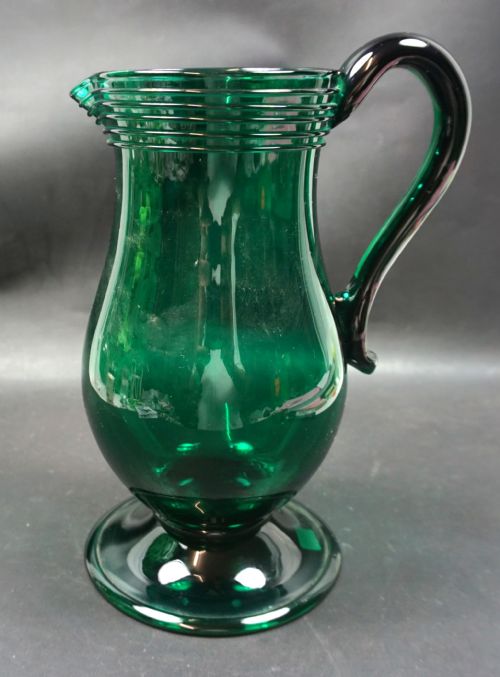


Green Glass Jug
A green glass jug brings a crisp, luminous colour to a table, combining utility with rich Victorian and Art Nouveau craftsmanship.
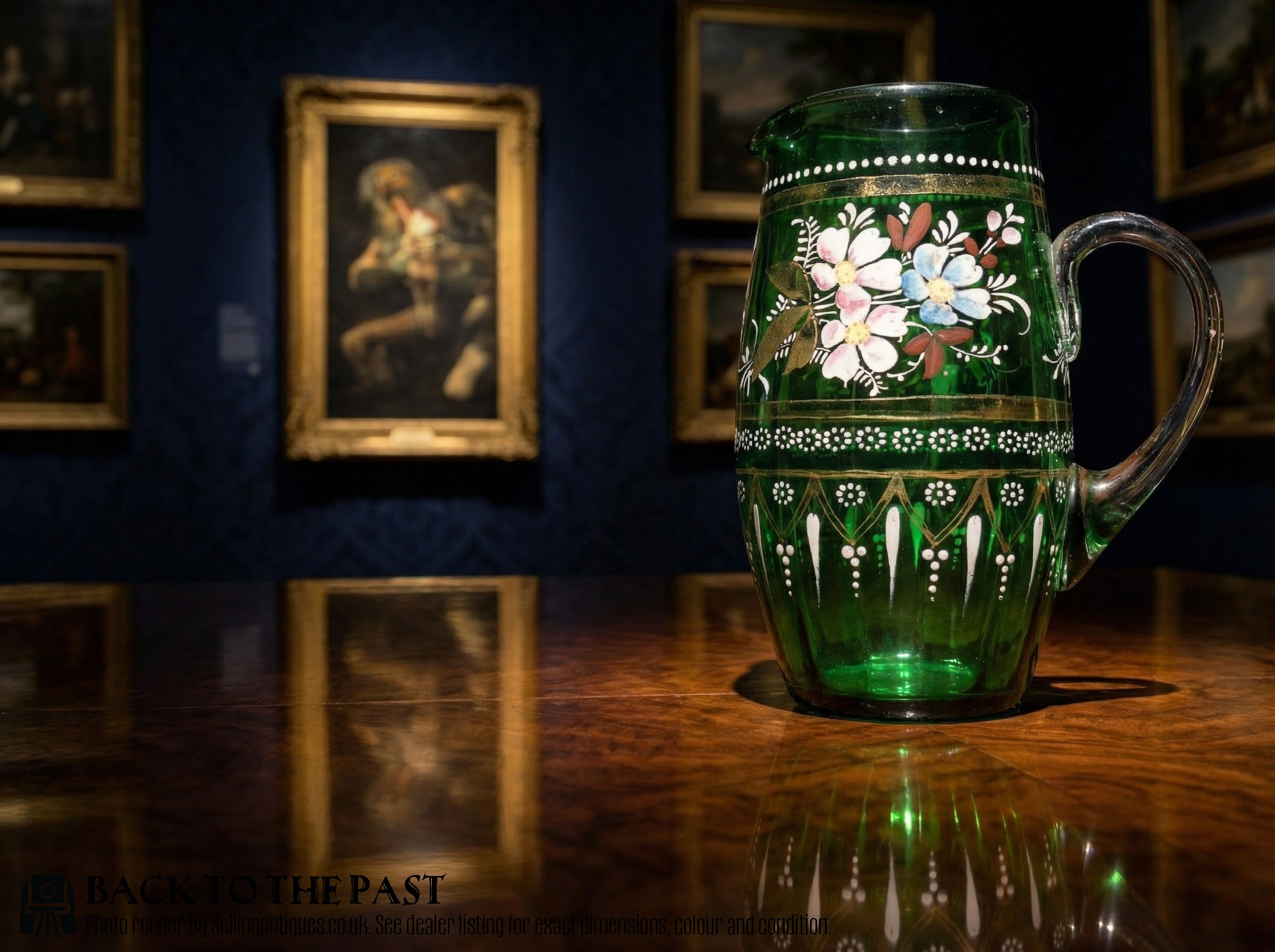
Green Glass Jug
A green glass jug spans utilitarian vessels and decorative tableware, appearing predominantly in Victorian, Arts and Crafts, and Art Nouveau forms. You will frequently encounter nineteenth century wine decanters, claret jugs with metal mounts, and hand-blown pitchers originating from English, Bohemian, and Austrian workshops.
The selection ranges from simple Bristol green storage bottles to elaborate vessels featuring enamel painted floral scenes, gilt details, and figural pewter mountings. These objects served variously at the dining table for wine and water, or stood as decorative ewers.
Mid-century examples also appear, offering cleaner lines and simpler silhouettes that contrast with the heavily ornamented Victorian and Edwardian pieces. Buyers find both standalone pitchers and matched pairs designed for formal service.
How they were made
Makers relied on free-blowing and mould-blowing techniques to shape the molten metal, frequently adding folded feet, trail rims, and applied handles while the glass remained hot. Overlay glass involved fusing a layer of green glass over clear glass before cutting away portions to reveal the contrasting base underneath.
Metalwork played a structural and decorative role, with pewter, silver plate, and sterling silver mounts cage-fitting the bodies or forming spouts and handles. Many surfaces received supplementary decoration through enamel painting, gilding, and intricate acid etching.
Specialised workshops utilised pewter alloys for collars and stoppers, employing designers associated with Liberty Co, WMF, and Orivit to shape the distinctive organic contours typical of the turn of the twentieth century.
Listings feature pieces spanning the Victorian era through the Art Nouveau period, alongside mid-century examples in glass, pewter, and enamel.
What varies in quality
The standard of metal mountings heavily influences the status of a piece, distinguishing mass-produced items from sculptural work produced by recognised metalsmiths. Finely cast pewter, crisp chasing on silver plating, and securely fitted collars demonstrate superior workshop standards.
Painted and gilded ornamentation varies from simple factory application to delicate, hand-rendered enamel scenes of flowers and butterflies that remain crisp and well-preserved.
Archibald Knox·Liberty Co·WMF·Whitefriars·Baccarat·AVEM·Orivit
The Green Glass Jug Glossary
- Claret jug
- A vessel specifically designed for serving red wine at the dining table, usually fitted with a hinged metal lid and handle. These often combine glass bodies with silver-plated or pewter mounts.
- Ewer
- A large jug with a wide spout and looped handle, traditionally used for holding water for washing or serving drinks. In decorative terms, the form leans toward classical or ornamental revival styles.
- Overlay glass
- A technique where a gather of coloured glass is encased in a second layer of a different colour before shaping. The outer layer is then cut away or engraved to create contrasting patterns.
- Pewter
- A malleable metal alloy used widely for mounts, handles, and frames in Arts and Crafts and Art Nouveau designs. It provides a soft metallic lustre that complements green glass.
- Enamel
- Opaque or translucent glass paste applied to the surface of a vessel and fired to fuse permanently. It allows for colourful painted decoration that resists fading over time.
Green Glass Jug: Frequently Asked Questions
What is a claret jug?
A claret jug is a specialised pouring vessel created to serve red wine, featuring a hinged metal lid and a secure handle for pouring at the table.
They frequently combine blown glass bodies with silver-plated, sterling silver, or pewter mounts that frame the neck and spout.
How do I clean an antique jug?
Cleaning requires lukewarm water and mild soap, avoiding harsh scrubbing that might damage enamel painted details or gilding on the exterior surface.
Metal mounts should be polished carefully with a suitable cloth, keeping moisture away from any glued joints or vulnerable historic repairs.
Were these jugs used for wine?
Many examples served as wine decanters or claret jugs for formal dining tables during the Victorian and Edwardian periods.
Others functioned as water pitchers or purely decorative display ewers meant to showcase the vibrant qualities of coloured glass.
How do I identify Art Nouveau pieces?
Art Nouveau pieces typically feature organic motifs, whiplash lines, and stylised floral patterns integrated into the metal mounts or glass surface.
Workshops like WMF and designers such as Archibald Knox embraced these fluid, nature-inspired forms around the turn of the twentieth century.