
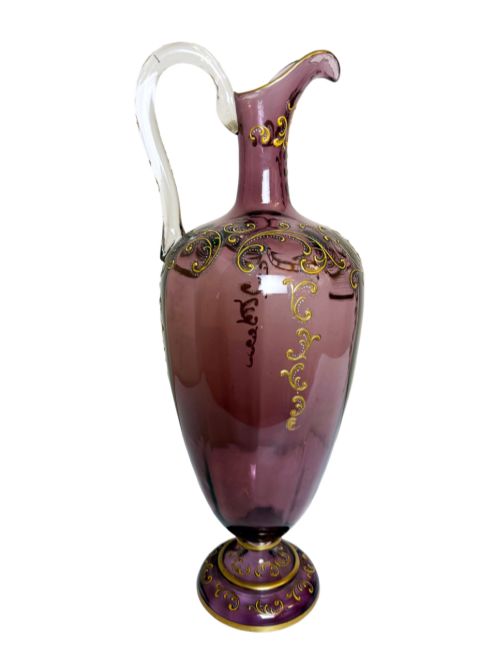
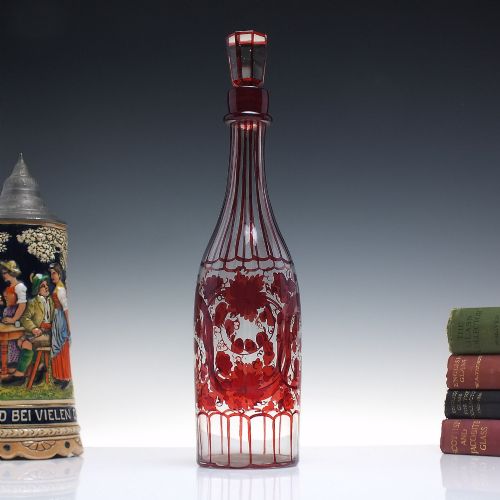


Hand Painted Glass Decanter
A hand painted glass decanter brings colour and character to a table, uniting decorative skill with practical service across several centuries.
Hand Painted Glass Decanter
A hand painted glass decanter encompasses serving bottles, ewers, and flasks decorated by hand from the Georgian and Victorian eras through to the Art Deco period. Buyers seeking a hand painted glass decanter often encounter Victorian green, cranberry, and blue examples alongside earlier Bohemian and German vessels.
The selection ranges from tall wine jugs and liqueur sets to personal gin decanters and cocktail shakers. Many pieces feature traditional scenes, floral motifs, or heraldic enamel work applied directly to blown or opaline glass.
How they were made
Makers utilised free-blown and mould-blown glass techniques to create the foundational bottles and ewers, often employing distinct hues such as cranberry, cobalt, and opal. Artisans then applied opaque enamels, polychrome pigments, and gold leaf by hand to the surface.
The decorated glass was subsequently fired in a kiln to fuse the enamel colours permanently to the vessel. Details such as gilt appliques and hand-painted figural scenes required steady brushwork and multiple firings to achieve depth.
Hand Painted Glass Decanter Retail Price Guide 2026
Typical asking prices for hand painted glass decanter among the pieces listed under this phrase on Sellingantiques today, from the lower quarter to the upper quarter. They describe what is for sale here now, not the wider market.
What varies in quality
Quality depends upon the fineness of the glass body and the precision of the hand-applied enamel or gilding. Superior pieces display crisp, detailed brushwork and well-balanced forms without distortion in the blown glass.
The distinction between standard domestic wares and exceptional examples rests in the complexity of the polychrome decoration and the preservation of the original gold leaf and enamel pigments over time.
Moser·Salviati
The Hand Painted Glass Decanter Glossary
- Mary Gregory glass
- A style of glassware featuring white enamel silhouettes of children amidst foliage, typically set against coloured glass backgrounds such as green, blue, or cranberry.
- Opaline glass
- An opaque or translucent glass developed in pale tints of white, pink, or blue, which served as a smooth ground for delicate enamel painting.
- Mell decanter
- A specific Georgian bottle form with a broad body tapering towards the neck, frequently used for holding Irish whiskey or spirits.
- Enamel
- A powdered glass paste applied to the surface of the vessel and heated until melted, creating durable coloured designs.
- Polychrome
- The practice of decorating a single object using multiple distinct colours in the painted design.
Hand Painted Glass Decanter: Frequently Asked Questions
How do I clean a painted decanter?
Wash the vessel gently by hand in warm soapy water using a soft bottle brush. Avoid soaking the exterior where enamel or gold leaf rests to preserve the hand-painted decoration.
Dry the interior thoroughly and store the piece without the stopper inserted to allow air circulation inside the bottle.
Were these decanters meant for daily use?
Many examples served practical functions on dining tables and sideboards for dispensing wine, spirits, and cordials. Others were designed as ornamental items for display within cabinets and liquor stands.
Care should be taken with pieces featuring delicate gilt appliques or raised enamel work if utilised for serving.
How do I identify a Victorian piece?
Victorian decanters often display characteristic colours like cranberry and deep green, alongside popular decorative motifs such as the white enamel children associated with Mary Gregory.
Form and pontil mark characteristics further assist in separating 19th-century production from earlier Georgian or later Art Deco examples.
What is an opaline glass decanter?
An opaline glass decanter is made from opaque or semi-translucent glass that has a milky appearance. This pale background provided a high-contrast canvas for detailed enamel painting.
These pieces date frequently to the late 18th and 19th centuries, particularly from Bohemian workshops.