



Mary Gregory Glassware
Mary Gregory glassware brings distinctive Victorian white enamel decoration to coloured glass, offering a charming focal point for any room.
Mary Gregory Glassware
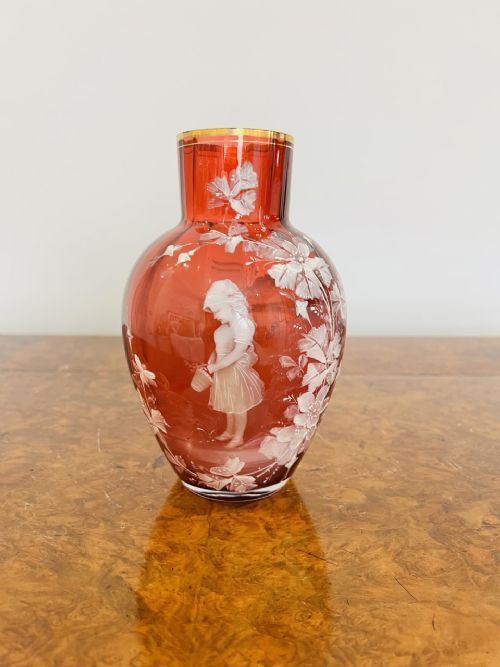
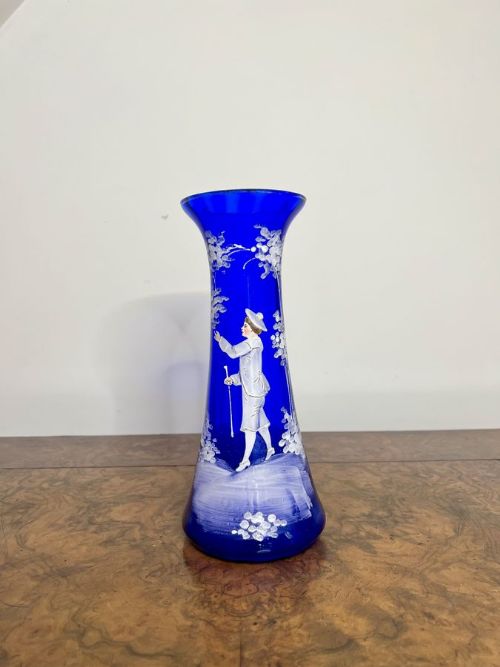
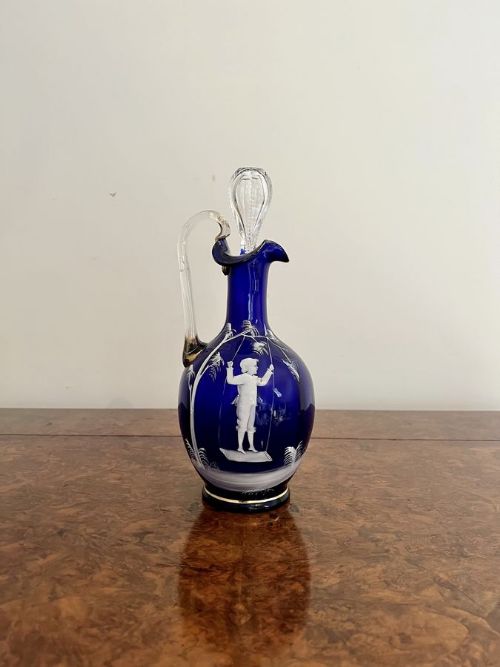
Mary Gregory glassware comprises decorative items featuring hand-painted figures rendered in white enamel paint upon coloured glass grounds.
The pieces available here include vases, ewers, decanters, jars and covers, and dressing table sets originating from the Victorian era.
Dated examples in the records span from the 1860s through to 1900, with Victorian styles dominating the selection.
How they were made
These items utilise coloured glass bases such as cranberry glass, blue glass, green glass, and black glass.
Decoration is applied using white enamel and gold leaf to create the characteristic figural scenes on the glass surface.
What varies in quality
Quality differences lie in the intricacy of the enamel paintwork and the richness of the underlying glass colour, such as cranberry or emerald glass.
Form also dictates distinction, ranging from standard small vases to large pieces, pairs, and complete dressing table sets.
The Mary Gregory Glassware Glossary
- Cranberry glass
- A rich red-pink transparent glass created by adding gold to the molten batch. It forms a striking background for white enamel painting.
- Ewer
- A large jug with a wide spout and a handle, designed historically for water or wine. In this glassware, they serve as decorative display pieces.
- Dressing table set
- A matched collection of glass vessels used on a vanity table. Sets often include jars, bottles, and matching trays.
- Gold leaf
- Thinly hammered sheets of gold applied to enrich decorative surfaces. It frequently accompanies white enamel on Victorian pieces.
Mary Gregory Glassware: Frequently Asked Questions
What is Mary Gregory glassware?
It is Victorian glass decorated with hand-painted white enamel scenes, often depicting children.
The style originates from the nineteenth century and covers various decorative forms.
What colours do these pieces come in?
The recorded pieces appear in cranberry, blue, green, and black glass.
Each colour provides a distinct contrast against the white enamel paintwork.
How do I date these items?
Dates in the evidence range from 1860 through the Victorian period to 1900.
Form, style, and glass manufacture help establish the approximate decade of production.
What types of items are available?
The selection includes vases, ewers, decanters, jars and covers, and dressing table sets.
Some examples also survive as matched pairs or larger singular display pieces.