



Embroidered Cotton Suzani
An embroidered cotton suzani brings rich Central Asian textile tradition into a modern interior as a vibrant wall hanging or cover.
Embroidered Cotton Suzani
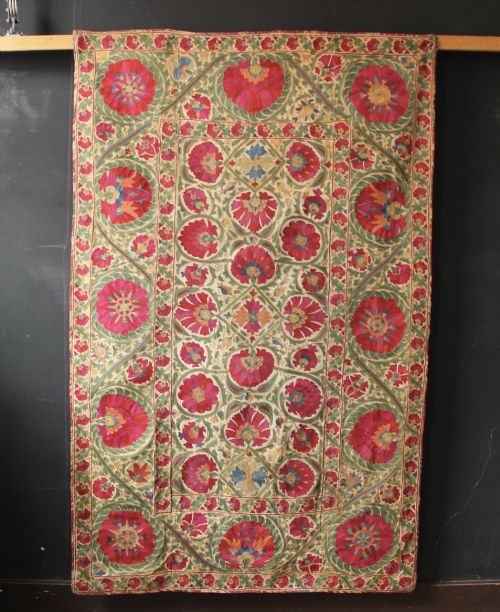
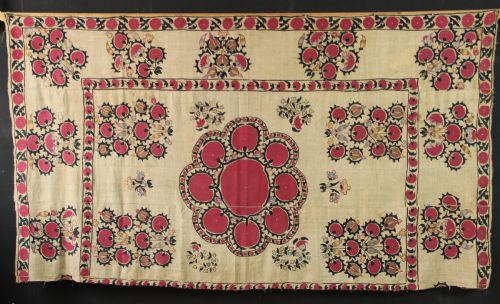
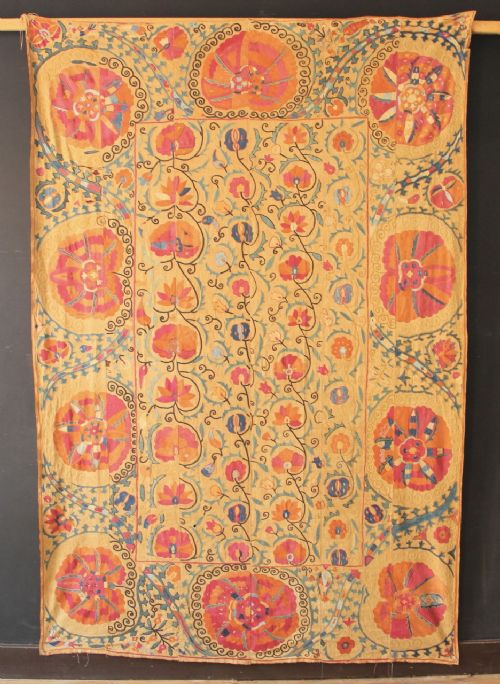
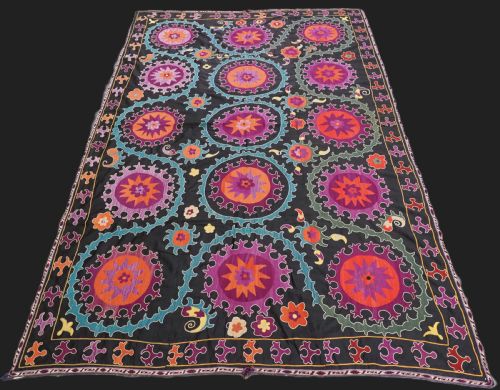
An embroidered cotton suzani is a traditional Central Asian wall hanging or textile cover originating largely from Uzbekistan and surrounding regions. Pieces found here span from the early nineteenth century through the early twentieth century, showing distinct regional formats and decorative schemes.
Buyers will encounter specific regional types such as Bokhara, Tashkent, Shahrisabz, Samarkand, and Nurata examples. Many are full-sized wall hangings, while others are nim suzanis, which are smaller formats created for domestic use.
The decorative vocabulary encompasses large medallions, prayer formats, and palak designs featuring dense floral motifs. Grounds vary in tone, including striking red, yellow, black, and white cotton or adras fabrics.
Materials and construction
These textiles are constructed using a ground fabric of woven cotton, linen, or adras, which is a hybrid of silk and cotton. Artisans then applied dense hand embroidery using fine silk thread across the surface.
Needlework techniques determine the density of the pattern, ranging from open floral layouts to full work where the background is nearly obscured by stitching. Regional workshops utilised specific colour palettes and repeating motifs tied to local traditions.
Ground materials recorded across the inventory include plain cotton, linen, and adras silk-cotton blends in red, yellow, black, and white.
Distinguishing quality in textiles
Quality in these embroideries rests upon the density of the silk threadwork and the precision of the needle technique. Full work pieces demonstrate greater labour intensity than open floral designs.
The vitality and preservation of the dyed silk threads determine visual impact. Strong contrast between the embroidered motifs and the cotton or adras ground elevates the piece.
The Embroidered Cotton Suzani Glossary
- Suzani
- A traditional embroidered textile from Central Asia, historically made as part of a bride's dowry. The word derives from the Persian term for needle.
- Nim suzani
- A smaller version of the standard wall hanging, often translated as half suzani. These compact pieces function well in restricted wall spaces.
- Adras
- A traditional hand-woven fabric combining silk warp and cotton welt threads. It provides a textured, slightly lustrous ground for silk embroidery.
- Palak
- A large-scale design type featuring a dominant central star or medallion surrounded by dense floral ornamentation. These are typically fully embroidered across the ground.
- Prayer format
- A textile layout defined by an arched mihrab design at one end. This specific format relates to Islamic architectural motifs.
Embroidered Cotton Suzani: Frequently Asked Questions
How were suzanis used historically?
These embroidered textiles served multiple domestic and ceremonial functions within Central Asian households. Families utilised them as wall hangings, bed covers, and ceremonial wrappings.
They formed a central part of a bride's dowry, showcasing the needlework skill of the maker and her family.
What is a nim suzani?
A nim suzani is a smaller variant of the standard embroidered textile. The prefix translates to half, indicating dimensions more compact than a full-scale wall hanging.
These smaller formats were produced for specific domestic spaces or as quicker commissions while maintaining traditional regional designs.
How do I hang a textile safely?
Mounting a textile requires distributing the weight evenly across the entire upper edge to prevent strain on the historical fabric. Conservation-grade Velcro or a padded sleeve stitched to the reverse is standard.
Keep mounted pieces away from direct sunlight to protect the natural silk dyes from fading over time.
How are regional styles identified?
Regional attribution relies on the specific drawing style, colour combinations, and composition of the embroidery. For instance, Tashkent and Samarkand pieces exhibit distinct medallion structures and floral treatments.
Ground fabric choices, such as yellow or red cotton, also point toward particular workshops and tribal groups like the Lakai.