



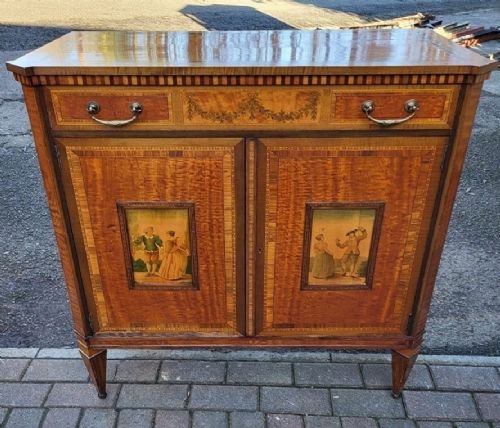


Edwardian Satinwood Credenza
An edwardian satinwood credenza is a refined timber storage piece built for formal reception rooms, bringing light surfaces and classical revival design to traditional interiors.
Edwardian Satinwood Credenza
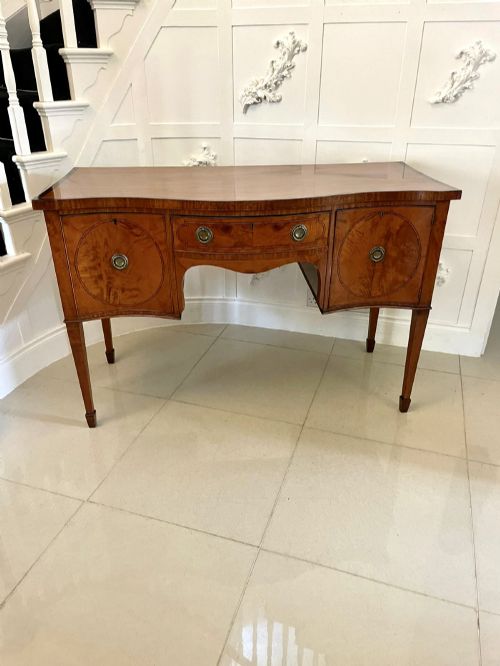
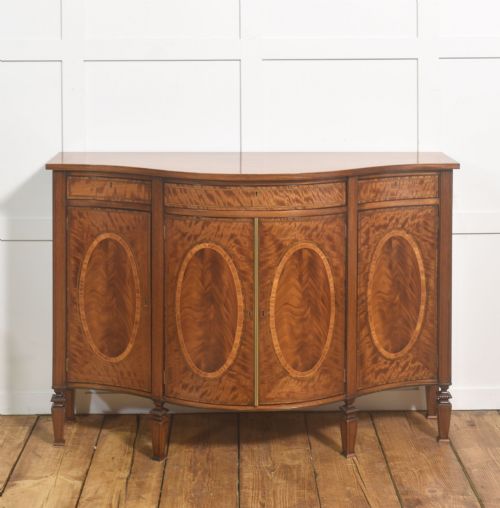
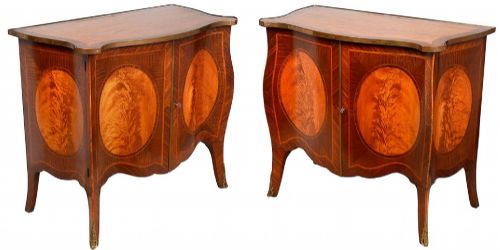
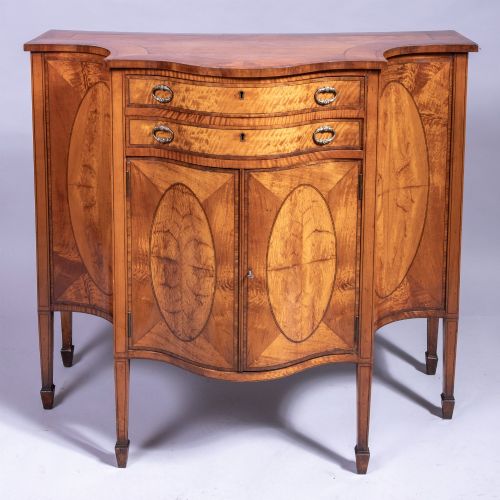
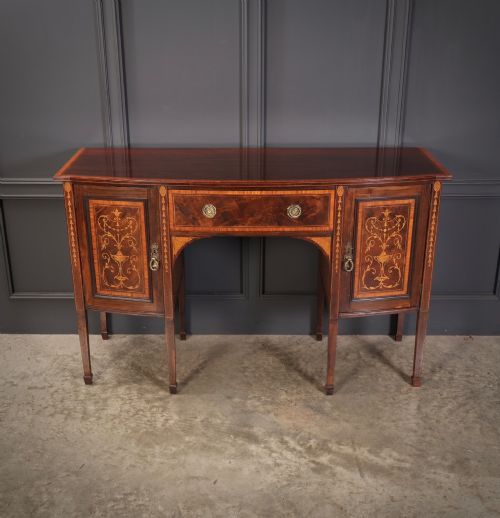
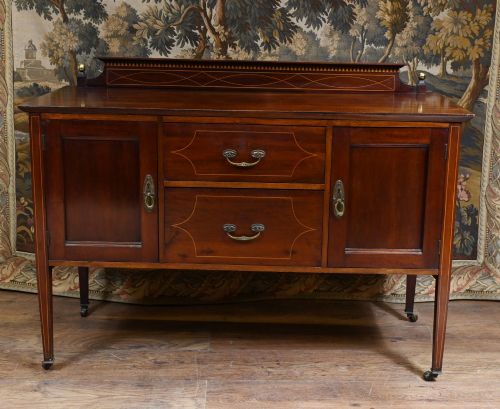
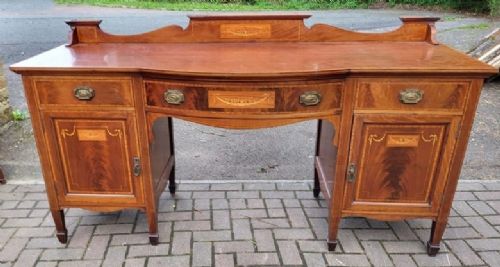
When you search for an edwardian satinwood credenza, you encounter refined display cabinets, serpentine commodes, and bow-front sideboards spanning the Victorian, Edwardian, and early twentieth-century periods. These items draw heavily on Sheraton Revival, Adam Revival, and Neoclassical styles, reflecting a sustained taste for eighteenth-century elegance adapted for later townhouses.
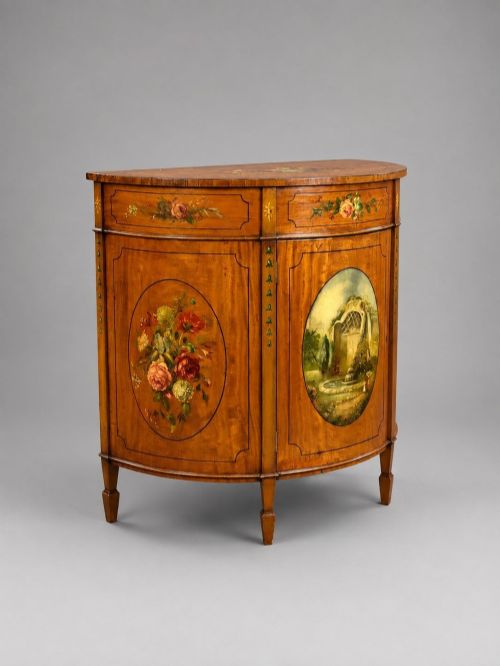
The pieces you meet most often on this page take the form of demi-lune side cabinets and crossbanded sideboards. Cabinetmakers of the period utilised light timbers and painted decoration, producing forms designed to brighten reception spaces and dining rooms.
Makers blended utilitarian storage with decorative presence, combining cupboard space and display surfaces within compact footprints. This architectural lineage places them firmly within the tradition of formal British cabinet work.
Materials and Construction
Craftsmen built these pieces using a foundation of mahogany, pine, or other structural timbers, overlaid with satinwood veneers. Artisans employed contrasting woods such as boxwood and rosewood for delicate stringing and crossbanding.
Surface ornament relied on marquetry inlay and hand-painted classical panels depicting floral motifs or figures. Cabinetmakers shaped timber through steam and sawing to achieve the characteristic bow-front and serpentine curves.
Brass fittings, including handles and key escutcheons, completed the construction, while glass panels were integrated into doors for display cabinets.
Listings feature items spanning the Victorian, Edwardian, and early twentieth-century periods, utilising satinwood, mahogany, and painted decoration.
Distinctions in Quality
The standard of execution in marquetry and painted panels separates exceptional examples from ordinary production. Finely balanced timber selection across curved surfaces demonstrates superior cabinet work.
The crispness of inlay work and the precision of the mitres indicate the skill invested by the workshop. Depth of colour in the satinwood veneer and the integration of secondary timbers further distinguish high-grade pieces.
Structural integrity in serpentine and demi-lune frames requires expert joinery, particularly where veneers meet tight curves. Pieces retaining original brassware and undamaged painted decoration occupy the higher tier.
James Hicks·Maple and Co·Collinson and Lock London·Gillows·Edwards and Roberts
The Edwardian Satinwood Credenza Glossary
- Satinwood
- A lustrous, hard timber native to tropical regions, prized for its pale yellow colour and natural sheen. It served as the primary veneer for high-status Edwardian case furniture.
- Demi-lune
- A half-moon shape characteristic of commodes and side cabinets designed to stand flat against a wall. This form gained popularity during the neoclassical revivals of the nineteenth and twentieth centuries.
- Marquetry
- The art of applying pieces of veneer to a structural surface to form decorative patterns or pictorial scenes. Craftsmen used various tinted and natural woods to achieve contrast.
- Crossbanding
- A border technique where strips of veneer are laid perpendicular to the grain of the main panel. This method frames table tops, drawer fronts, and cabinet doors.
- Serpentine
- A furniture front shaped with a convex centre flanked by concave curves. This undulating line demands advanced joinery and precision veneering.
Edwardian Satinwood Credenza: Frequently Asked Questions
What is an edwardian satinwood credenza?
An edwardian satinwood credenza is a decorative storage cabinet finished in pale veneer, often featuring painted panels and marquetry inlay.
These pieces reflect neoclassical and Sheraton revival styles popular around the turn of the twentieth century.
How were these cabinets used?
They functioned as serving surfaces, storage units for dining silver, and display areas for porcelain in formal rooms.
The enclosed cupboards and shelves kept household items secure while displaying decorative objects on top.
How do I care for satinwood?
Keep the wood away from direct sunlight and excessive heat to prevent the veneer from drying and fading.
Apply a microcrystalline wax periodically to nourish the surface without building up heavy residues.
How do I distinguish revival styles?
Sheraton and Adam revival pieces from the late nineteenth and early twentieth centuries employ machine-sawn veneers alongside hand-painted classical motifs.
Construction details, secondary timbers like pine or mahogany, and lock types help separate Victorian and Edwardian interpretations from genuine eighteenth-century work.