


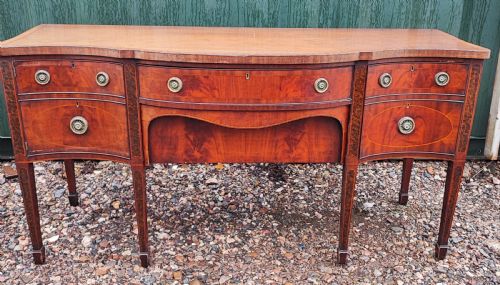


George III Style Credenza
A george iii style credenza brings refined neoclassical elegance and practical storage to a room through balanced proportions and fine timber work.
George III Style Credenza
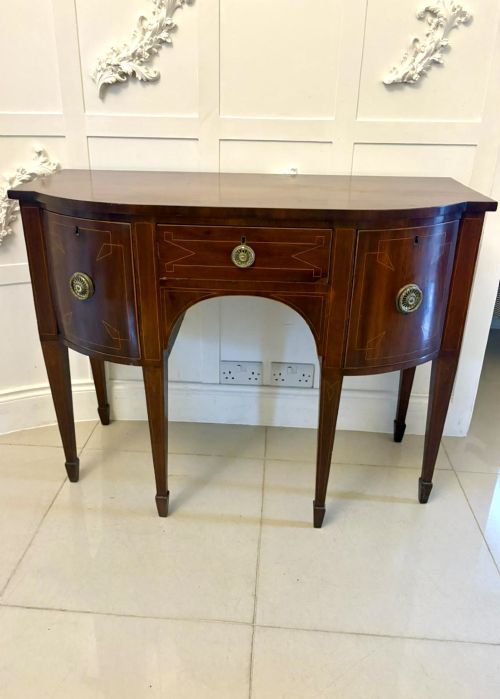
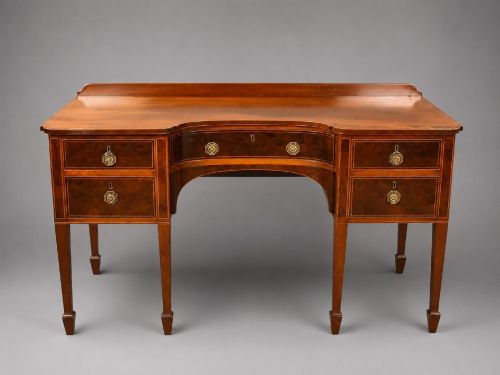
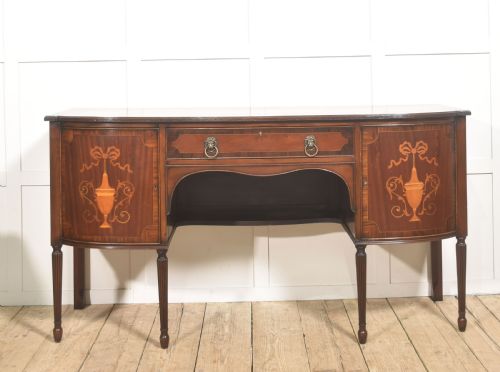
When you search for a george iii style credenza, you encounter sideboards, side cabinets, and serving tables that share the restrained lines and classical motifs of the late eighteenth century. These pieces emerge in various periods, spanning authentic Georgian manufacture, nineteenth-century revivals, and early twentieth-century interpretations.
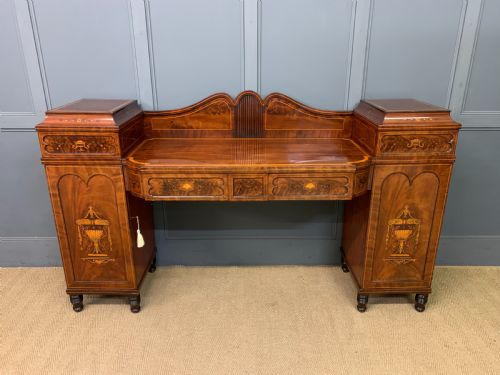
The predominant forms on this page take the shape of sideboards with straight, bowfront, or serpentine outlines, alongside occasional demi-lune cabinets and linen presses. Mahogany forms the core of the selection, frequently paired with lighter wood inlays and decorative borders.
Makers across different eras borrow heavily from Sheraton and general neoclassical idioms, creating substantial items designed for dining rooms and principal reception spaces. You will find both compact dwarf versions and large scale pedestal designs among the offerings.
Materials and Technique
Makers construct these pieces primarily from solid and figured mahogany, often utilising flame veneers to create striking grain patterns across the drawer fronts and doors. Satinwood, rosewood, boxwood, and ebony appear as contrasting inlay materials, forming geometric borders, fan motifs, and delicate stringing.
Cabinetmakers shape the carcase using traditional joinery, executing complex serpentine and bowfront curves with steam-bending and segmental construction. Brass hardware, including drop handles and backplates, completes the structural assembly on many of the items.
One dwarf linen press manages to smuggle the utility of a wardrobe into the compact proportions of a side cabinet.
Assessing the Pieces
The standard of a piece rests heavily on the crispness of its inlay work and the visual weight of the timber selection. Finer examples display tightly figured mahogany veneers matched symmetrically across the front, complemented by precisely cut boxwood and satinwood stringing rather than painted substitutes.
Structural integrity and the retention of original brass mounts distinguish better examples from simpler workshop output. The handling of difficult curves, particularly on serpentine and bowfront models, reveals the underlying competence of the cabinetmaker.
The George III Style Credenza Glossary
- Serpentine
- A front outline that curves outward in the centre and concavely towards the ends, demanding advanced woodworking skill to execute properly. This contour appears frequently on better sideboards.
- Marquetry
- The art of creating decorative patterns on furniture by fitting together small pieces of various coloured woods and veneers. It adds intricate pictorial or geometric detail to the surface.
- Satinwood
- A durable, lustrous timber with a golden-yellow sheen, frequently used for contrasting inlays and banded borders on mahogany carcases. It brightens the overall appearance of the piece.
- Demi-lune
- A half-moon shape used for the plan of cabinets and tables designed to sit flush against a wall. This format saves floor space while retaining formal presence.
- Pedestal sideboard
- A form featuring distinct side pedestals flanking a central serving section, often incorporating cupboards or drawers within the outer blocks. It represents a more substantial dining room format.
George III Style Credenza: Frequently Asked Questions
How do I date a sideboard?
Dating relies on examining the timber species, construction methods, and secondary woods used inside drawer linings and carcase backs. Eighteenth-century pieces display hand-cut dovetails and period-specific finishing techniques.
Later revival pieces from the nineteenth and twentieth centuries often employ more uniform machine-sawn timber and standardised hardware fixings.
Where should I place one?
These pieces suit dining rooms, hallways, and principal reception areas where their length and decorative fronts can be fully appreciated. Their shallow depth allows them to sit comfortably against walls without dominating the floor plan.
Ensure you measure the available wall space and clearance for opening drawers and doors before settling on a specific footprint.
How do I care for mahogany surfaces?
Maintain the wood by dusting regularly with a soft, dry cloth and avoiding placement near direct heat sources or strong sunlight. Periodic applications of appropriate wax nourish the grain and preserve the finish.
Keep liquids away from the polished top to prevent water marking and ring damage on the antique timber.