




Hepplewhite Style Server
These pieces for a hepplewhite style server offer elegant serving surfaces and refined storage derived from late eighteenth-century dining room forms.
Hepplewhite Style Server
A hepplewhite style server encompasses sophisticated dining room furniture designed for service and display, frequently appearing in forms such as sideboards, console tables, and serving tables. These pieces emerge primarily from Georgian, George III, and later revival periods spanning the nineteenth and early twentieth centuries.
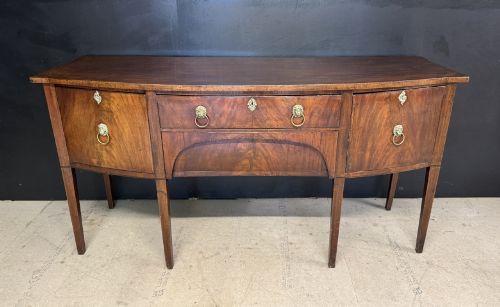
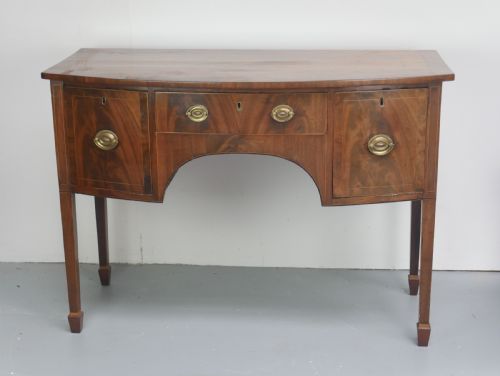
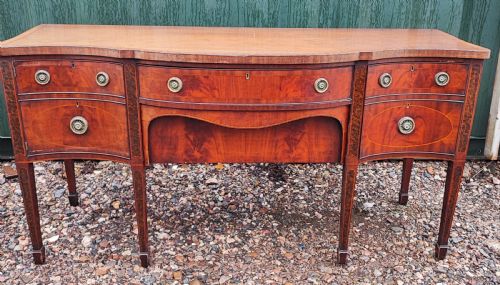
The versions most commonly met on this page feature mahogany timbers shaped with distinctive bowfront or serpentine outlines. Cabinetmakers constructed these forms to follow slender, tapering legs that typify the grace associated with eighteenth-century design manuals.
Buyers encounter both period originals and later revivals, including Georgian style and Hepplewhite revival pieces produced around nineteen hundred. Each variation maintains the characteristic proportions and surface refinement suited to formal dining spaces.
Materials and construction
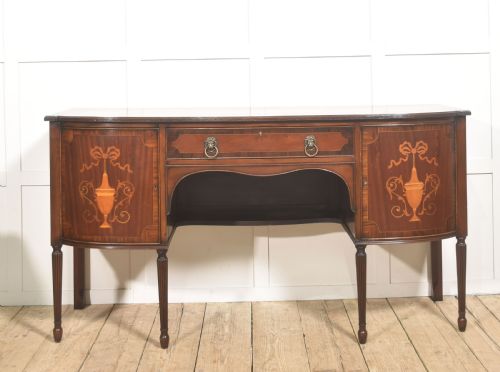
Craftsmen built these servers using solid and veneered mahogany as the primary timber, valued for its rich grain and structural stability. Workshops added decorative contrast through delicate inlay work utilising satinwood, boxwood, and marquetry.
Surfaces often incorporate elaborate wood inlay and geometric stringing to define drawer fronts and tabletops. Structural hardware typically relies on cast brass handles and escutcheons that complement the darker tones of the polished mahogany.
Hepplewhite Style Server Retail Price Guide 2026
Typical asking prices for hepplewhite style server among the pieces listed under this phrase on Sellingantiques today, from the lower quarter to the upper quarter. They describe what is for sale here now, not the wider market.
Cabinetmakers occasionally concealed secret drawers behind decorative serpentine aprons to safeguard family silver.
Measures of quality
Quality rests upon the crispness of the serpentine or bowfront shaping and the precision of the timber joints. Superior examples display carefully selected mahogany veneers that align harmoniously across multiple drawer fronts.
The refinement of the inlaid decoration and the integrity of the original tapering leg structure separate fine cabinetmaking from standard production. Artisans who achieved subtle curvature and balanced proportions created pieces of lasting architectural harmony.
Gillow
The Hepplewhite Style Server Glossary
- Serpentine
- A front outline that curves outward in the centre and inward toward the ends, creating a flowing, undulating surface. This profile requires immense skill from the cabinetmaker to execute cleanly.
- Bowfront
- A convex, outwardly curved front found on many sideboards and serving tables. It softens the linear appearance of dining room furniture.
- Satinwood
- A durable, yellowish timber native to Ceylon and India, prized for its lustrous grain. It served as a favoured material for contrasting stringing and marquetry panels.
- Marquetry
- The art of forming decorative patterns using thin veneers of various woods applied to a carcass. This technique allows for complex floral and geometric motifs.
- George III
- The period of British history spanning from seventeen sixty to eighteen twenty, noted for refined classical furniture design. Pieces from this era establish the aesthetic baseline for subsequent revivals.
Hepplewhite Style Server: Frequently Asked Questions
How do I identify a true period piece?
Examine the secondary timbers inside the drawers, such as oak or pine, alongside the hand-cut dovetail joints. Construction methods and wood ageing provide clear indicators of eighteenth-century origin compared to later nineteenth-century revivals.
Surface patination also reveals age through soft wax accumulation and natural oxidation on the mahogany. Revival pieces from nineteen hundred often display uniform machine finishing and different internal wood species.
Where should I place a server?
These pieces suit dining rooms, grand hallways, or living spaces where surface area and subtle storage are required. Their shallow depth compared to full sideboards makes them practical for narrower rooms.
Keep them away from direct heat sources and strong sunlight to protect the polished mahogany finish and delicate satinwood inlay from fading.
What is the difference between a sideboard and a server?
Servers generally lack the heavier cupboard pedestals or extensive bottle drawers found on large dining room sideboards. They function primarily as console or serving tables with shallow drawers for linens and flatware.
This lighter form allows the piece to double as a display table in reception rooms while retaining the aesthetic hallmarks of Georgian design.