



Edwardian Mahogany Kidney Table
An Edwardian mahogany kidney table brings a distinct serpentine sweep to a room, functioning equally as a compact writing desk or a delicate display surface.
Edwardian Mahogany Kidney Table
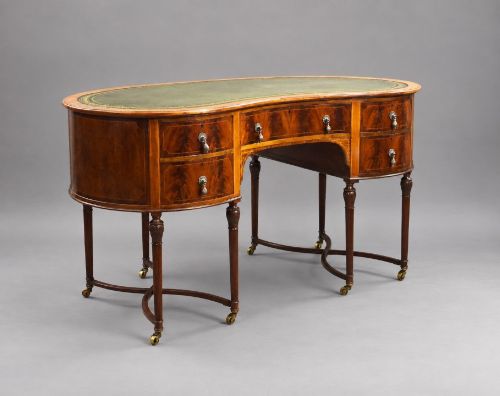
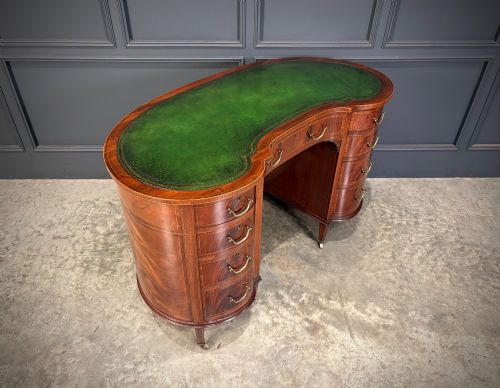
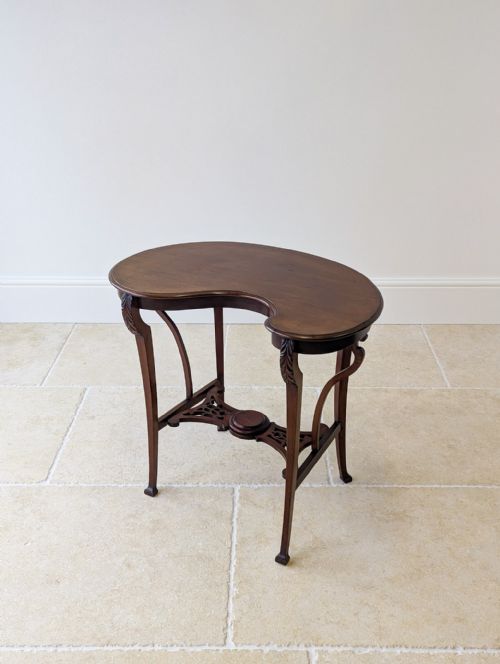
The Edwardian mahogany kidney table is defined by its characteristic curved top, reminiscent of a bean, designed to fit comfortably against the body of someone seated at work. These pieces emerge predominantly from the Edwardian period and the late nineteenth century, alongside occasional Victorian and Sheraton Revival examples.
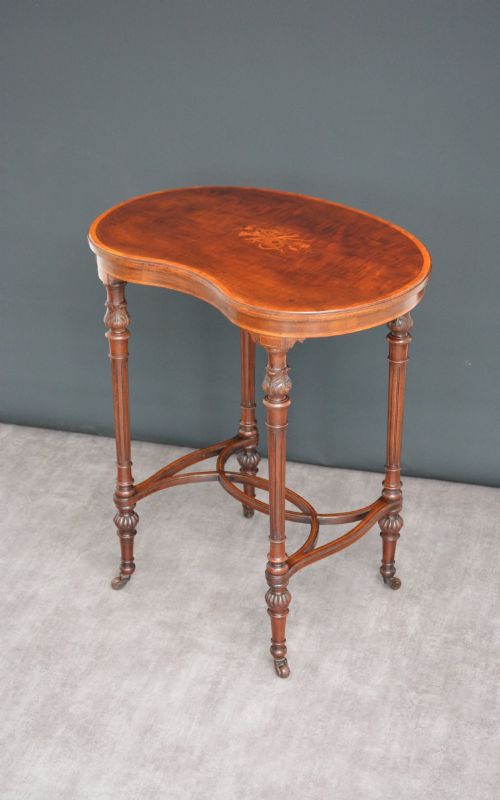
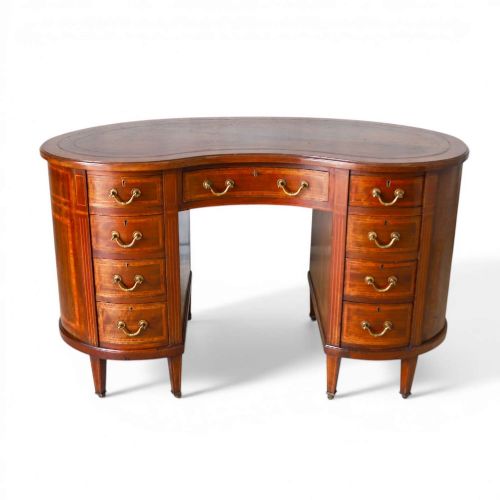
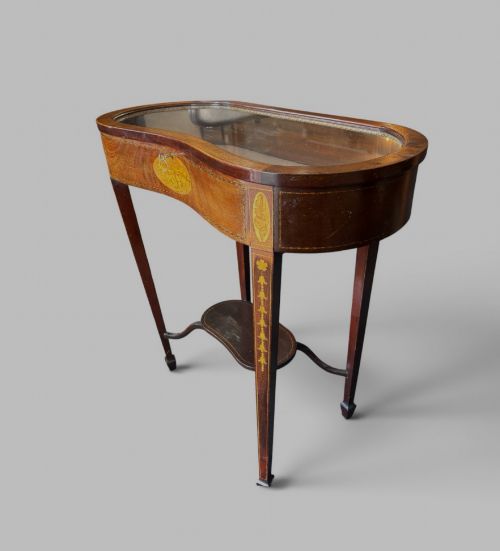
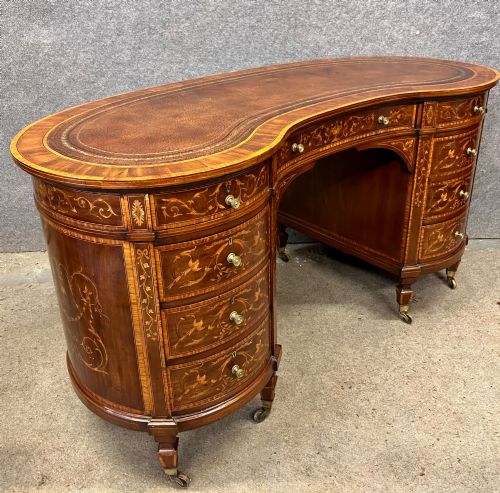
The forms on this page span several practical uses, appearing most frequently as writing desks and side tables, with occasional display cabinets, dressing tables, and nesting sets. The standard version encountered here is an Edwardian writing desk, often detailed with inlaid timbers along the top surface and fitted with slender legs.
While the core of the inventory sits firmly in the early twentieth and late nineteenth centuries, the design draws heavily on earlier eighteenth-century proportions and French Revival influences. Makers applied the kidney silhouette to varied domestic furniture, ranging from freestanding occasional tables to elaborate marquetry-adorned writing desks.
Materials and Technique
Construction relies upon solid mahogany and flame mahogany veneers, selected for rich grain patterns and warm underlying tones. Workshops shaped the complex curved top by joining timber carefully before applying edge banding.
Surface enrichment frequently involves satinwood and boxwood inlay, creating delicate contrasting lines or elaborate marquetry motifs. Many writing surfaces incorporate inset leather panels, often tooled with gilt borders around the perimeter.
Structural details include brass fittings, such as casters on desks and gallery rails on display tables, alongside glass panels for bijouterie cabinets. The joinery combines traditional framing methods with precise veneer work to maintain stability across the sweeping curve.
Listings feature mahogany, satinwood, and boxwood inlay alongside inset leather writing surfaces and brass gallery rails.
Distinctions in Execution
The standard of a piece rests upon the crispness of the inlay and the selection of the mahogany veneer, where flame figuring and matched grain create visual depth. Fine examples display meticulous hand-cut marquetry rather than simpler banded lines, showing deliberate placement of contrasting satinwood and boxwood.
Proportion and execution of the curved frame dictate the success of the silhouette, separating standard utility pieces from exhibition quality works. Workshops known for high production standards achieved cleaner lines in the serpentine sweep and more robust underframing without losing the inherent delicacy of the form.
Wolfe & Hollander·Shapland & Petter·Edwards & Roberts·Gillows·Maple & Co
The Edwardian Mahogany Kidney Table Glossary
- Kidney Table
- A low table or desk featuring a top curved in the middle on one side, resembling a bean. This shape allows the user to sit closer to the centre while keeping surface area within reach.
- Marquetry
- Decorative patterns formed by inserting pieces of contrasting wood into a veneered surface. Artisans use varied timbers like satinwood and boxwood to create floral or geometric designs.
- Sheraton Revival
- A late nineteenth and early twentieth-century design movement inspired by the neoclassical furniture of Thomas Sheraton. These pieces utilise mahogany, delicate inlay, and classical proportions.
- Bijouterie Table
- A display table with a glass top and upper section designed for showing small decorative objects or jewellery. They often feature hinged lids and fabric-lined interiors.
- Flame Mahogany
- A veneer cut from the fork of a mahogany tree where the branches join the trunk. This produces a characteristic flickering flame-like pattern across the wood grain.
Edwardian Mahogany Kidney Table: Frequently Asked Questions
What is a kidney table used for?
These tables function primarily as compact writing desks, occasional side tables, or display surfaces for smaller items. The curved design allows them to sit comfortably in room corners or freestanding in open spaces.
Historically, ladies utilised the smaller versions for correspondence and dressing, while larger freestanding variations served as library writing desks.
How do I identify an Edwardian piece?
Edwardian furniture generally dates from the reign of King Edward VII, spanning the early years of the twentieth century. Characteristics include lighter proportions, mahogany construction, and refined satinwood or boxwood stringing.
Makers of this era frequently revived eighteenth-century Sheraton and French styles, combining traditional cabinet-making with the era's taste for delicate marquetry.
What is a bijouterie table?
A bijouterie table is a specialised display piece featuring a glazed top and compartment designed to exhibit small treasures. They frequently appear in the Edwardian inventory as kidney-shaped occasional tables.
The glass lid protects the contents while allowing light to enter from above, making them suitable for displaying collections of medals, fans, or small ornaments.
Are these desks comfortable for writing?
The central curve of the kidney shape is specifically designed to accommodate the user sitting directly before the centre of the desk. This allows close access to the writing surface without awkward reaching.
Most surviving examples retain their original leather or tooled writing surfaces, providing a suitable texture for everyday use.