
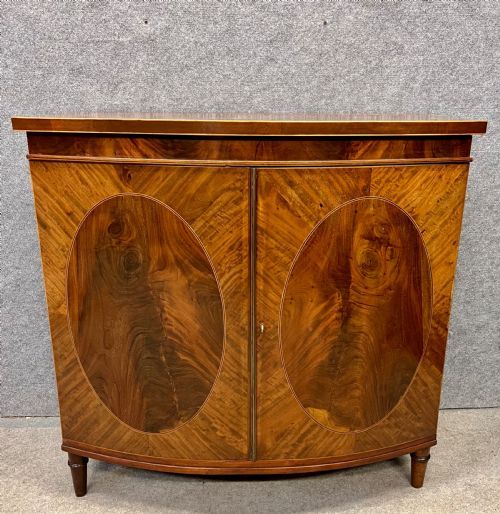
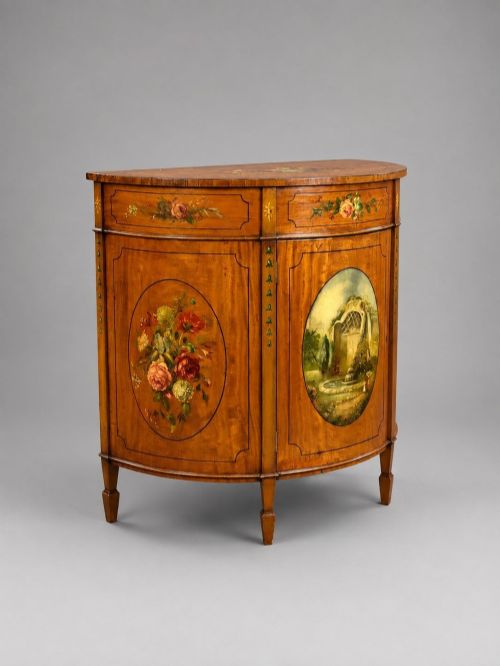


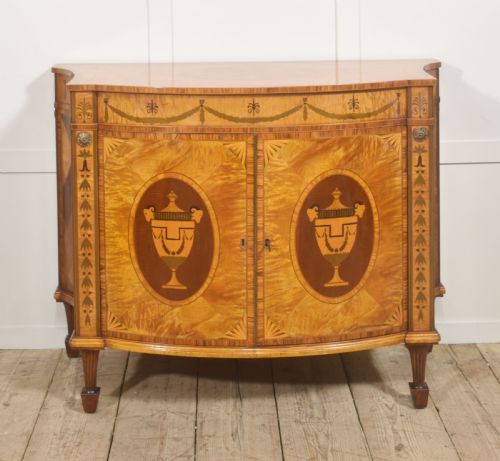


Edwardian Half Moon Cabinet
An edwardian half moon cabinet brings curved elegance and refined wood inlay to a room, offering both surface display and discreet storage.
Edwardian Half Moon Cabinet
An edwardian half moon cabinet takes the form of a semicircular or demi-lune console, commode, or side cabinet designed to fit flush against a wall. These pieces frequently appear in Edwardian, Victorian, and 19th century eras, alongside revival styles that mirror earlier Georgian and Neoclassical tastes.
The construction typically involves a flat back edge with a curving front, housing doors or drawers beneath a matching top surface. Listings show variations from simple mahogany side cabinets to elaborate display pieces with glass panels and intricate painted decoration.
How they were made
Cabinet makers utilised fine timbers such as satinwood and mahogany as the primary construction bases, often incorporating timber, rosewood, and brass hardware. Surfaces were frequently embellished with wood inlay and marquetry to create intricate geometric or floral patterns.
Some pieces feature applied paint and painted panels directly onto the wood, while others incorporate marble tops or glass doors. These traditional joinery and decoration techniques allowed craftsmen to achieve the smooth, sweeping curves characteristic of the demi-lune form.
Cabinet makers solved the challenge of curving doors by painstakingly bending thin strips of timber around custom wooden moulds.
What varies in quality
Quality rests upon the precision of the curving woodwork and the intricacy of the marquetry or painted panels. Pieces featuring detailed wood inlay, fine satinwood veneers, and original brass fittings demonstrate a higher tier of craftsmanship than simpler mahogany variants.
The overall harmony of the proportions and the crispness of the Neoclassical or Sheraton Revival motifs separate standard workshop production from finer examples commissioned during the period.
James Hicks
The Edwardian Half Moon Cabinet Glossary
- Demi-lune
- A half-moon or semicircular shape utilised for tables and cabinets designed to stand against a wall. This profile became particularly popular in Neoclassical and Sheraton Revival furniture.
- Marquetry
- The art of applying small pieces of veneer to a structure to form decorative patterns or pictures. Craftsmen used various coloured woods to achieve contrasting pictorial designs.
- Satinwood
- A durable, yellowish timber prized for its smooth, satin-like sheen and luminous grain. It served as a favoured surface veneer for high-end Edwardian and revival furniture.
- Sheraton Revival
- A late 19th and early 20th century design movement that reinterpreted the lighter, elegant furniture styles of Thomas Sheraton. Pieces from this era often feature delicate inlay and classical motifs.
- Commode
- A decorative low cabinet or chest featuring doors or drawers. In earlier periods, these served as prominent reception room furniture rather than utilitarian items.
Edwardian Half Moon Cabinet: Frequently Asked Questions
Where should I place a half moon cabinet?
Their flat backs allow these cabinets to sit snugly against a wall, making them ideal for hallways, narrow landings, or dining rooms where floor space is limited.
They also function well beneath a mirror or painting in a living room, providing a surface for lamps or decorative objects without obstructing pathways.
How do I distinguish Edwardian from Victorian pieces?
Edwardian examples generally lean towards lighter satinwood finishes, delicate painted panels, and brighter Sheraton Revival motifs. Victorian pieces often employ heavier timbers like mahogany and denser, darker varnishes.
However, because revival styles overlapped, examination of the interior secondary woods and construction methods provides clearer dating evidence.
What is the difference between a commode and a side cabinet?
A commode typically refers to a low, decorative cabinet with doors or drawers built for formal reception spaces. Side cabinets cover a broader category that can include display shelving and glass panels.
Both share the curving demi-lune footprint but serve different storage and display functions.
How do I care for satinwood surfaces?
Satinwood benefits from regular dusting with a soft, dry cloth to prevent particulate buildup. Avoiding direct sunlight and maintaining stable room humidity protects the delicate veneers and inlay work from cracking.
Occasional application of appropriate furniture wax preserves the natural sheen without forming heavy wax layers.