
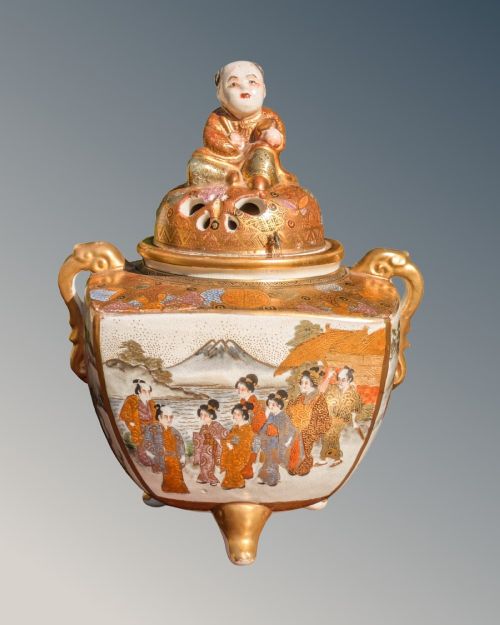


Earthenware Incense Burner
An earthenware incense burner brings texture and ritual into a room, offering a tactile focal point shaped by Japanese and Victorian hands.
Earthenware Incense Burner
When you search for an earthenware incense burner, you encounter vessels designed for burning aromatics, predominantly originating from Japanese Meiji period workshops and Victorian Britain. The pieces listed on this page range from large covered koros to miniature burners and decorative holders.
The Japanese examples span nineteenth-century Satsuma wares, including signed Kyoto pieces featuring mythical creatures and family crests. Alongside these, the selection includes Victorian Staffordshire cottages and Chinese Famille Rose earthenware figures serving as incense holders.
Materials and construction
Makers shaped these objects from porous earthenware clay before applying detailed glaze, enamel, and gold leaf decorations. Many pieces incorporate gilt highlights and bronze elements to accent lids, feet, and sculpted handles.
Artisans painted intricate figural and animal motifs by hand, often featuring prominent figures such as Shi-Shi lions and laughing boys. Firing techniques varied across Kyoto potteries and Victorian kilns, producing distinct surface textures and crackle glazes.
Materials recorded across the inventory include earthenware, enamel, gold leaf, gilding, gilt, glaze, bronze, and porcelain.
Distinguishing quality across the range
The finest pieces demonstrate exceptional precision in hand-painted enamel work and the crispness of gilded details. Signatures from recognised makers and specific crests elevate the standing of a vessel, distinguishing standard production items from masterworks.
Scale and complexity also define the range, moving from simple miniature lidded forms to monumental footed bowls with elaborate sculptural covers. The preservation of original lids, delicate gilding, and intricate surface decoration dictates the standing of each individual burner.
Kotobuki-do·Kizan·Shizan
The Earthenware Incense Burner Glossary
- Koro
- A traditional Japanese incense burner, typically featuring a body, a pierced cover for releasing smoke, and small feet. These vessels are central to Japanese ceramic art.
- Satsuma
- A type of Japanese pottery originating from Satsuma Province, known for its ivory-coloured crackle glaze and elaborate overglaze enamel and gold decoration.
- Shi-Shi
- A mythical guardian lion frequently depicted in Asian art. Sculptural representations often crown the lids of incense burners.
- Famille Rose
- A palette of Chinese ceramic glazes dominated by opaque pink or rose enamel. This style emerged during the Qing Dynasty and appears on figures adapted for incense use.
- Gilding
- The application of gold leaf or gold dust to the surface of ceramic or bronze elements. It accents the decorative panels and handles of nineteenth-century burners.
Earthenware Incense Burner: Frequently Asked Questions
How do I use an earthenware incense burner?
Place your incense inside the bowl or holder, ensuring the vessel sits safely on a heat-resistant surface. Many Japanese koros feature removable lids that allow scented smoke to escape through pierced openings.
Take care not to let excessive heat damage antique glazes. Empty ash regularly with a soft brush to preserve the interior earthenware surface.
What periods do these incense burners come from?
The pieces available span the nineteenth and early twentieth centuries, with a strong representation of the Japanese Meiji period. You will also encounter Victorian British ceramics and Qing dynasty Chinese pieces.
Dates generally range from the 1880s through to the early twentieth century, reflecting the global trade and aesthetic exchanges of those decades.
How do I distinguish Satsuma ware from other ceramics?
Satsuma ceramics are characterised by an earthenware body covered in a distinctive cream-coloured glaze featuring a fine network of crackles. They are further identified by dense hand-painted enamel designs enriched with gold leaf.
Look for workshop signatures and Japanese crests painted on the underside of the base to confirm origin.
Are these burners fragile?
Earthenware is more porous and susceptible to chipping than hard-paste porcelain or stoneware. The added enamel and gold leaf decorations on the surface require gentle handling during cleaning.
Display your burner away from high-traffic edges and clean it only with a dry, soft cloth to protect the historic glaze.