


Gilt Japanese Censer
A gilt japanese censer brings the skilled metalwork and earthenware traditions of the nineteenth and early twentieth centuries directly into a room.
Gilt Japanese Censer
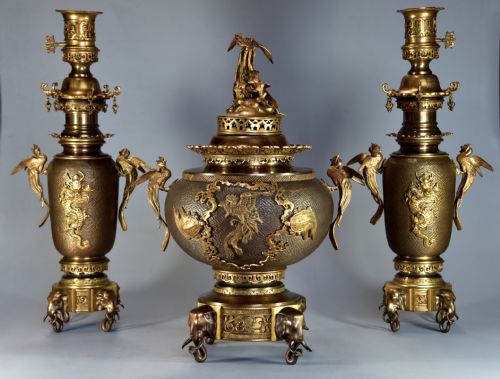
When you search for a gilt japanese censer, you enter a field defined by nineteenth-century Meiji period bronzes and earthenware vessels designed to burn incense. The examples on this page span incense burners, lidded urns, footed bowl burners, and garniture sets originating from Japan as well as French Japonisme interpretations.
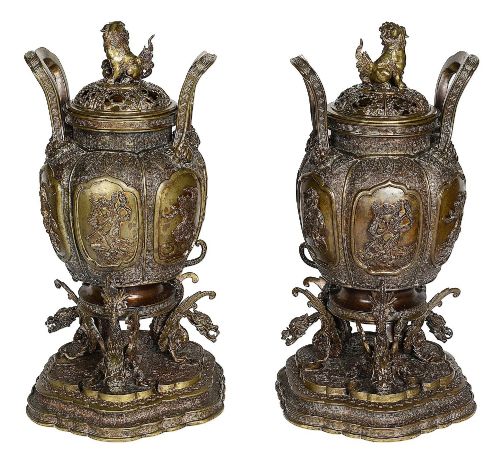
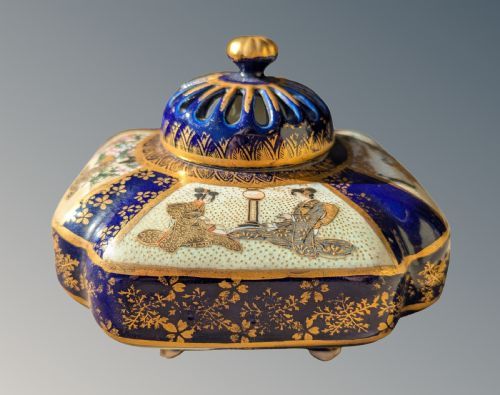
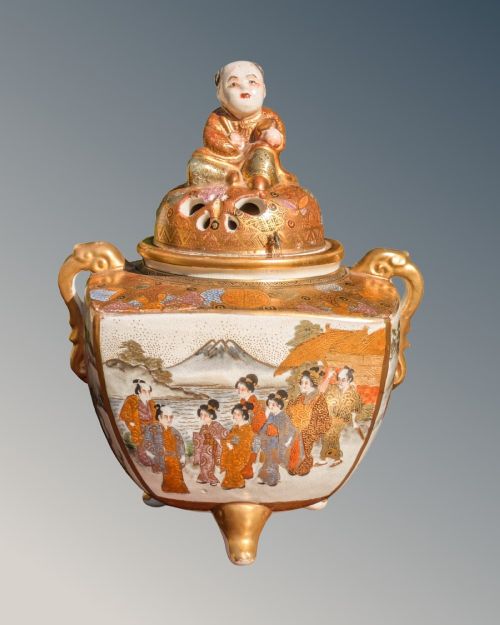
Most pieces date from the late nineteenth century, including Satsuma koro featuring finely detailed painted earthenware with gilt highlights, alongside cast bronze and patinated metal works. Buyers commonly encounter traditional tripod forms topped with lids, often guarded by sculpted Shi-Shi lions.
The selection includes marked pieces from notable kilns and workshops, alongside miniature incense burners and larger decorative urns. Whether cast in bronze with parcel-gilt details or formed from earthenware with gold leaf, each item reflects the distinct aesthetic currents of the Meiji and Taisho periods.
What varies in quality
Quality rests upon the precision of the casting or the fineness of the ceramic body, alongside the crispness of the hand-applied gilding and enamel work. Superior examples demonstrate complex sculptural modeling, such as detailed Shi-Shi lion finials and well-defined metalwork that maintains its structural integrity.
The presence of legible maker signatures, historical crests like the Shimazu clan mark, and refined Satsuma painting elevates an individual piece. Lesser examples display simpler decoration and coarser surface finishes, whilst the finest works balance sculptural weight with delicate, intact surface gilding.
Shi-Shi lions stand guard on the lids of these burners, keeping watch over the fragrant smoke as it curls through the room.
Kinkozan·Kizan·Kotobuki-do·Shizan
The Gilt Japanese Censer Glossary
- Koro
- A traditional Japanese incense burner, typically featuring a lid and three or more feet. These vessels form the core of the incense-burning tradition.
- Meiji Period
- The era in Japanese history spanning from 1868 to 1912, characterised by intense artistic production and opening trade with the West. Many fine bronzes and ceramics originate from this time.
- Satsuma
- A style of Japanese earthenware featuring a crackled, ivory-coloured glaze decorated with rich enamel colours and heavy gilding. These ceramics are frequently formed into intricate incense burners.
- Shi-Shi
- A mythical guardian lion or dog frequently depicted as a sculptural finial on incense burner lids. They symbolise protection and authority in East Asian art.
- Japonisme
- A nineteenth-century European artistic movement influenced by Japanese art and aesthetics. French makers often adopted these motifs into local bronze and metalwork.
Gilt Japanese Censer: Frequently Asked Questions
What is a koro used for?
A koro serves as a traditional vessel for burning aromatic incense in Japanese culture. These burners were placed in domestic and ceremonial settings to scent the air and display fine craftsmanship.
Over time, many of these lidded vessels transitioned into purely decorative objects, valued for their sculptural forms and intricate surface decoration rather than daily use.
How do I identify a Meiji period piece?
Meiji period pieces typically date between 1868 and 1912, often carrying specific stylistic markers such as dense enamel work, detailed bronze casting, and traditional maker signatures. Examining the base of an earthenware koro or the patina on a bronze body often reveals clues about its age.
Many of these objects bear artist signatures or workshop marks stamped or painted onto the surface, connecting them to documented kilns and metalworkers from the era.
What is Satsuma ware?
Satsuma ware is a type of Japanese earthenware recognised by its distinctive pale, crackled glaze and elaborate polychrome enamel and gold decoration. Originating in Satsuma Province, the style spread to workshops in Kyoto and other regions during the nineteenth century.
These pieces often feature finely detailed figures, floral patterns, and heavy gilt highlights, making them some of the most recognisable ceramics associated with the Meiji period.
How should I display a gilt bronze censer?
Displaying a gilt bronze or parcel-gilt censer requires a stable surface away from direct moisture and excessive handling to protect the delicate metallic finish. Allowing adequate space around the piece lets the sculptural details and patinated surfaces catch ambient light.
Keep these vessels out of direct sunlight to preserve the integrity of any applied gold leaf or enamel details over the long term.