
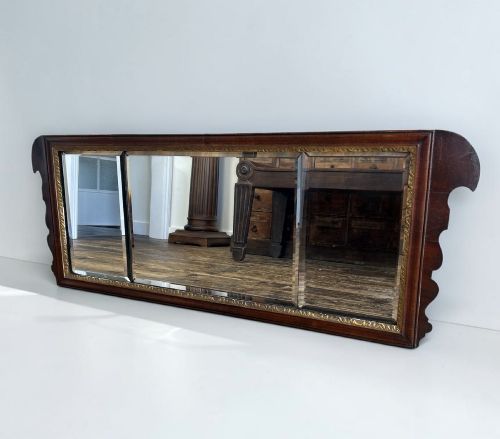
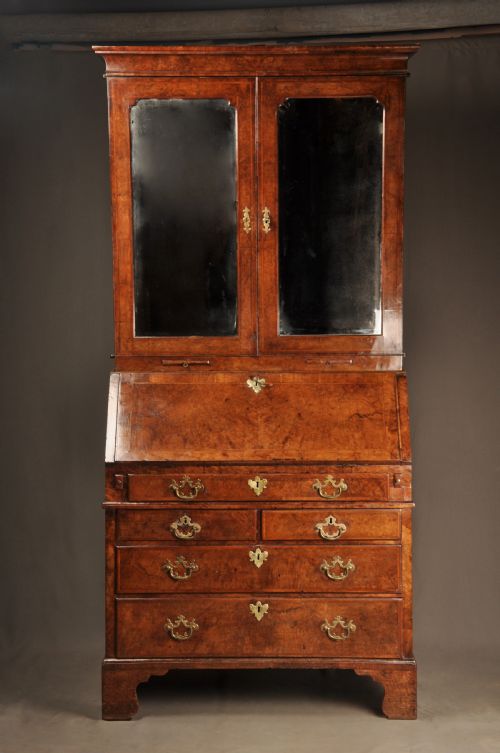


Early Georgian Walnut Mirror
An early georgian walnut mirror brings warmth and architectural presence to a room through rich timber and disciplined proportions.
Early Georgian Walnut Mirror
The search for an early georgian walnut mirror reveals domestic furnishings from the eighteenth century, encompassing both wall-hanging pier mirrors and smaller dressing or toilet mirrors designed for chests and tables. These pieces span the reigns of Queen Anne, George I, and George II, showing how cabinetmakers handled timber to create refined focal points for period interiors. Alongside wall-mounted examples, the category includes related forms such as bureau bookcases and corner cabinets that share the same material palette and aesthetic vocabulary.
Most examples encountered on this page belong to the eighteenth century, though later revivals also appear. Wall mirrors often incorporate parcel-gilt details or original glass plates, while dressing mirrors feature swing frames supported by uprights above small drawer bases. The timber ranges from straight-grained walnut to figured and burr surfaces, frequently combined with oak for secondary carcase structures.
Assessing quality and craftsmanship
Quality rests in the selection of the timber veneers and the crispness of any parcel-gilt carving or fretwork details. Fine cabinet work shows careful book-matching of burr walnut figures across the frame face, creating balanced symmetry.
The survival of original mirror glass plates and secondary softwoods without extensive replacement contributes significantly to the integrity of the piece. Proportion and the subtlety of edge moulding profiles distinguish superior workshop output from simpler domestic production.
Some eighteenth-century toilet mirrors include tiny hidden drawers behind secret sliding panels for secret letters.
The Early Georgian Walnut Mirror Glossary
- Burr walnut
- A figured timber harvested from walnut tree growths, prized for its swirling grain patterns used in decorative veneers. It forms the primary visual surface on many fine eighteenth-century frames.
- Parcel-gilt
- Partially gilded ornament applied to specific carved details, such as mouldings or inner bezels, to contrast against the dark walnut timber. This technique adds brightness to wall mirrors.
- Pier mirror
- A tall wall mirror designed specifically to hang on the narrow wall space between windows. These pieces often feature architectural pediments and original glass plates.
- Toilet mirror
- A smaller swing mirror mounted on a box base containing small drawers for personal items, designed to sit on a dressing table. They are also frequently called dressing mirrors.
- Fretwork
- Thin board pierced with decorative patterns using a fretsaw, seen on the scrolling crests and aprons of Georgian wall glasses.
Early Georgian Walnut Mirror: Frequently Asked Questions
How do I date an early georgian walnut mirror?
Dating relies on examining the construction methods of the frame, the thickness and bevelling of the glass plate, and the secondary woods used behind the mirror. Early pieces often feature oak backing boards and hand-cut screws.
stylistic details such as Queen Anne pad feet on dressing boxes or George II gilt parcel accents also help narrow the period of manufacture.
What is the difference between a pier mirror and a dressing mirror?
A pier mirror is designed to hang permanently on a wall, usually between architectural openings or above a pier table. Its scale is vertical and substantial.
A dressing mirror is portable and stands on a table or chest, featuring a frame that pivots between two upright supports attached to a small drawer base.
Are original mirror plates common on these pieces?
Original glass plates do survive, though many mirrors have received replacement glass over the centuries due to damage or silver degradation. An original plate often exhibits minor foxing, slight distortions, and hand-bevelling.
Examining the rebate and fixings reveals whether the glass has been re-secured or replaced entirely.
How should I care for walnut veneer?
Walnut veneer requires stable indoor humidity and protection from direct sunlight to prevent the timber from fading or the glue beneath from failing. Dusting with a dry cloth is generally sufficient for routine maintenance.
Avoid modern silicone polishes, opting instead for occasional applications of microcrystalline wax if the finish requires nourishment.